 English
 Русский
 Bahasa Indonesia
 Bahasa Malay
 ไทย
ไทย Español
 Deutsch
 Български
 Français
 Tiếng Việt
 中文
中文 বাংলা
বাংলা हिन्दी
 Čeština
 Українська
 Română


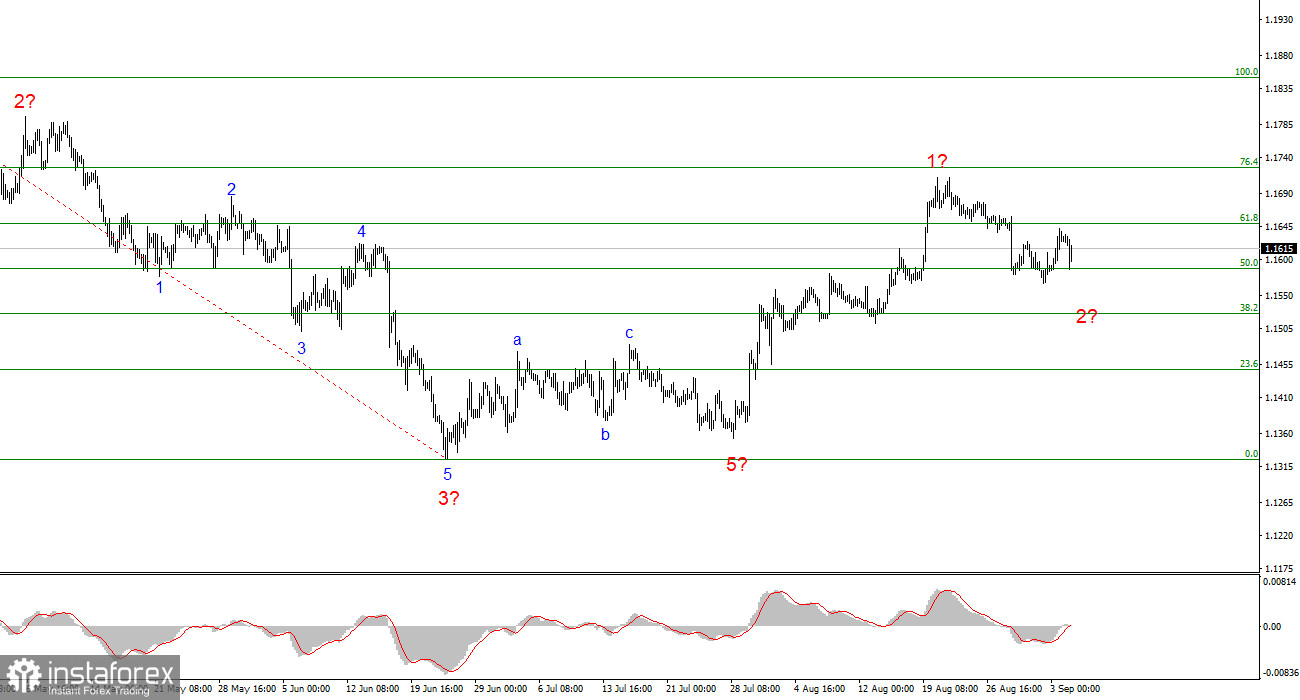
The wave pattern on the four-hour chart for EUR/USD is becoming more complex. There is still no question of canceling the upward section of the trend (lower chart), which began in January of last year. On the contrary, we saw a complete A-B-C corrective structure, which has most likely been completed. We never saw a convincing wave 5 in C. This wave took a truncated form, which also happens from time to time. Let me remind you that classical wave structures are generally found only in textbooks. In real-life market conditions, traders and analysts should be more flexible in their analysis.
Unfortunately, the wave structure may become more complex again at present. Wave C may take a three-wave form, the wave that follows it will be identified as wave D, and the entire trend section that began on January 27 will take the five-wave corrective form A-B-C-D-E. If this assumption is correct, wave D will take a three-wave form, and on August 21, EUR/USD entered the phase of forming wave E, whose low should be below the low of wave C at 1.1325. At the same time, however, this scenario is an alternative one. Based on the fundamental backdrop, I am more inclined to expect the formation of a global upward wave.
The EUR/USD pair declined by 10 basis points during Friday's trading session. Of course, by the end of the day, the exchange-rate change may turn out to be much greater than the current figure. However, the absolute change in the EUR/USD rate is not the key factor today; rather, the intraday price movements are more important. In short, the US currency managed to gain approximately 35 points after the release of an exceptionally strong Nonfarm Payrolls report. This increase was relatively small given the strength of the report. The Nonfarm Payrolls report showed a figure that market participants had been waiting for for at least four months. In August, 162,000 jobs were created, exceeding market expectations by at least three times. The unemployment rate did not deteriorate and remained unchanged at 4.1%. Accordingly, the US currency had an excellent opportunity to strengthen its position following its gains in recent weeks, but it failed to take advantage of it. Why?
In my view, the answer is straightforward and particularly clear, just like today's payrolls report. Despite the strong August figure, the overall state of the US labor market in 2025 and 2026 remains unsatisfactory. Over the past 17 months, we have seen a Nonfarm Payrolls figure above 100,000 only five times. Let me remind you that during Joe Biden's presidency, at least 100,000 jobs were created every month, and usually considerably more. Therefore, the August payrolls figure is an exception rather than the rule. The US labor market remains in a "cooled" state, so in my view, the Fed is unlikely to risk raising the interest rate in September. This explains the lack of a strong strengthening of the US currency today. The market once again does not believe that the FOMC will tighten policy.
Overall Conclusions.
Based on my EUR/USD analysis, I conclude that the pair remains within a local upward section of the trend as part of the first wave of a new global upward section. It should be acknowledged that the trend section that began in January of this year may take the form of A-B-C-D-E. If this assumption is correct, the decline in quotations will resume, with targets below the low of wave C at 1.1325. However, I consider this scenario to be an alternative one. I believe that a new upward section of the trend began forming in June, which will return the euro currency to the 20th level and take it significantly above this level.
On the higher time frame, an upward section of the trend is visible, followed by the formation of an A-B-C corrective structure. This structure may take a five-wave form, but at the current time I consider it complete. If so, the formation of a new impulsive upward section of the trend has begun.
Main Principles of My Analysis:
- Wave structures should be simple and easy to understand. Complex structures are difficult to trade and often involve changes.
- If there is no certainty about what is happening in the market, it is better not to enter the market.
- There can never be 100% certainty about the direction of a price movement. Do not forget to use protective Stop Loss orders.
- Wave analysis can be combined with other types of analysis and trading strategies.