 English
 Русский
 Bahasa Indonesia
 Bahasa Malay
 ไทย
ไทย Español
 Deutsch
 Български
 Français
 Tiếng Việt
 中文
中文 বাংলা
বাংলা हिन्दी
 Čeština
 Українська
 Română


Gold rose 0.7 percent to $4,434.02 per ounce, then gave back gains and now trades around $4,392 per ounce. Silver added 1 percent to $66.88, while platinum and palladium also gained.
Yesterday's source of strength came not from the metal itself but from Tokyo. The Japanese currency approached its yearly high versus the dollar, continuing last week's rally on rising expectations of a Bank of Japan rate hike. Gold traditionally moves inversely to the US dollar, and a weaker dollar automatically makes the metal more attractive to buyers outside the United States.
At the same time, the metal faces a cap from the Middle East. Prolonged disruptions of energy flows through the Strait of Hormuz accelerate inflationary risks, and Brent approached $100 per barrel after renewed clashes between the US and Iran. Traders price in roughly a 60 percent chance of a Federal Reserve rate hike as early as next week, and policy tightening traditionally works against a non-yielding asset like gold.
This creates a setup in which two channels pull the metal in opposite directions. The currency channel supports gold via dollar weakness; the rate channel pushes it down via inflation expectations. Short-term traders win from such an equilibrium, earning from volatility inside a narrow range, while positional investors lose as their directional bets are repeatedly reset.
Does this mean gold's upside is exhausted? I don't think so, and the behavior of large capital confirms that. Central bank buying and fears of debasement recall the rally that took the metal to a record near $5,600 in January, and the world's largest managers have been rebuilding gold positions in recent weeks. These investors are buying not on the September meeting, but on doubts about fiscal sustainability and to diversify away from the dollar.
However, higher oil prices will sustain inflationary worries, so US producer and consumer price prints this week will be decisive in determining whether gold can extend gains or whether pressure will rise again.
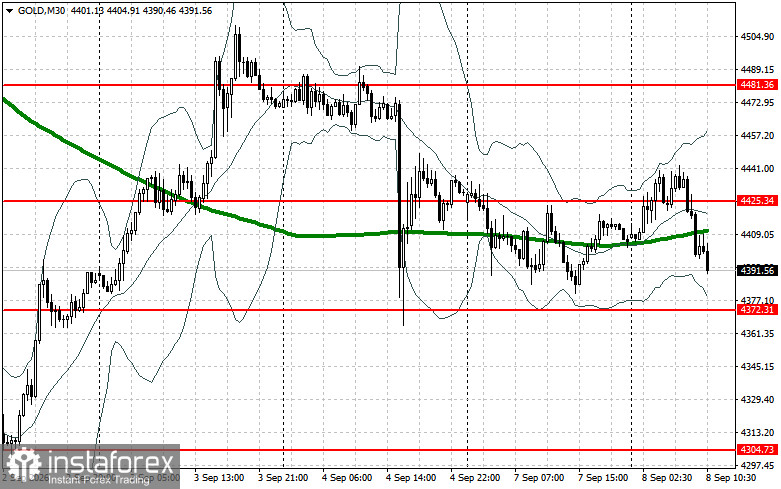
Technically, gold remains below the 200-day moving average and, since the July rebound from around $4,000, has traded in a relatively narrow range around $4,400. Three months in a range amid so much geopolitical and monetary news is notable. The market consistently reacts to each incoming signal, but none has been sufficient to change the regime.
A new catalyst is needed. Inflation data this week could be that catalyst — but perhaps not in the way most expect. A hot inflation report, paradoxically, could support gold if the market reads it as evidence that the Fed is powerless against an energy shock rather than as a reason for decisive tightening.
I would tentatively suggest that confirmed disinflation would push gold toward $4,500–4,550, while strong price prints may keep it in the current range rather than causing the expected drop.
Regarding the current technical picture for gold, buyers need to reclaim the nearest resistance at $4,425. That would allow targeting $4,480, above which a breakout would become rather difficult. The farther target sits around $4,540. If gold falls, bears will try to take control of $4,372. If they succeed, a break of that range would deal a serious blow to bulls and push gold toward the $4,304 low, with a further prospect of reaching $4,249.