 English
 Русский
 Bahasa Indonesia
 Bahasa Malay
 ไทย
ไทย Español
 Deutsch
 Български
 Français
 Tiếng Việt
 中文
中文 বাংলা
বাংলা हिन्दी
 Čeština
 Українська
 Română


Review of Trades and Trading Advice for the European Currency
The test of the 1.1388 price level occurred when the MACD indicator had already moved significantly above the zero line, which limited the pair's upward potential. For this reason, I did not buy the euro, and I made the right decision, as no significant rise followed.
The data showed that Germany's GfK consumer climate index for October was much weaker than expected, falling sharply to -30.6 points versus the forecast of -27.1. The overall picture was supplemented by a batch of data for the eurozone as a whole. Private-sector lending growth in August fell short of the consensus forecast, coming in at 3.1% versus the expected 3.2%, while the M3 money supply increased exactly as much as the market had expected, by 3.5%. Nevertheless, this data had virtually no effect on the euro, which is becoming a consistent pattern this week.
The key risks for EUR/USD in the second half of the day remain the U.S. durable goods orders data and the University of Michigan data, including the Consumer Sentiment Index and inflation expectations. Speeches by John Williams and Beth Hammack will add to the picture, but they are unlikely to bring any surprises, as both have already commented in recent days, while the overall tone of Fed officials this week has been surprisingly consistent. For the euro, this sequence of statements means that the market has already largely priced in the hawkish shift in the Fed's rhetoric, and today the determining factor is likely to be the economic data rather than new comments from Fed officials. Weak orders data or a disappointing University of Michigan report could give the pair temporary relief, while strong figures, in my view, would only reinforce the already significant divergence with the much more cautious ECB, keeping EUR/USD under pressure.
As for the intraday strategy, I will focus more on the implementation of Scenarios No. 1 and No. 2.
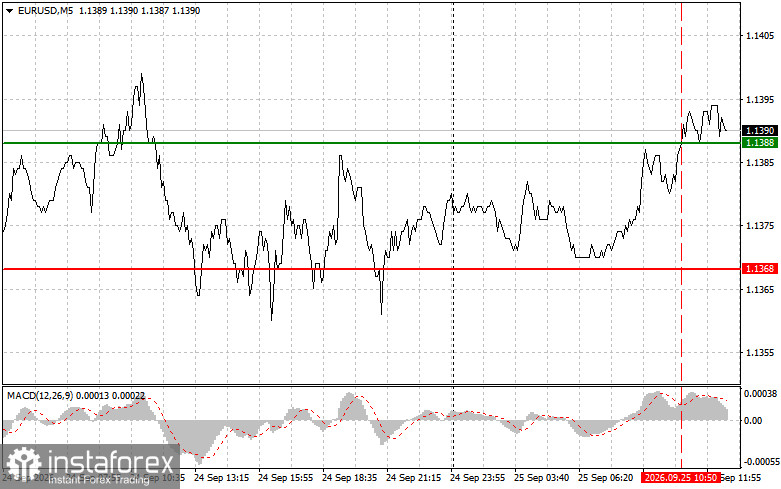
Buy Signal
Scenario No. 1: Today, the euro can be bought when the price reaches the 1.1397 level (the green line on the chart), with the target of rising to the 1.1420 level. At 1.1420, I plan to exit the market and also sell the euro in the opposite direction, targeting a move of 30–35 points from the entry point. Any rise in the euro today can only be expected as part of a correction. Important! Before buying, make sure that the MACD indicator is above the zero line and is just beginning to rise from it.
Scenario No. 2: I also plan to buy the euro today if the price tests 1.1382 twice consecutively while the MACD indicator is in the oversold area. This will limit the pair's downward potential and lead to a reversal to the upside. A rise toward the opposite levels of 1.1397 and 1.1420 can be expected.
Sell Signal
Scenario No. 1: I plan to sell the euro after the price reaches the 1.1382 level (the red line on the chart). The target will be 1.1363, where I plan to exit the market and immediately buy in the opposite direction, targeting a 20–25-point move in the opposite direction from the level. Downward pressure on the pair could return at any time. Important! Before selling, make sure that the MACD indicator is below the zero line and is just beginning to decline from it.
Scenario No. 2: I also plan to sell the euro today if the price tests 1.1397 twice consecutively while the MACD indicator is in the overbought area. This will limit the pair's upward potential and lead to a reversal to the downside. A decline toward the opposite levels of 1.1382 and 1.1363 can be expected.
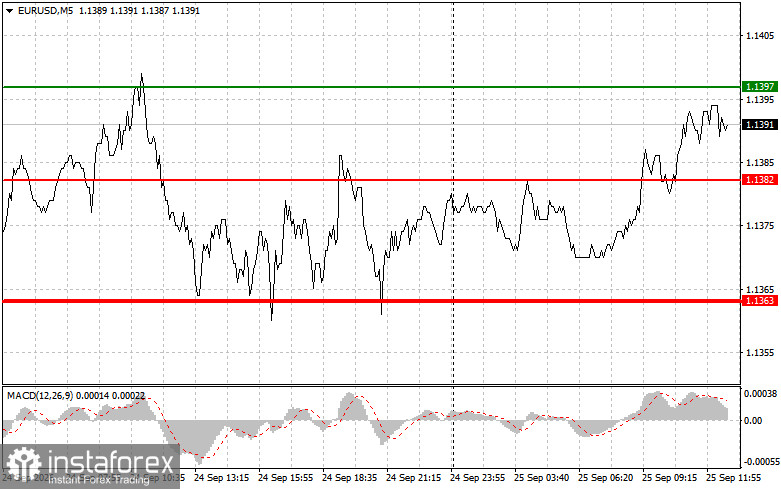
What Is Shown on the Chart:
- Thin green line – the entry price at which the trading instrument can be bought;
- Thick green line – the expected price level where Take Profit orders can be placed or profits can be taken manually, as further growth above this level is unlikely;
- Thin red line – the entry price at which the trading instrument can be sold;
- Thick red line – the expected price level where Take Profit orders can be placed or profits can be taken manually, as further decline below this level is unlikely;
- MACD indicator. When entering the market, it is important to take the overbought and oversold zones into account.
Important. Beginner Forex traders need to make market-entry decisions very carefully. Before the release of important fundamental reports, it is best to stay out of the market to avoid exposure to sharp exchange-rate fluctuations. If you decide to trade during news releases, always place stop orders to minimize losses. Without stop orders, you can lose your entire deposit very quickly, especially if you do not use money management and trade large volumes.
And remember that successful trading requires a clear trading plan, such as the one presented above. Making trading decisions spontaneously based on the current market situation is an inherently losing strategy for an intraday trader.