 English
 Русский
 Bahasa Indonesia
 Bahasa Malay
 ไทย
ไทย Español
 Deutsch
 Български
 Français
 Tiếng Việt
 中文
中文 বাংলা
বাংলা हिन्दी
 Čeština
 Українська
 Română


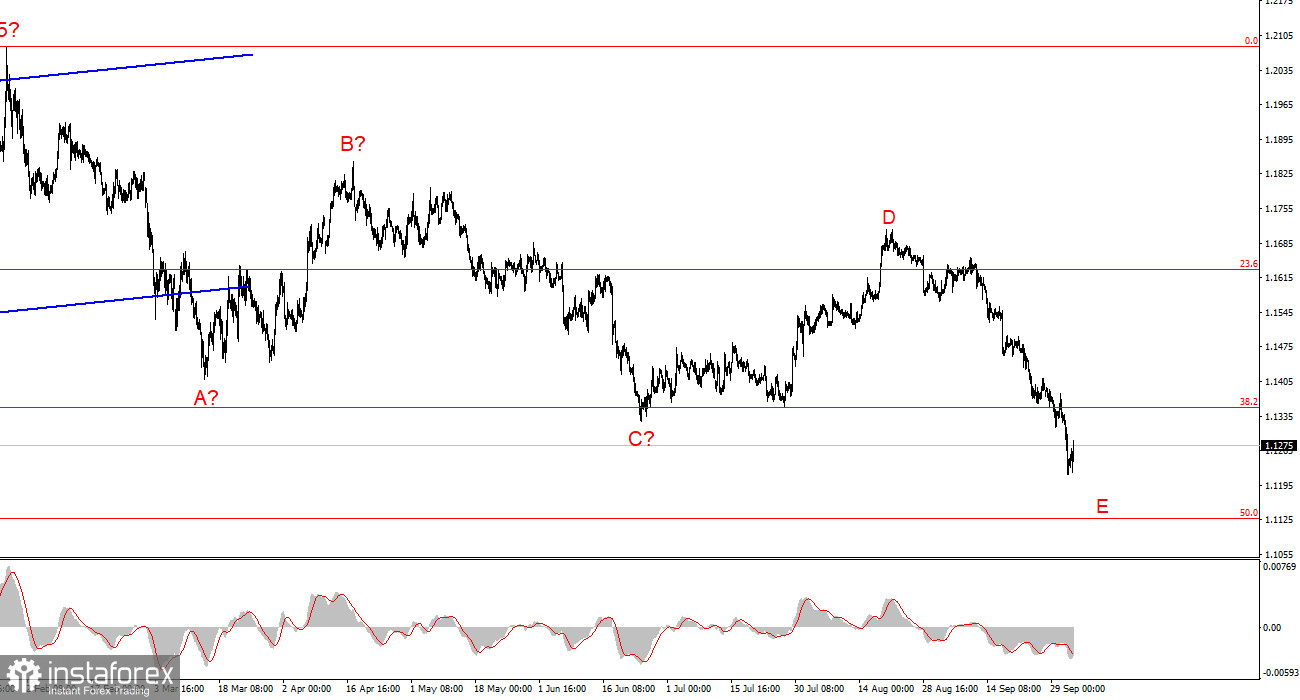
The wave count on the four-hour EUR/USD chart is becoming more complex. There is still no question of invalidating the upward trend segment (lower chart) that began in January last year. On the contrary, a complete A-B-C corrective structure has emerged and may have been completed. However, recent events related to the Federal Reserve and its policy have once again affected the current wave structure, making the wave count more complex. It should be noted that the fundamental backdrop and wave count often conflict with each other, making adjustments necessary.
The wave count has now developed into a more complex structure. Wave C has taken a three-wave form, while the following wave is identified as wave D. The entire trend segment that began on January 27 may have taken the form of a five-wave corrective structure, A-B-C-D-E. If this assumption is correct, wave D has been completed, and on August 21, EUR/USD entered the wave E formation phase. Its low should be below the low of wave C at 1.1325. The pair is only a short distance from this level, and below it, the projected wave E could complete its formation at any time.
Even the Nonfarm Payrolls report was not enough...
The EUR/USD exchange rate rose by 25 points on Friday, but this modest gain could be lost by the end of the day. To be frank, it is difficult to determine what conclusion to draw from today's session. The market did not start selling the US currency even after two of the three key reports for the US economy and the outlook for monetary policy came in significantly below expectations. The unemployment rate increased, the number of Nonfarm Payrolls was three times lower than forecast, and the August payrolls figure was revised down by 30,000, as previously indicated. Therefore, today's three US reports showed figures that provide no basis for the increase in demand for the dollar observed over the past month. This once again demonstrates that the dollar's recent appreciation has not been driven by economic factors.
In addition, the euro-area inflation report showed an acceleration to 3.8% year-on-year, while the market expected an increase only to 3.6%. What do these figures indicate? They suggest that the ECB has moved one step closer to a third rate hike this year, as the previous two hikes have not had a cooling effect on inflation. This means that hawkish expectations for the ECB are strengthening while hawkish expectations for the Federal Reserve are weakening. It should be recalled that this week, Fed official John Williams said there was no need to rush into another rate hike, immediately reducing the probability of a policy tightening in October to 30%, according to the CME FedWatch tool. Today, that probability fell even further as the labor market produced figures pointing to another period of "cooling."
Overall Conclusions
Based on the EUR/USD analysis, the pair remains within a global corrective trend segment, A-B-C-D-E. If this assumption is correct, the decline will continue toward targets below the low of wave C at 1.1325. This scenario was previously considered an alternative, and without the Federal Reserve meeting, it would have remained a secondary scenario. However, the Fed delivered an unexpected outcome, leaving the market with no other option but another wave of US currency buying. Yet the dollar has continued to attract buying for several weeks, despite the absence of new supporting factors. Opening short positions would not be appropriate against such a fundamental backdrop; instead, preparations should be made for a potential reversal.
On the larger timeframe, a downward trend segment can be seen taking the form of A-B-C-D-E. Therefore, EUR/USD may continue to decline below the low of wave C, while the internal wave structure of wave E could take the form of a five-wave impulse.
Main Principles of the Analysis:
- Wave structures should be simple and clear. Complex structures are difficult to trade and often require adjustments.
- If there is no confidence in what is happening in the market, it is better not to enter a trade.
- There can never be 100% certainty about the direction of a market move. Do not forget to use protective Stop Loss orders.
- Wave analysis can be combined with other forms of analysis and trading strategies.