 English
 Русский
 Bahasa Indonesia
 Bahasa Malay
 ไทย
ไทย Español
 Deutsch
 Български
 Français
 Tiếng Việt
 中文
中文 বাংলা
বাংলা हिन्दी
 Čeština
 Українська
 Română


Thursday opened without the usual catalysts for the euro and pound to rally, leaving both currencies to face the dollar alone. The US currency ignored the Fed minutes overnight but did not lose strength, so silence in Europe turned into pressure on the pairs. Thus, the euro is targeting a fresh one-month low, the pound has already approached its one-month low, and buyers have shown little willingness to defend either.

The only notable data point this morning for the euro was Germany's August trade balance. For an export-driven economy, it is an important barometer of external demand. The surplus came in at €19.5 billion versus €19.0 billion expected, which, on the surface, should have provided slight support. But the prior month's surplus was larger, and the seasonally adjusted surplus dropped from €22.5 billion to €15.0 billion. That signals weakening external demand, and the recent 2.0% rise in German industrial output looks like an outlier. The euro received no real reason for optimism.
The broader backdrop is familiar. The spread between French and German bond yields remains at the widest level since 2011, worries about France persist, and high US yields support dollar demand. The ECB's report on its September meeting could change the picture if it contains hawkish language. After all, inflation in the euro area has accelerated to 3.8%, and the deposit rate now stands at 2.50%. However, the report is still pending, and the market is reluctant to position ahead of it. I believe euro buyers won't appear before that release, and any rallies are likely to be short-lived while the dollar keeps the upper hand.
The pound's morning was light on UK data but featured remarks from BoE Monetary Policy Committee member Huw Pill. Market participants looked to him for clues on how the Bank of England will balance high inflation against a cooling labor market, but he offered nothing new.
Expect limited moves in the afternoon. Weekly initial jobless claims in the US (consensus ~200k) and the wholesale inventories report will be released, followed by a speech from Fed hawk Alberto Musalem. Jobless claims measure the number of people filing for unemployment benefits for the first time in a week, making them the quickest read in the labor market — a low print implies limited layoffs. Wholesale inventories are a secondary indicator that the market often overlooks. Musalem is a hawk, and his comments are unlikely to check dollar strength, especially after the dollar brushed off the Fed minutes, which showed all 19 participants backing the recent 3.75–4.00% policy range.
Momentum
For the euro, a move above 1.1202 opens a path to 1.1238 and then 1.1275, while a move below 1.1165 opens the way to 1.1133 and 1.1097. The corridor between these points is 37 pips, and ahead of the ECB report, the pair can easily trade back and forth within it, so I wouldn't trade the first touches. I favor selling because the pair is aimed at a one-month low — but only if the price holds below 1.1165. The upside scenario requires a hawkish ECB report, and I would only believe it through the first target.
For the British pound, I'm looking at buy entries above 1.3219 with targets of 1.3251 and 1.3279, and sell entries below 1.3183 with targets of 1.3155 and 1.3128. The range between those points is 36 pips. The downside scenario looks more likely — the pound is already tight to its one-month low and lacks domestic reasons to hold up. Weak jobless claims could trigger a short bounce toward 1.3251, but without fresh catalysts, I wouldn't expect much beyond that.
Mean reversion
Today's euro levels sit within the corridor, while the pound's lower trigger is just past the breakout point, so scenarios can be easily confused.
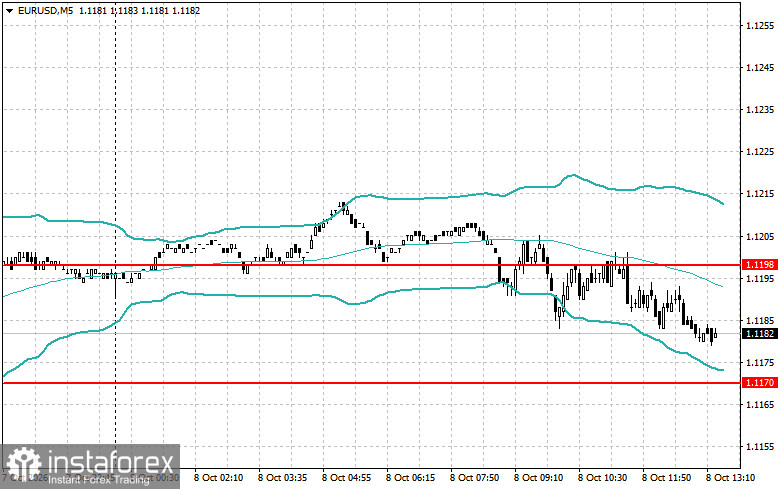
For the euro, the upper reference at 1.1198 is only 4 pips below the breakout point of 1.1202, so traders should be cautious. That gap is smaller than normal market noise, making it hard to distinguish a real breakout from a false one on the first touch. If the price breaks through 1.1202 and consolidates above it, the move toward 1.1238 is underway, and selling is off the table. If the price spikes above 1.1202 but fails to hold and returns below 1.1198, then a fade is in play — consider selling with a stop-loss order above the high of the failed attempt. The lower reference at 1.1170 sits 5 pips above the 1.1165 breakout point, and the same caution applies. If the price falls and closes below 1.1165, that's a confirmed breakout, and buying should be avoided. If the price briefly dips below 1.1165 but fails to hold and returns above 1.1170, consider buying with a stop-loss order below the low of the breakout. Such a recovery is more likely if the ECB report is neutral, in which case an initial reaction would quickly peter out.
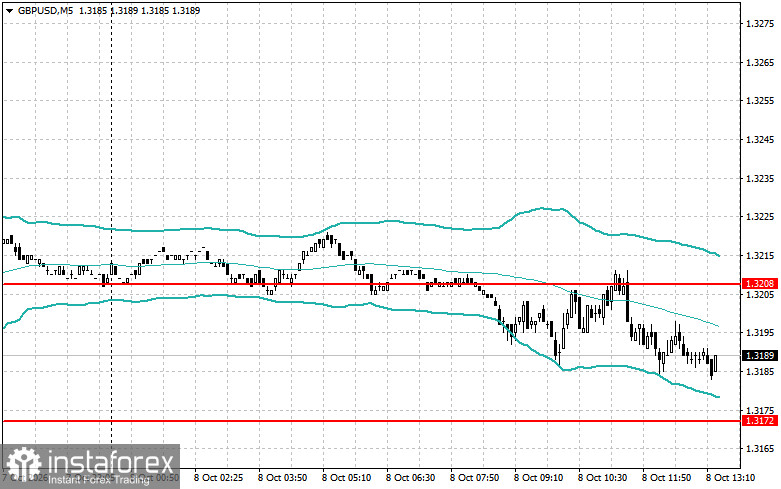
For the pound sterling, the upper reference at 1.3208 lies within the corridor, 11 pips below the breakout point at 1.3219 and 25 pips above the 1.3183 level. If the price moves above 1.3219 but fails to hold and returns below 1.3208, I'd consider going short with a stop-loss order above that attempt's high — though as a short-term play, not a trend reversal. If the price consolidates above 1.3219, selling should be avoided — the breakout targets 1.3251. The lower reference at 1.3172 sits 11 pips below the 1.3183 trigger and on the path to the first target at 1.3155. If the pair drifts calmly lower, 1.3172 is just a pause, and buying there is premature. Buy entries are appropriate when the price slides below 1.3172, fails to continue lower, and returns above 1.3183 — place stop-loss orders below the breakout low. For the pound, that type of recovery is most plausible if US data prints near expectations. In that case, the first knee-jerk reaction will likely fade, and the pair will return to its familiar corridor.