 English

 Русский
 Bahasa Indonesia
 Bahasa Malay
 ไทย
 Español
 Deutsch
 Български
 Français
 Tiếng Việt
 中文
 বাংলা
 हिन्दी
 Čeština
 Українська
 Română



While Bitcoin and Ether claw their way up from monthly lows, Visa has moved its Visa Direct technology from pilot to commercial operation. The company said in a press release that USDC will now be used to prefund international payouts, meaning funds for disbursements can be loaded almost in real time without waiting for banks' funding windows.

The report says the first partner is payment company Inyo Global, which has embedded the new capability into its platform. Through Inyo users can access payouts to more than 180 countries, while Visa's own network covers over 200 countries and territories. Scale does not yet equal availability: USDC access is currently limited to selected partners and is not active in every country, with onboarding requirements in place. Visa did not disclose transaction volumes or financial metrics.
The logic of the move is clear. Classic cross-border transfers are constrained by bank operating hours and the need to hold pre-funded balances in accounts across jurisdictions, which ties up capital. A stablecoin operates 24/7, so a payment firm can top up a balance at night or on weekends and immediately send payouts. That is why Visa speaks of rollout rather than experiments. "The next chapter for stablecoins is deployment," said Vira Platonova, head of Visa Direct, adding that pilots are turning into working solutions.
Notably, Visa is not acting alone. Very recently Mastercard also announced the launch of its Global Money Platform, built with BVNK, where fiat and stablecoins sit on the same account and convert via a single API. Both payment networks this week have moved stablecoins from tests into production infrastructure—a signal that is hard to ignore.
I think the number of Visa partners on this scheme will rise noticeably over the coming quarters, but USDC will not become a mass market settlement layer until country and access restrictions are relaxed. For the market this is more of a structural foundation for institutional stablecoin demand than a quick price driver for crypto as a whole.
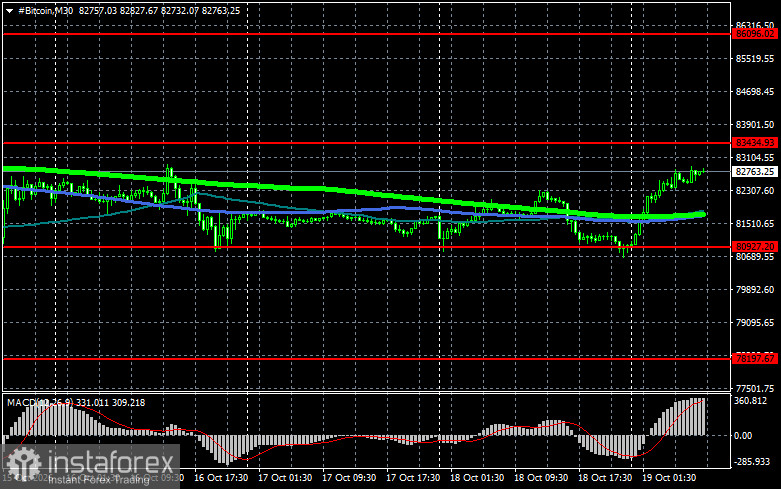
Technical picture for Bitcoin
Buyers are currently targeting a reclaim of $83,400, which would open a direct path to $86,000 and then toward $89,000; breaking $89,000 would signal attempts to restore a bull market. On the downside, buyers are expected at $80,900. A return of the trading instrument below that area could quickly push BTC toward $78,100. The most distant downside target would be around $76,900.
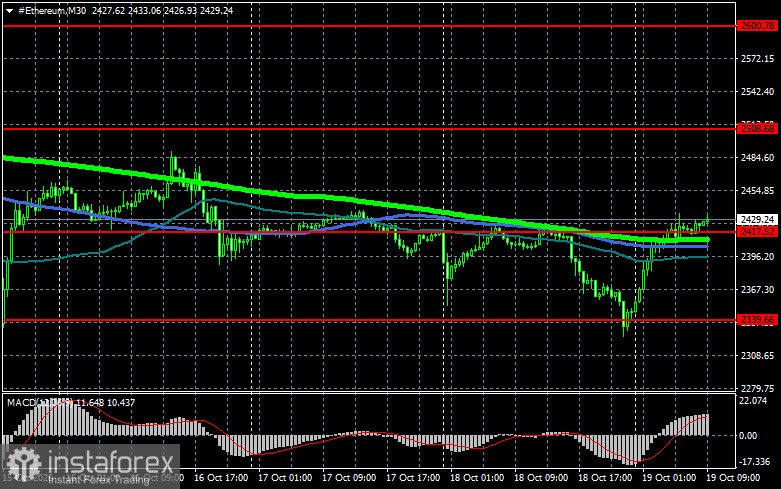
Technical picture for Ethereum
A clear hold above $2,508 would open a direct path to $2,600. The furthest upside target is the high near $2,679; breaking that level would indicate strengthening bullish sentiment and a return of buyer interest. On the downside, buyers are expected at $2,417. A return below that area could quickly push ETH toward $2,339. The most distant downside target would be around $2,274.
What we see on the chart:
- Red lines indicate support and resistance levels where either a price slowdown or active growth is expected;
- Green lines indicate the 50-day moving average;
- Blue lines indicate the 100-day moving average;
- Light green lines indicate the 200-day moving average.
A crossover, or a price test of moving averages, typically either halts the move or sparks fresh market momentum.