 English

 Русский
 Bahasa Indonesia
 Bahasa Malay
 ไทย
 Español
 Deutsch
 Български
 Français
 Tiếng Việt
 中文
 বাংলা
 हिन्दी
 Čeština
 Українська
 Română



Trade review and tips for trading the Japanese yen
The test of the price 158.04 came at a time when the MACD indicator had moved far down from the zero mark, which limited the pair's downside potential. For that reason, I didn't sell and missed a good downward move.
Given how rapidly the yen is strengthening against the dollar today and how noticeably the euro and the pound jumped during Asian trading, the Japanese central bank likely intervened in the FX market. We have seen such moves several times in recent months, often with U.S. support, and today appears to be no exception. Recall the last joint Japan–U.S. intervention on July 31; in September the pair moved from 160.37 on September 2 to 153.40 on September 9 — levels not seen since February. That reversal also came with loud political signals.
Officials from both countries have made similar declarations before. Scott Bessent has been pressing the Bank of Japan and met with Kazuo Ueda, and recently publicly suggested traders bet against him, saying he relied on insider information. On October 6, Ueda confirmed that rate rises would continue, though he left pace and timing open; on October 15, board member Junko Koda warned against excessive caution and said the neutral rate is significantly above 1%. For comparison, the BOJ's current rate is 1.25%. The market prices in about a 25% chance of a rate hike at the October 30 meeting, and 10-year JGB yields reached around 3% for the first time in 30 years on October 9, at 3.025%.
I would not be surprised if leading U.S. and Japanese politicians make new statements on this topic in the coming days. When central banks stand behind a move, it can be sharp and unexpected, and levels that seemed reliable can be pierced in minutes. For this reason, I will be extremely cautious about buying USD/JPY in the near term and will not rush to trade against parties willing to spend reserves to defend the yen.
For the intraday strategy, I will rely more on Scenarios No. 1 and No. 2.
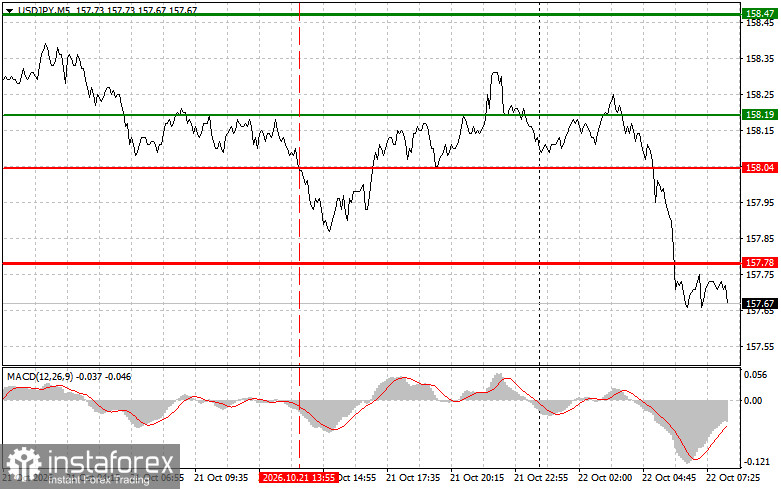
Scenarios for Buying
Scenario No. 1: I plan to buy USD/JPY today upon reaching an entry point around 157.69 (the green line on the chart), targeting 158.27 (the thicker green line on the chart). Around 158.27, I intend to exit long positions and open short positions in the opposite direction (expecting a 30–35-pip move away from the level). It is best to return to buying the pair on corrections and significant USD/JPY drawdowns. Important! Before buying, make sure the MACD indicator is above the zero mark and is only beginning to rise from it.
Scenario No. 2: I also plan to buy USD/JPY today in the event of two consecutive tests of the price 157.30 at a time when the MACD indicator is in the oversold area. This will limit the pair's downward potential and lead to an upward reversal. One can expect a rise to the opposite levels of 157.69 and 158.27.
Scenarios for Selling
Scenario No. 1: I plan to sell USD/JPY today only after the 157.30 level is refreshed (red line on the chart), which will lead to a rapid decline in the pair. Sellers' key target is 156.77, where I intend to exit shorts and immediately open longs in the opposite direction (expecting a 20–25-pip move away from the level). Sellers will return at any moment — only a hint from the central bank is needed. Important! Before selling, make sure the MACD indicator is below the zero mark and is only beginning to decline from it.
Scenario No. 2: I also plan to sell USD/JPY today in the event of two consecutive tests of the price 157.69 at a time when the MACD indicator is in the overbought area. This will limit the pair's upside potential and lead to a downward reversal. One can expect a decline to the opposite levels of 157.30 and 156.77.
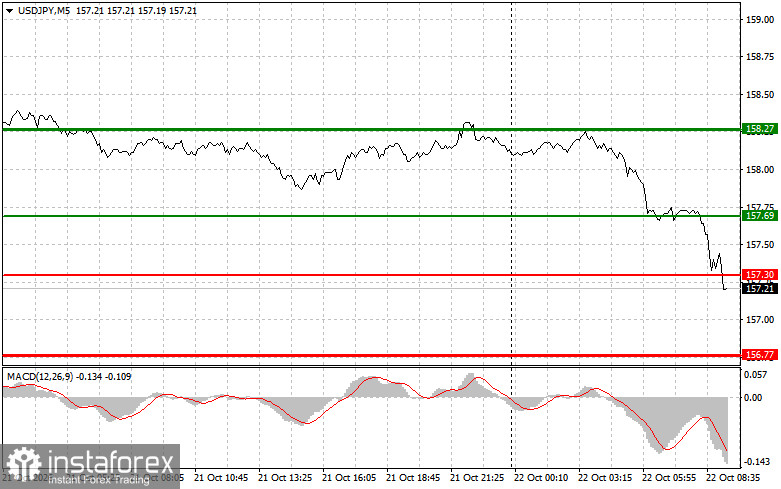
What's on the chart:
Thin green line — entry price where you can buy the instrument.
Thick green line — approximate price where you can place Take Profit or manually lock in profits, because further upside above this level is unlikely.
Thin red line — entry price where you can sell the instrument.
Thick red line — approximate price where you can place Take Profit or manually lock in profits, because further downside below this level is unlikely.
MACD indicator. When entering the market, it's important to consider overbought and oversold zones.
Important. Novice Forex traders must be very cautious when deciding to enter the market. It is best to stay out before major fundamental reports to avoid getting caught in sharp price swings. If you decide to trade during news releases, always place stop orders to minimize losses. Without stop orders, you can quickly lose your entire deposit, especially if you don't use money management and trade large volumes.
Remember: successful trading requires a clear trading plan, like the example above. Spontaneous trade decisions based solely on the immediate market situation are, by definition, a losing strategy for an intraday trader.