 English

 Русский
 Bahasa Indonesia
 Bahasa Malay
 ไทย
 Español
 Deutsch
 Български
 Français
 Tiếng Việt
 中文
 বাংলা
 हिन्दी
 Čeština
 Українська
 Română



Trade Analysis and Tips for Trading the Euro
The test of 1.1125 occurred when the MACD indicator had just started moving upward from the zero line, confirming that it was an appropriate entry point for buying the euro. However, the pair rose by only 5 points, and that was the extent of the move.
Today's Fed decision is particularly important because it comes at a time when the single currency is already under pressure. The market expects a pause, although US inflation for September exceeded forecasts. Recently, FOMC members Hammack, Kashkari, and Logan, who voted against the decision in July, may again call for a rate increase. Warsh will need to explain why the central bank, which unanimously raised rates last month, is now pausing. A hawkish outcome would be unfavorable for the euro. If Warsh reaffirms the Fed's commitment to fighting inflation and signals a possible rate increase in December, the dollar will strengthen, and EUR/USD, which has already lost ground this week, could fall to new recent lows. In addition, the ECB meeting is scheduled for tomorrow, with a pause expected, leaving the euro with few strong arguments to resist further pressure. Weak eurozone PMIs and deteriorating German sentiment reinforce this outlook.
A dovish tone would change the picture. If the Fed indicates that it is prepared to wait for further data, pressure on the dollar could intensify, giving the euro an opportunity for a technical rebound, particularly as the US currency has already become overbought. However, the likelihood of this scenario appears low. As long as energy prices remain high, EUR/USD has little chance of staging a sustained recovery.
Regarding the intraday strategy, greater emphasis will be placed on implementing Scenarios No. 1 and No. 2.
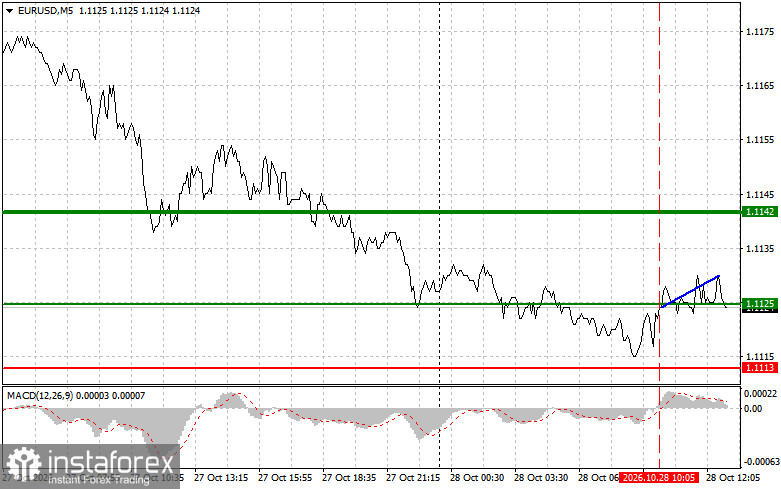
Buy Signal
Scenario No. 1: Today, the euro can be bought when the price reaches the level around 1.1135 (the green line on the chart), with a target at 1.1179. At 1.1179, the position can be closed, and a short position can be opened in the opposite direction, targeting a move of 30–35 points from the entry point. The euro could rise today if US economic data are weaker than expected. Important! Before buying, make sure that the MACD indicator is above the zero line and has just started rising from it.
Scenario No. 2: The euro can also be bought today if the price tests 1.1114 twice consecutively while the MACD indicator is in the oversold zone. This would limit the pair's downward potential and trigger an upward market reversal. A rise toward the opposite levels of 1.1135 and 1.1179 can then be expected.
Sell Signal
Scenario No. 1: The euro can be sold after the price reaches 1.1114 (the red line on the chart). The target will be 1.1080, where the position can be closed and a long position opened immediately in the opposite direction, targeting a rebound of 20–25 points from that level. Selling pressure on the pair could return at any time. Important! Before selling, make sure that the MACD indicator is below the zero line and has just started falling from it.
Scenario No. 2: The euro can also be sold today if the price tests 1.1135 twice consecutively while the MACD indicator is in the overbought zone. This would limit the pair's upward potential and trigger a downward market reversal. A decline toward the levels of 1.1114 and 1.1080 can then be expected.
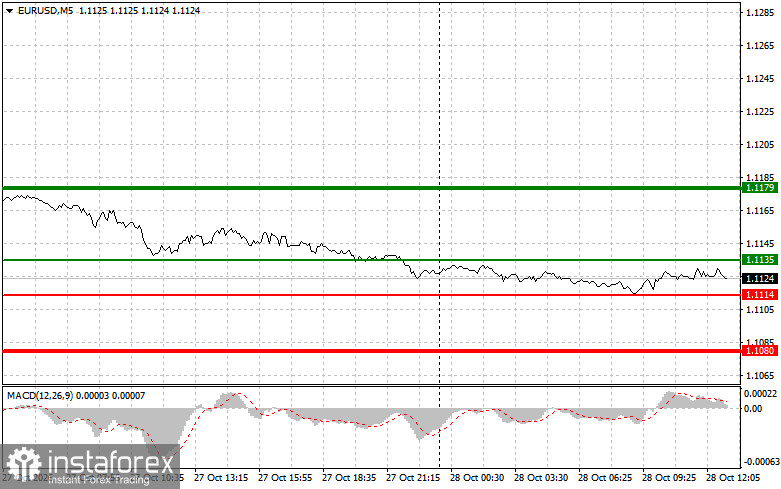
What the Chart Shows:
- Thin green line — the entry price at which the trading instrument can be bought.
- Thick green line — the projected price level for placing a Take Profit order or closing the position manually, as further gains above this level are considered unlikely.
- Thin red line — the entry price at which the trading instrument can be sold.
- Thick red line — the projected price level for placing a Take Profit order or closing the position manually, as further declines below this level are considered unlikely.
- MACD indicator. When entering the market, it is important to consider the overbought and oversold zones.
Important: Beginner Forex traders should exercise considerable caution when deciding whether to enter the market. Before the release of major fundamental reports, it is generally best to remain out of the market to avoid exposure to sharp exchange-rate fluctuations. If trading during news releases, always place stop-loss orders to minimize losses. Without stop-loss orders, the entire trading account can be depleted very quickly, especially when risk management rules are not followed and excessively large position sizes are used.
Remember that successful trading requires a clear trading plan, such as the example provided above. Making spontaneous trading decisions based on current market conditions is a fundamentally losing strategy for an intraday trader.