 English

 Русский
 Bahasa Indonesia
 Bahasa Malay
 ไทย
 Español
 Deutsch
 Български
 Français
 Tiếng Việt
 中文
 বাংলা
 हिन्दी
 Čeština
 Українська
 Română



The euro surprised the market yesterday. Strong U.S. data should have pushed the dollar higher, but the opposite happened. The pair climbed from around 1.1143 to the 1.1215 area, then pulled back a little and now trades near 1.1185. For a Friday morning, this is a notable rebound, showing the market is looking beyond headlines at what lies behind the numbers.
The main U.S. report was Q3 GDP growth of 3.4% year-on-year, above the 3.2% forecast. Q2 was 2.2%, so the economy accelerated to its fastest pace in a year. Business investment drove the expansion, up 12.7% and at its highest level since 2020, largely due to AI infrastructure spending. But that surprise was not unexpected — Kevin Warsh had already said growth could exceed 3%. More important for the market was inflation. The Federal Reserve's preferred measure, core PCE, rose 0.3% month-on-month (in line with forecasts) and 3.1% year-on-year (up from 3.0%). The GDP deflator — a broad price measure — was only 2.2% (well below forecasts). With inflation prints not alarming, traders had no reason to price in a firmer Fed path, and Warsh offered no decisive guidance on December. The dollar therefore had fewer supports.
In Europe, the main event yesterday was the European Central Bank meeting. The bank held the deposit rate at 2.50% and the main rate at 2.65%, yet the market still prices in a 2.75% hike in December. Another surprise was Christine Lagarde's earlier-than-expected resignation announcement, which adds uncertainty about who will lead the bank going forward and how it will conduct policy.
Today is a busy day for the euro, beginning with a series of European releases. First is the euro-area preliminary Q3 GDP estimate. Consensus expects 0.2% quarter-on-quarter after 0.6% in Q2, and 1.1% year-on-year after 1.2%. That slowdown is plausible given high energy prices and elevated rates, but any notable surprise will immediately affect the exchange rate. Unemployment data are due as well; the forecast matches the prior value at 6.4%, suggesting a resilient labor market.
Equally important is inflation. Germany will publish its preliminary October CPI. The month-on-month forecast is 0.1% after 0.6%, and year-on-year is expected to cool to 3.0% from 3.3%. France's monthly CPI is forecast at 0.2% after -0.3%, with the harmonized (HICP) reading at 0.3% after -0.3%. These figures matter greatly for the ECB because markets use them to judge the likelihood of a December hike. Softer German inflation would call that scenario into question and weigh on the euro; prints in line with forecasts would keep it priced in.
The day ends with remarks from Philip Lane, the ECB's chief economist. He will be watched closely after yesterday's meeting and the Lagarde news. Lane has previously described 2.5% as the upper boundary of neutral and advocated a balanced response without abrupt moves, so he can help clarify the near-term policy path. My view is that, before his remarks, EUR/USD will react to each GDP and inflation print, and Lane's tone will determine the final direction—hawkish language would favor the euro, dovish language would not.
Momentum
For the euro, the price is now at 1.1185. Above, the breakout level at 1.1195 sits about 10 pips away; a break and hold above it would open the path to 1.1211 and then 1.1231. Overnight, the pair moved above that zone to about 1.1215 but failed to hold and fell back, so the initial touch wasn't a confirmed breakout. For a genuine breakout, Germany's print would need to beat expectations, or Lane would need to sound hawkish. Below, the reference is 1.1172, about 13 pips away. A break and hold below that level would open the way to 1.1150 and 1.1130. I view this downside scenario as primary if German inflation comes in weaker than forecast, since that would call a December hike into question. The dollar lacked strong support yesterday, so I expect any decline to be orderly rather than a sharp plunge.
Mean Reversion
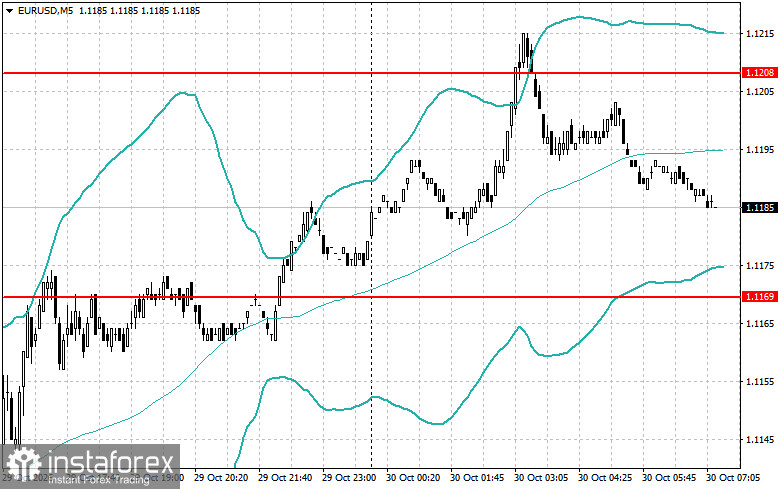
Upside reversion level: 1.1208, which lies about 13 pips above the breakout point 1.1195 — between that level and the first upside target. If price clears 1.1195, reaches 1.1208, and decisively holds above, that is a confirmed breakout and selling is off the table. If it merely spikes to 1.1208, fails and quickly returns below 1.1195, the mean-reversion plays, and I would consider selling with a stop above the high of the failed attempt. The overnight move to 1.1215 looked like exactly that kind of failed breakout, albeit it reached slightly higher.
Downside reversion level: 1.1169 sits only three pips below the breakout level 1.1172, so special caution is required. Three pips is market noise, and on the first touch you cannot distinguish a breakout from a rebound. If price falls below 1.1169 and holds there, that is a downside breakout, and buying is off the table. If it briefly dips under 1.1169, fails to extend and returns above 1.1172, the reversion works, and I would look to buy with a stop under the low of the failed attempt. Skip the initial reaction in this zone and wait for clarity — and be particularly careful with stops when German inflation data are released.