 English

 Русский
 Bahasa Indonesia
 Bahasa Malay
 ไทย
 Español
 Deutsch
 Български
 Français
 Tiếng Việt
 中文
 বাংলা
 हिन्दी
 Čeština
 Українська
 Română



Bitcoin fell more than 5.0% and briefly dropped below $77,000; Ether lost about 5.7%. The market received a double blow. First, weak earnings from major U.S. companies sent the S&P 500 down, along with Bitcoin. The second was the report of a hack at one of the world's largest exchanges, Binance.

Starting with stocks: Intel reported earnings above expectations but issued weak guidance for Q4. Revenue is expected to be $15–16 billion, while analysts had expected roughly $17 billion. Intel shares plunged about 16% in after-hours trading. Amazon posted slightly below-expected profit and revenue, and confirmed plans to spend around $220 billion on capex in 2026, mostly on infrastructure. The stock fell about 12%. Recall that concerns about the payback from AI spending have been weighing on the tech sector for weeks and, in turn, on crypto.
The exchange news was even more serious. On October 29, it emerged that Binance was hacked. The exchange's own estimate puts losses at about $6.3 billion; Chainalysis reports about $5.9 billion, and TRM Labs estimates the theft at $6.36 billion at prices at the time of the heist. This is the largest theft in the industry's history — roughly four times the $1.5 billion Bybit hack in February 2025. Binance said it found no evidence of private-key leakage from wallets and has suspended withdrawals until it resolves the issue.
Among the stolen funds in the attacker's wallets were roughly 18,270 BTC, over 200,000 ETH, and several billion in USDT and USDC. Approximately $2.7–3.0 billion has been frozen. Tether froze more than $1.57 billion in USDT, and Circle over $800 million in USDC. Still, the attacker retains coins that stablecoin issuers cannot touch — TRM estimates about $2.4 billion of assets, including Bitcoin and Ether. The main market risk is that those coins could be sold into exchanges or laundered through bridges and OTC brokers.
Trust in centralized exchanges is again in question. I believe selling pressure on Bitcoin will persist in the coming days. Beyond the risk-off hit in equities, market participants must factor in potential sell-offs from the attacker's wallets and the temporary suspension of withdrawals on the largest exchange. I allow for a move to $77,400 and lower, and a return above $79,700 is likely only after Binance resumes withdrawals and the equity market stabilizes after earnings.
On Bitcoin
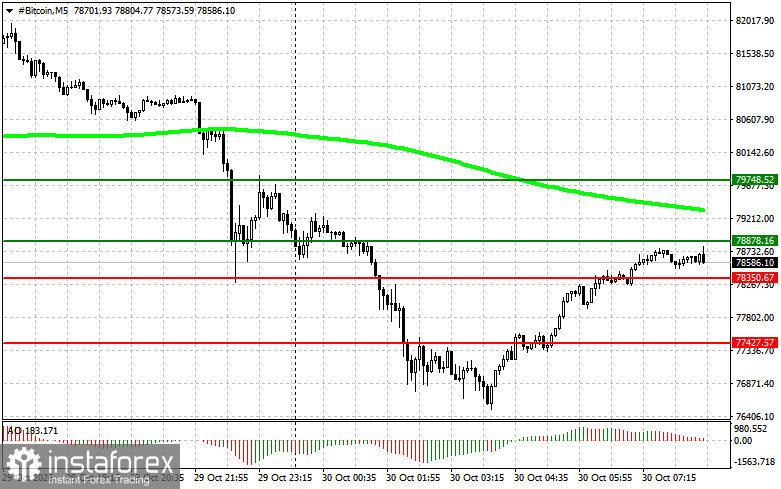
The price is near 78,000 in a range between support at 78,300 and resistance at 78,800, with outer reference points at 77,400 below and 79,700 above. The plan centers on two mirrored directions, each with a breakout and a bounce scenario.
I consider buying in two cases. If price breaks 78,800 to the upside and holds above it, I buy with a target of 79,700, provided price stays above the 50-day moving average and the Awesome Oscillator is above zero; at the target, I take profit and consider a short on the pullback. If a break below 78,300 fails and price returns above, I buy the bounce, targeting 78,800 initially, then 79,700.
I structure selling symmetrically. If price breaks 78,300 to the downside and holds below it, I open a short with a target of 77,400, provided the moving average is above price and the Awesome Oscillator is below zero. If a break above 78,800 fails and price returns below, I sell the bounce with an initial target of 78,300, then 77,400.
On Ether
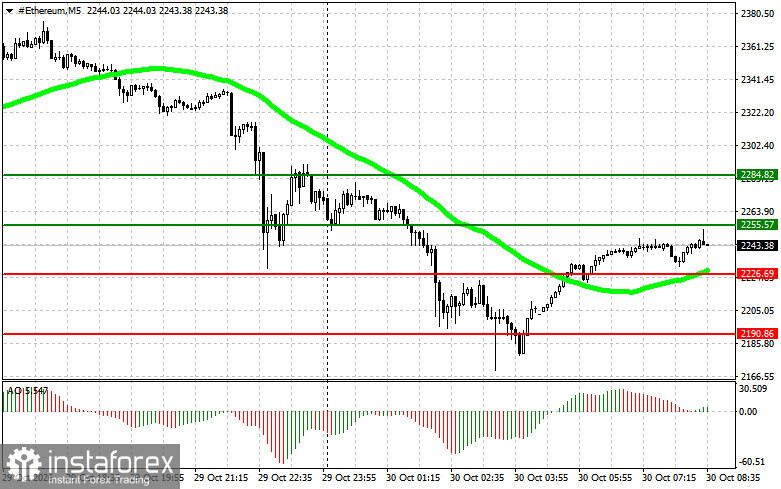
The logic fully mirrors Bitcoin on its own price scale. Nearest support is at 2,190 and resistance at 2,255 and 2,284.
I buy a break of 2,255 to the upside, holding above it with a target of 2,284, provided the price is above the 50-day moving average and the Awesome Oscillator is above zero. If a break of 2,190 to the downside fails and price returns above, I buy the bounce with an initial target of 2,255 and then 2,284.
I sell a confirmed break of 2,190 to the downside, provided the moving average is above price, and the Awesome Oscillator is below zero. If a break above 2,255 fails and the price returns below, I sell the bounce, targeting a return to 2,190.
Both indicators are used as filters to weed out false moves, not as standalone reasons to enter early; decisions are made only after price actually confirms the specified levels.