 English

 Русский
 Bahasa Indonesia
 Bahasa Malay
 ไทย
 Español
 Deutsch
 Български
 Français
 Tiếng Việt
 中文
 বাংলা
 हिन्दी
 Čeština
 Українська
 Română



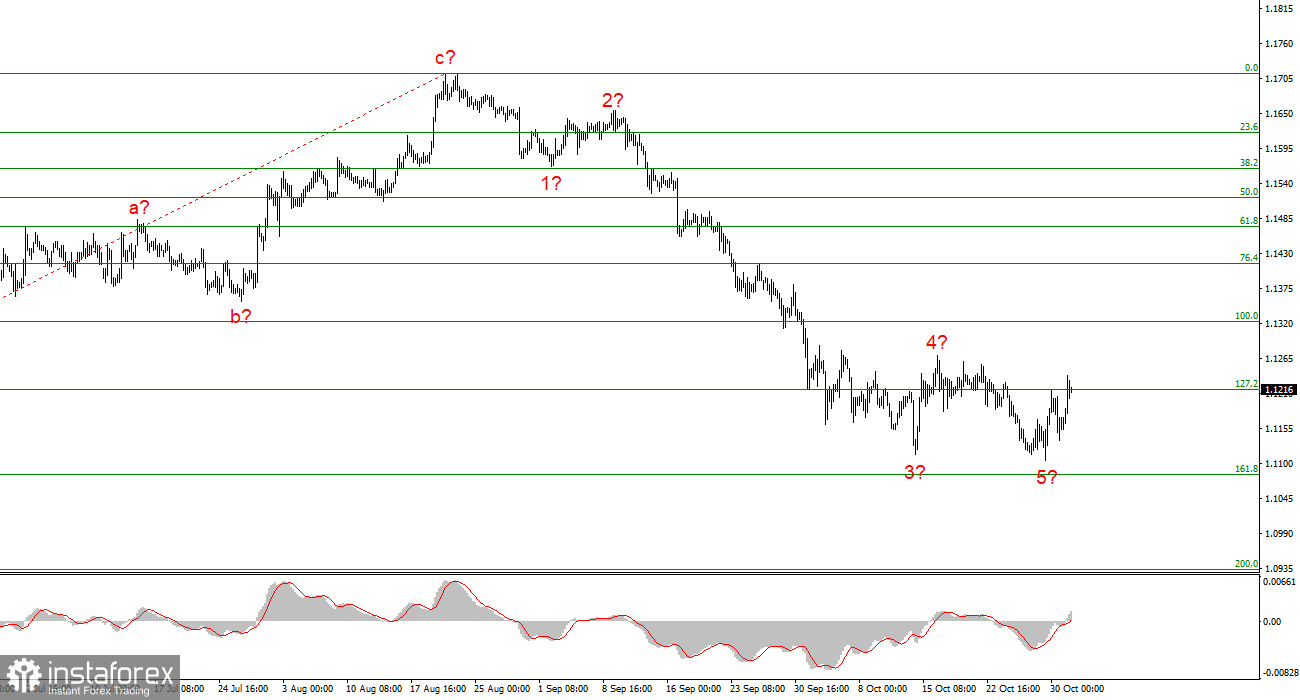
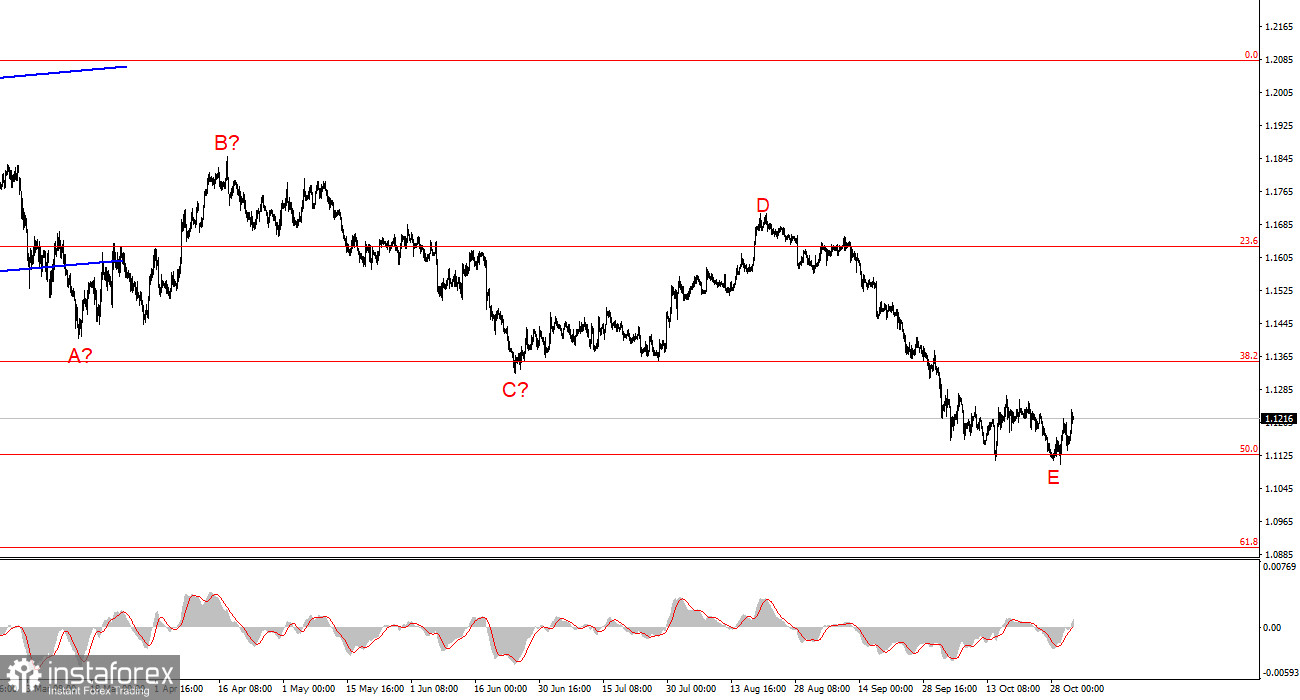
The 4-hour wave structure for EUR/USD has become more complex. On the higher timeframe (lower chart), the downward section of the trend has taken the form of a five-wave structure, A-B-C-D-E, which could be completed at any time, as it appears to be fully developed. All the waves in this section are approximately equal in size, which is why this structure is considered corrective. If this assumption is correct, an impulsive upward section of the trend will begin once it is complete, with targets well above the 1.2000 level.
On the lower timeframe (upper chart), the formation of an impulsive wave sequence is continuing, and it may belong to wave E of the higher timeframe. If this is indeed the case, then no matter how strongly the dollar rises, its appreciation is approaching an end. The presumed wave 5 of E is either complete or close to completion. In either case, the current wave structure suggests that the downward wave sequence is nearing completion on both charts. The news background and the sharp shift in market sentiment have driven a substantial appreciation of the U.S. currency, but there are few remaining reasons for further dollar strength.
The Dollar Shows Signs of Weakness Ahead of a Possible Trump Defeat
EUR/USD rose by 60 points on Monday, and in my view, there are only two plausible reasons for this move. First, the U.S. congressional elections will take place tomorrow. One day before the vote, the estimated probability of a Democratic victory in both chambers of Congress had already risen to 72%. Naturally, different polls are conducted, and they produce different results regarding public sentiment. However, the possibility of a Democratic victory is no longer news to anyone. The Republican Party continues to lose voter confidence because of the policies pursued by its leader. This distinction is important because Trump makes all the most important decisions himself. Therefore, it would be inaccurate to say that all Republicans have been ineffective over the past two years and that this is why Americans do not want to vote for them. Incidentally, voter turnout in the elections, which effectively began a week ago, is among the highest in several decades. In my view, this indicates just one thing: Americans do not want Trump to continue governing the country single-handedly.
The second reason is geopolitical. Several reports pointing toward de-escalation emerged today. Donald Trump once again decided to give Iran an opportunity to resolve the issue peacefully, while Iranian President Masoud Pezeshkian confirmed that the parties had resumed diplomatic efforts to resolve the conflict and prevent the outbreak of renewed hostilities. Following these reports, oil prices fell sharply, while demand for the U.S. currency may have declined as risk appetite increased. It is worth remembering that the dollar tends to perform well when geopolitical tensions escalate. De-escalation, by contrast, tends to weigh on the currency.
Monday's developments helped the European currency improve its position somewhat, and it still has a chance to begin forming a new upward section of the trend on both timeframes. This remains the primary scenario.
General Conclusions
Based on the EUR/USD analysis, the pair remains within the broader corrective section of the trend, A-B-C-D-E. However, this structure appears fully developed and may therefore be complete. In my view, this is a favorable time not only to consider buying the European currency but also to anticipate the formation of a full-fledged upward trend section. According to the higher timeframe, an advance to at least the 1.1700–1.1800 level should be expected. The failed attempt to break below 1.1126, which corresponds to the 50.0% Fibonacci level (lower chart, higher timeframe), also indicates that the market may be ready to move higher.
The higher timeframe shows a downward section of the trend that has taken the form of an A-B-C-D-E structure. The internal wave structure of wave E has developed into a five-wave impulsive pattern, but this pattern may already be complete. If this assumption is correct, the formation of a new upward section of the trend will now begin.
The main principles of the analysis are:
- Wave structures should be simple and easy to understand. Complex structures are difficult to trade and are often subject to change.
- If there is no clear understanding of what is happening in the market, it is better to stay out.
- There can never be absolute certainty about the direction of price movement. Do not forget to use protective Stop Loss orders.
- Wave analysis can be combined with other forms of analysis and trading strategies.