 English

 Русский
 Bahasa Indonesia
 Bahasa Malay
 ไทย
 Español
 Deutsch
 Български
 Français
 Tiếng Việt
 中文
 বাংলা
 हिन्दी
 Čeština
 Українська
 Română



Yesterday, one of the leading candidates for ECB president, Klaas Knot, signaled that a tight monetary policy at the bank is likely to stay for a long time. He said core inflation — the second-round effects in services and consumer goods — is also likely to pick up, and that will present a problem for the ECB. "We will continue to see small shocks that raise inflation, and the ECB will have to counter them with somewhat hawkish monetary policy," said Knot, the former head of the Dutch central bank. He added that the ECB will probably find itself approaching the 2% target from above more often than from below.
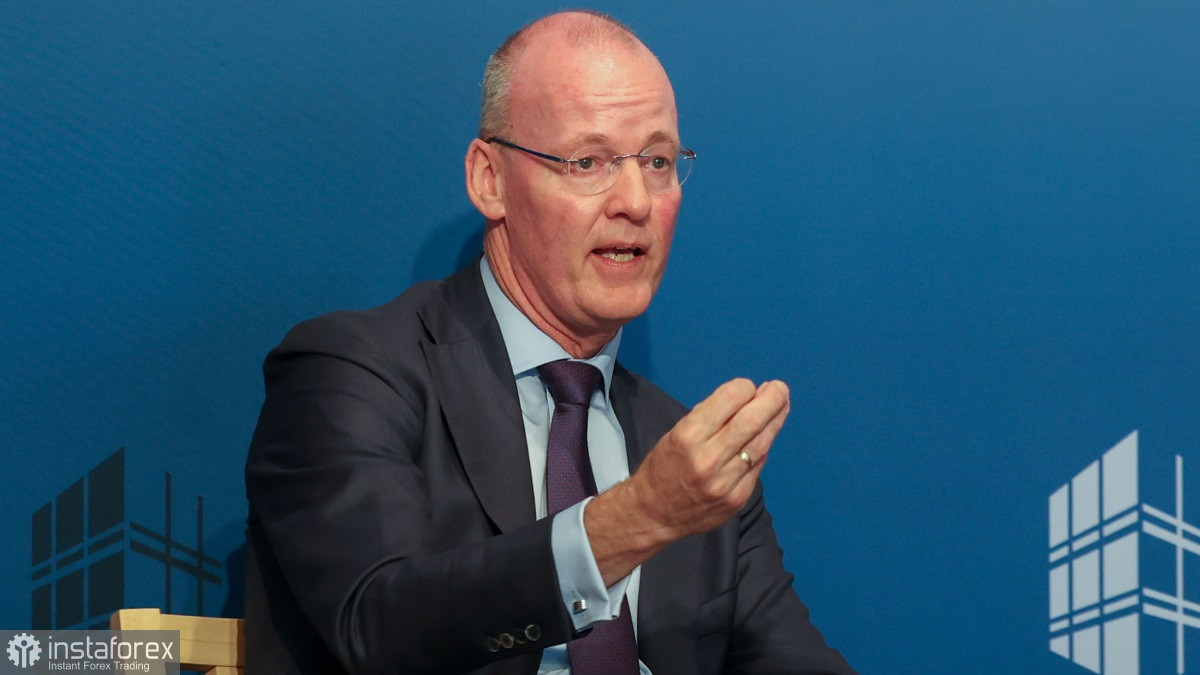
Knot's remarks came against an apt backdrop. Eurozone inflation rose to 4.0% in October from 3.8% in September, hitting a three-year high — roughly double the target. The ECB raised rates twice, in June and September, and currently holds the deposit rate at 2.50%, having paused unanimously last week. At that meeting, Christine Lagarde said that in the absence of major shocks, the policy direction was fairly clear to all, and markets read that as a signal of further hikes. The base case remains: a 25-bp increase to 2.75% on December 17, which would be the final step of the cycle.
Knot also explained why today's prices are hard to unwind. He called the rise in energy prices "water under the bridge," noting that ECB instruments work with a lag of one and a half to two years. Supply shocks are the hardest for central bankers to handle, he argued, because they boost inflation while slowing the economy — reducing purchasing power and companies' profits. The data already show this dilemma: the composite PMI fell to 51.7 in October from 53.1 in September, and employment fell for the first time since May. The winners from a tight policy are savers and euro holders; the losers are indebted countries, notably France, whose 10-year yields have recently risen above 5% for the first time since 2002.
Now about the race itself. The Netherlands confirmed on Wednesday that it will nominate Knot; he faces Spain's Pablo Hernandez de Cos, whom markets view as comparatively dovish. Euro-area countries must submit candidates by Friday; finance ministers will take an interim stock on November 9 without deciding, and EU leaders will meet on November 26–27. Lagarde will step down on February 7, 2027 — nearly nine months early. Many considered Knot a frontrunner in February, but the outcome depends on support from Germany and France. Berlin has already ruled out Nagel, and Paris is reportedly prepared to back Knot if a French economist is appointed chief economist.
Knot also takes a broader view than rates alone. He believes the world has fundamentally changed, driven mainly by the US, which is motivated by rivalry with China, leaving Europe on the receiving end. "Dependencies that were considered normal for decades will have to be revised — not only in security and defence," he said. For markets, that implies the ECB will live in a world of frequent negative supply shocks, meaning any future pause will likely be short-lived.
All this suggests I do not expect the ECB's rhetoric to soften before December, and a rise to 2.75% on December 17 remains the base case, which supports the euro. Knot looks like a favourite for a hawkish stance, and if he wins the post, I expect the firm policy line to continue into 2027. A Hernandez de Cos victory, in my view, would have weakened the euro.
Technical outlook for EUR/USD
Buyers need to reclaim 1.1275 to target a test of 1.1300. From there, a move to 1.1335 is possible, but doing so without support from big players will be difficult. On any pullback, serious buying is likely only around 1.1245. If there are no bids there, it would be prudent to wait for a break of the 1.1210 low or consider opening longs from 1.1170.
Technical outlook for GBP/USD
Pound buyers need to take immediate resistance at 1.3500 to target 1.3530; above that level, further progress will be difficult. The farther target is 1.3550. On a downside move, bears will try to seize control at 1.3475. If they succeed, a range break would severely damage bulls' positions and push GBP/USD toward 1.3455 with a potential extension to 1.3430.