English

 Русский
 Bahasa Indonesia
 Bahasa Malay
 ไทย
 Español
 Deutsch
 Български
 Français
 Tiếng Việt
 中文
 বাংলা
 हिन्दी
 Čeština
 Українська
 Română




On Friday, the euro continued to decline for the second consecutive day. The US dollar remained in strong demand as risk appetite weakened following the sell-off in equity markets, which particularly affected the technology sector. During the European session, EUR/USD traded between 1.1180 and 1.1200, retreating from Thursday's highs near 1.1270. The positive German industrial production data released today failed to support the European currency.
According to the Federal Statistical Office of Germany, industrial production increased by 0.7% in September. The figure exceeded market expectations, which had pointed to no change, and was higher than August's 0.1% increase. The improvement was mainly driven by the automotive and pharmaceutical industries. At the same time, declines were recorded in construction and the production of machinery and equipment.
Later on Friday, Eurostat will release September retail sales data for the eurozone. Analysts expect the indicator to decline by 0.1%, offsetting an increase of the same magnitude in August. Unless the data deliver an unexpectedly positive surprise, they are unlikely to provide significant support for the euro.
The US dollar, traditionally regarded by investors as a safe-haven asset, is benefiting from falling equity markets. The sell-off is linked to growing concerns about the artificial intelligence (AI) sector. Shares of US and Asian chipmakers fell sharply as investors became concerned that a Democratic victory in the United States could lead to tighter regulation and the abandonment of plans to build data centers. OCBC strategists note that the combination of resilient US economic growth, persistent inflation, and the Federal Reserve's commitment to further monetary policy tightening continues to favor the dollar overall.
Today, the October Nonfarm Payrolls (NFP) report, due later during the North American session, is the main focus for identifying trading opportunities. Labor market data released earlier this week were strong: initial jobless claims fell to their lowest level in almost four months, ADP employment growth significantly exceeded forecasts, and the JOLTS report showed a sharp increase in job openings in September. If the NFP report confirms this picture, the dollar could receive additional support.
From a technical perspective, the pair remains under selling pressure, as indicated by negative oscillators and its recent failure to hold above the 20-day SMA. The pair is also trading below all key moving averages, further confirming bearish pressure. Selling pressure may ease somewhat if the pair consolidates above the 20-day SMA. The next resistance level is Thursday's high near 1.1270. Support is provided by the 1.1180–1.1150 level. The next major support level is 1.1100, below which the pair could accelerate its decline.
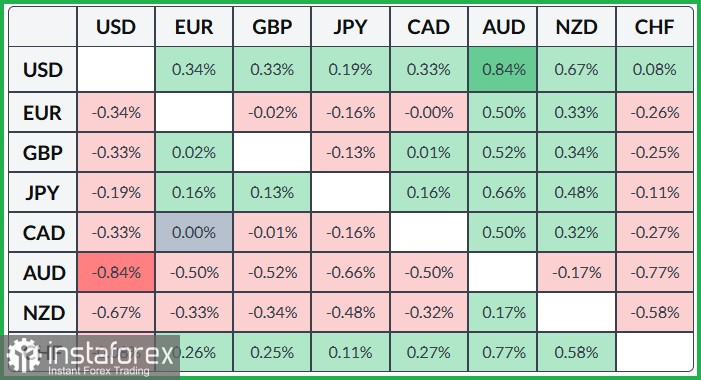
The table below shows how the euro has performed against the major currencies today. The euro has been weakest against the US dollar.