 English

 Русский
 Bahasa Indonesia
 Bahasa Malay
 ไทย
 Español
 Deutsch
 Български
 Français
 Tiếng Việt
 中文
 বাংলা
 हिन्दी
 Čeština
 Українська
 Română



ECB President Christine Lagarde said on Friday that inflation in the euro area will remain above target in the coming quarters and that the regulator is preparing for a new round of tightening in December. "The higher inflation is and the longer it stays high, the greater the risks to achieving our medium-term objective," Lagarde said. Recall that the consumer price index in the euro area accelerated to 4.0% in October, which amounts to a 2.3% increase over the past year. I have no doubt the European regulator will continue the tightening cycle. How long it lasts will depend on the duration of the Middle East conflict, any near-term escalations, and energy prices. At present I see no signs the war in the Middle East is ending, although media outlets periodically report that talks between Tehran and Washington are continuing and even that the "nuclear issue" is being discussed. I suggest waiting for official information rather than relying on various leaks, of which there have been many in recent months.
Lagarde also said that very strong reasons and changes in the economy would be required to alter the ECB's current course. In plain terms, the ECB president has all but promised a third round of tightening in December. Even three rate hikes, however, may not be enough to put inflation back on a disinflationary path toward 2%. Therefore, three rounds of tightening are already effectively guaranteed, and a fourth may follow in March next year.
Lagarde noted that core inflation remains unchanged at 2.5% year-on-year. The ECB, she said, will carefully analyze all components of inflation before deciding on a rate rise in December. "At the moment we do not see secondary signs of inflation, but we are closely watching long-term indicators that could affect wage growth. If they begin to rise, stronger policy measures may be required," the ECB president said.
Taken together, this implies the ECB will raise rates in December with about 99% probability, and markets continue to ignore this factor, since the euro has not enjoyed demand for almost three months...
Also see my other articles:
Analysis of EUR/USD. November 9. Market shifts attention to inflation.
Wave analysis for EUR/USD:
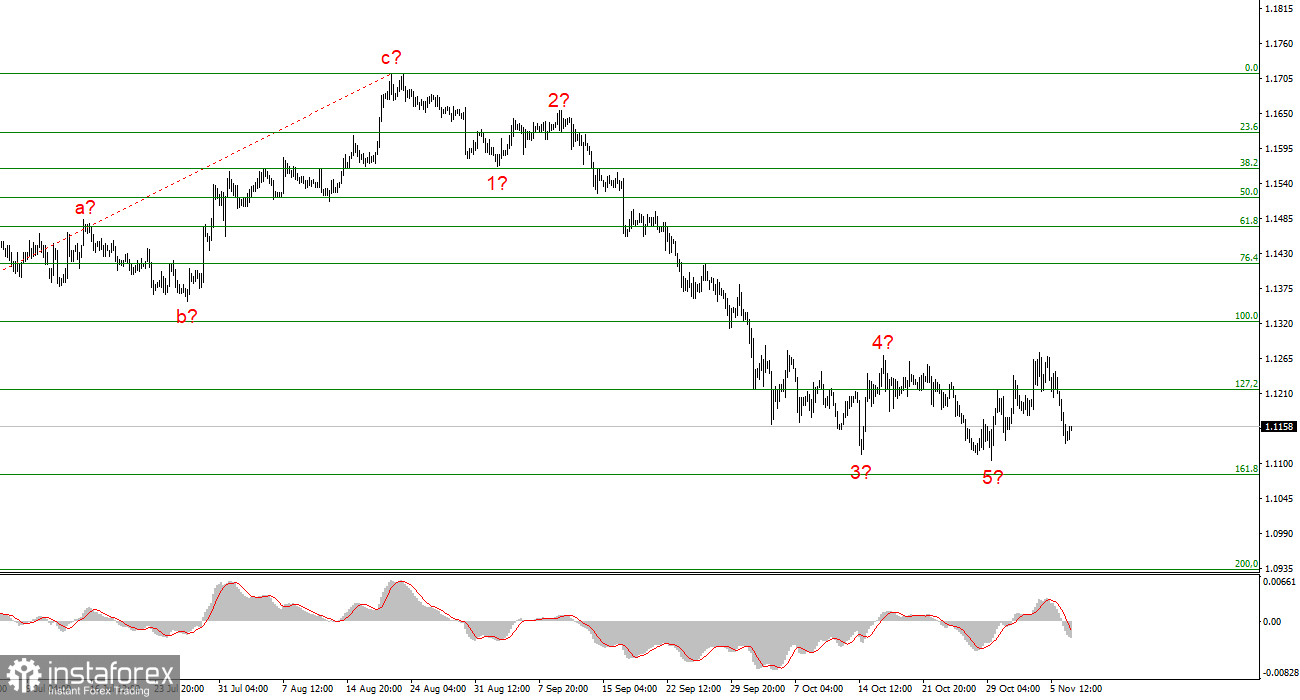
Based on my EUR/USD analysis, I conclude the instrument remains within a global corrective A-B-C-D-E trend segment. However, this structure looks complete and may be finished. In my view, now is a good time not only to buy the European currency but also to expect a full bullish trend segment. On the higher timeframe, one should expect a rise of at least 1,700–1,800 pips. An unsuccessful attempt to break 1.1126, which corresponds to 50.0% on Fibonacci (lower chart, higher timeframe), also indicates market readiness to buy.
Wave analysis for GBP/USD:
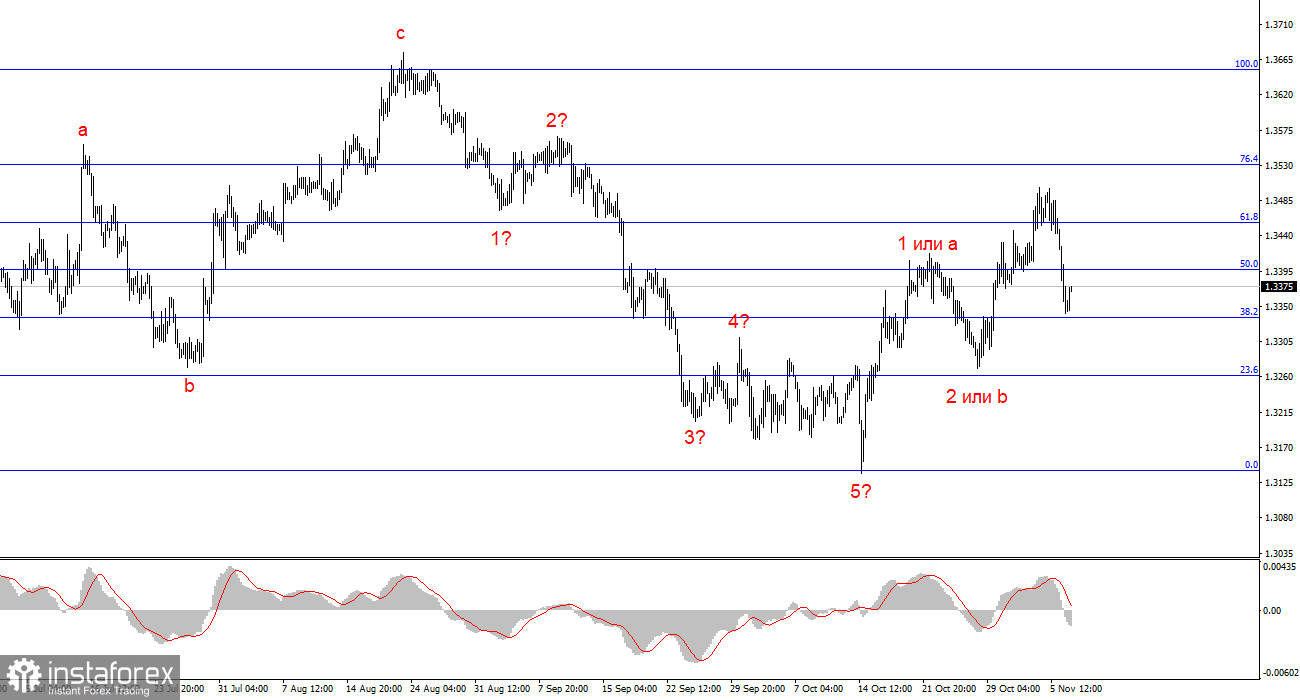
The wave picture for GBP/USD has become fairly clear. Charts show a distinct corrective A-B-C-D-E structure that may be complete. A similar structure on EUR/USD may also be complete. If that assumption is correct, Sterling has finished its decline and has begun building a bullish trend segment with targets above the peaks of waves B and D—i.e., above the 3,700-pip level. Two waves of the initial wave of the new bullish segment are already formed. Consequently, the advance may continue toward targets near 1.3531 and 1.3651, which correspond to 76.4% and 100.0% on Fibonacci.
Key principles of my analysis:
1) Wave structures should be simple and understandable. Complex structures are hard to trade and often change.
2) If you are not confident about what is happening in the market, it is better not to enter.
3) There is no such thing as 100% certainty in direction; do not forget stop-loss protective orders.
4) Wave analysis can be combined with other types of analysis and trading strategies.