 English

 Русский
 Bahasa Indonesia
 Bahasa Malay
 ไทย
 Español
 Deutsch
 Български
 Français
 Tiếng Việt
 中文
 বাংলা
 हिन्दी
 Čeština
 Українська
 Română



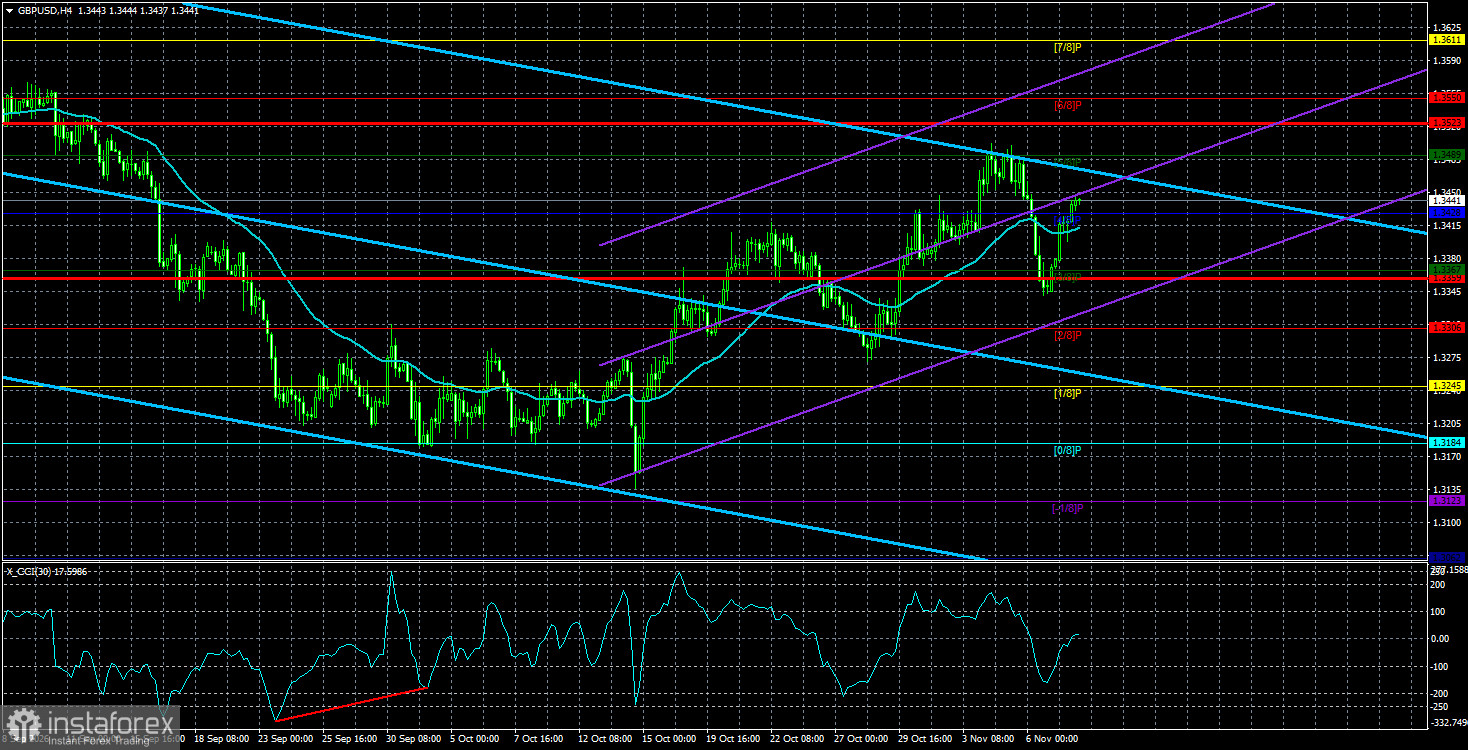
The GBP/USD currency pair also edged higher during the day and generally maintains a bullish bias, unlike EUR/USD. It should be recalled that there has been virtually no correlation between the euro and the pound over the past month or two, although these two currencies have generally moved in the same direction for most of the time. However, despite the ECB's monetary policy tightening, the European currency continues to decline sharply, while the pound is trading in line with the technical picture on the higher timeframes. It should be noted that sideways channels remain in place on the daily and weekly timeframes, within which the pound has been moving with remarkable precision.
For some reason, traders focusing on the British pound seem to overlook all the negative factors that are, one way or another, associated with the European currency. They see the Bank of England's monetary policy tightening, which has only just begun. They see little long-term potential in the US dollar, which, in 2026, may have only Donald Trump to thank for its performance, following his decision to start a war with Iran. They also note that central banks around the world have been reducing their dollar reserves for roughly a decade. They see Donald Trump's policies, which are aimed, firstly, at weakening the US currency and, secondly, have few supporters both globally and even in the United States, as the latest elections have shown. Based on these observations, the willingness to bet on the dollar over the long term "for some reason" disappears. From this perspective, however, there is nothing particularly surprising about this.
Meanwhile, the UK's new Prime Minister, Andy Burnham, is increasingly pursuing closer ties with the European Union. Naturally, there is currently no discussion of reversing Brexit, but Burnham would like Britain to establish closer relations with the EU. The past 10 years have shown that the United Kingdom is perfectly capable of surviving independently in this harsh and dangerous world. However, life would be more secure and prosperous with Europe. As a result of Brexit, the United Kingdom risks losing at least Scotland, which is strongly in favor of rejoining the EU, and potentially Wales and Northern Ireland as well, both of which also favor the European Union over the UK.
The UK's economic situation has deteriorated since its separation from the European Union, while establishing new ties will take years. The two sides spent several years negotiating a trade agreement. Therefore, if the issue could be resolved quickly and easily, Britain would most likely rejoin the bloc without hesitation. However, Burnham faces a challenging task. Recent opinion polls have shown that attitudes toward the European Union within British society have become considerably more favorable than they were during the first years after Brexit. However, this does not mean that a new referendum on rejoining the bloc can be announced tomorrow.
The European Union offers a number of benefits but also makes considerable demands. The UK wants access to the Single European Market, but this would require concessions on migration and visa-free travel. Therefore, even if the UK eventually rejoins the EU, this is unlikely to happen in the coming years. Public opinion must first be prepared to avoid a repeat of the 2016 situation, when the share of Brexit supporters exceeded that of opponents by just a few percentage points.
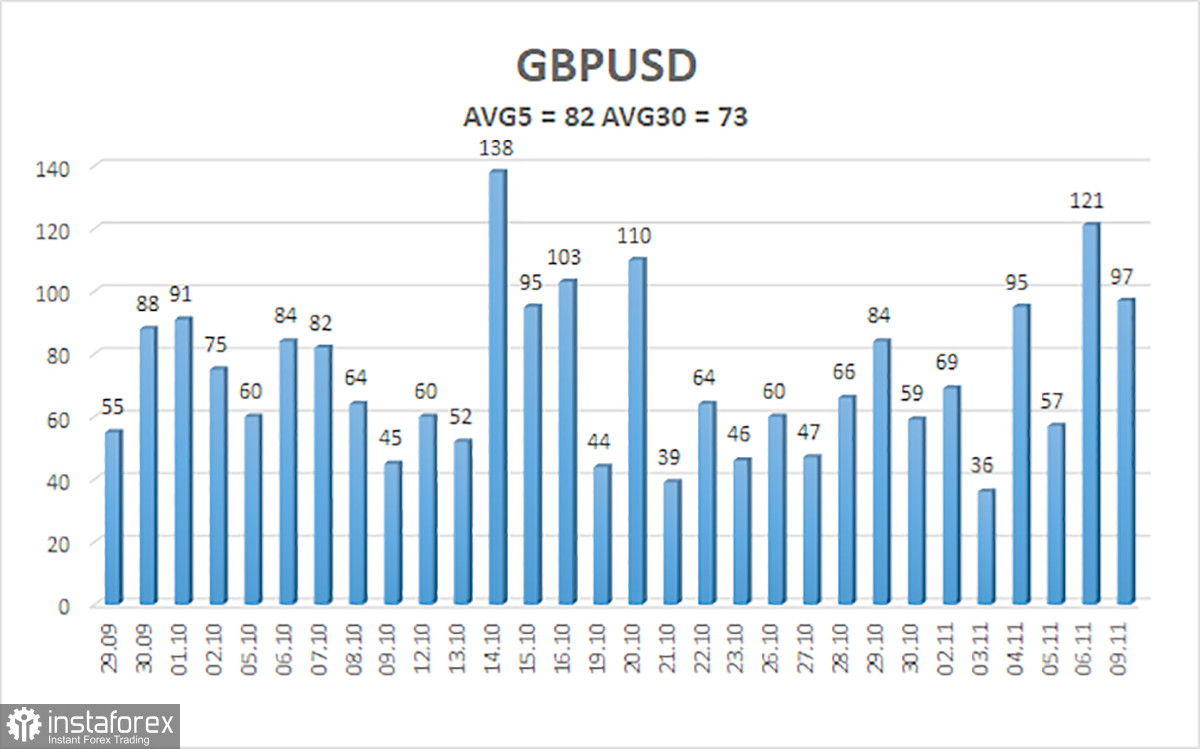
The average volatility of GBP/USD over the past five trading days is 82 points. For the pound/dollar pair, this is considered an average reading. Accordingly, on Tuesday, November 10, the pair is expected to trade within a range bounded by 1.3359 and 1.3523. The upper linear regression channel has turned downward again. The CCI indicator has not recently entered overbought or oversold territory and has not formed any divergences.
Nearest support levels:
S1 – 1.3428
S2 – 1.3367
S3 – 1.3306
Nearest resistance levels:
R1 – 1.3489
R2 – 1.3550
R3 – 1.3611
Trading Recommendations:
GBP/USD continues to follow an upward trend, which may form part of the broader trend that began in 2022. Donald Trump's policies will continue to put pressure on the US economy, so no long-term appreciation of the US dollar is expected. So far, 2026 has been a positive year for the dollar due to geopolitical developments and inflation, which have prompted capital to seek safety and forced the Federal Reserve to resume monetary policy tightening. However, the weekly timeframe continues to show a sideways range between 1.3150 and 1.3780 within a four-year upward trend, suggesting that the British pound could appreciate over the medium term. Long positions with targets at 1.3489 and 1.3523 may be considered when the price is above the moving average. If the price moves below the moving average, short positions with targets at 1.3367 and 1.3359 may be considered.
Explanations for the illustrations:
Linear regression channels help identify the current trend. If both channels point in the same direction, the current trend is strong.
The moving average (settings: 20.0, smoothed) identifies the short-term trend and the direction in which trading should currently be conducted.
Murray levels are target levels for price movements and corrections.
Volatility levels (red lines) indicate the probable price range within which the pair is expected to trade over the next 24 hours, based on current volatility readings.
The CCI indicator: entry into oversold territory (below -250) or overbought territory (above +250) indicates that a trend reversal in the opposite direction may be approaching.