 English

 Русский
 Bahasa Indonesia
 Bahasa Malay
 ไทย
 Español
 Deutsch
 Български
 Français
 Tiếng Việt
 中文
 বাংলা
 हिन्दी
 Čeština
 Українська
 Română



Review of Trades and Trading Tips for the Japanese Yen
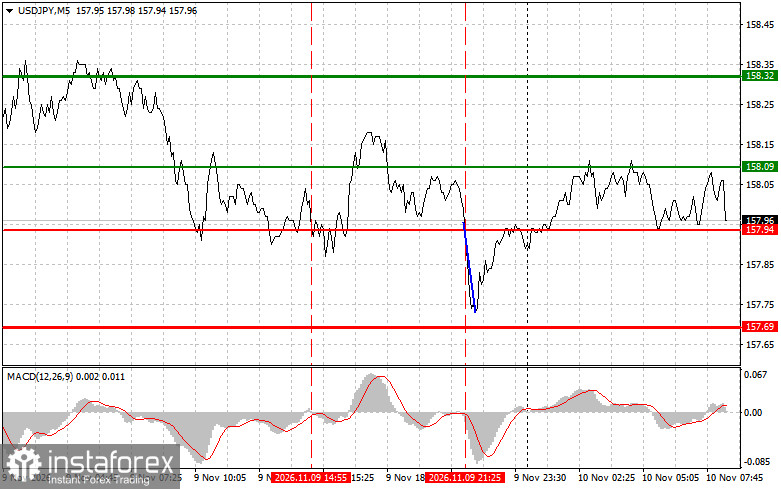
The test of the 157.94 price level occurred when the MACD indicator was just beginning to move downward from the zero line, confirming that it was an appropriate entry point for a short position on the US dollar. As a result, the pair declined by 20 points.
The yen began trading today on a negative note, following disappointing economic data from Japan. Inflation-adjusted household spending fell by 6.8% year over year in September, compared with an expected decline of 3.1%, while the previous month's decrease was also 3.1%. This was the sharpest contraction since 2020, with transportation, education, and recreation making the largest contributions to the decline. On a month-over-month basis, spending fell by 2.8% after seasonal adjustment. Other figures also confirmed the weakness in domestic consumption. The Economy Watchers Survey came in at 46.1 in October, compared with a forecast of 46.8, while the current account surplus narrowed to JPY 1,817.7 billion in September, against an expected JPY 2,790.0 billion.
This presents a serious dilemma for the Bank of Japan. The interest rate remains at 1.25%, following the central bank's decision to leave it unchanged on October 30 in an 8–1 vote. For the first time, the regulator also stated that underlying inflation had reached its 2% target, while acknowledging the risk of it exceeding that level. Many market participants expect the next rate increase on December 18, with the labor market providing the main justification. Cash earnings rose by 4.6% year over year in September, compared with a forecast of 3.8% and 3.9% in the previous month, marking the highest reading since 1997. Real wages also increased by 2.2%. However, despite rising incomes, consumers continue to cut spending. This raises questions about the possibility of accelerating monetary tightening, as weak demand calls for lower inflationary pressures, while higher borrowing costs, including mortgage rates, place additional pressure on the same households.
The Japanese authorities are also attempting to support household purchasing power. Prime Minister Sanae Takaichi has proposed reducing the consumption tax on food from 8% to 1% for two years, starting in April. The implications for the yen are mixed. Strong wage growth keeps a December rate hike as the baseline scenario, while weak consumer spending makes it difficult to justify a faster pace of monetary tightening.
The risk of government intervention also remains a factor limiting selling pressure on the yen. During the summer, Japan intervened in the currency market three times, spending a record JPY 15.4 trillion over three days. Of this amount, JPY 7.98 trillion was spent on July 30, followed by another JPY 5.55 trillion and JPY 1.87 trillion on the subsequent days. For the first time in almost three decades, the operation was coordinated with the United States. In addition, both countries confirmed that Japan could obtain dollar liquidity through the Federal Reserve's FIMA Repo Facility without selling US Treasury securities. This removes the argument that Japan has limited capacity to conduct currency interventions. If the US dollar remains strong, the yen is likely to continue losing ground amid weak Japanese economic data. However, the decline is unlikely to be particularly rapid, as the market remains mindful of Tokyo's recent interventions.
As for the intraday strategy, the focus will primarily be on the implementation of Scenarios #1 and #2.
Buy Scenarios
Scenario #1: USD/JPY can be bought today if the price reaches the entry level around 158.10 (the green line on the chart), with an upward target at 158.48 (the thicker green line on the chart). Around 158.48, the long position can be closed and a short position opened in anticipation of a downward move of 30–35 points from that level. It is preferable to consider buying the pair again during corrective pullbacks and significant declines in USD/JPY.
Important! Before opening a long position, make sure that the MACD indicator is above the zero line and is just beginning to move upward from it.
Scenario #2: USD/JPY can also be bought today if the price tests the 157.90 level twice consecutively while the MACD indicator is in the oversold area. This would limit the pair's downward potential and trigger a reversal to the upside. A rise toward the opposite levels of 158.10 and 158.48 can then be expected.
Sell Scenarios
Scenario #1: USD/JPY can be sold today only after the 157.90 level is broken (the red line on the chart), which could trigger a rapid decline in the pair. The sellers' main target will be 157.59, where the short position can be closed and a long position opened immediately in the opposite direction, targeting a 20–25-point move upward from that level. Sellers could return to the market at any time, as even the slightest indication from the central bank could trigger renewed selling pressure.
Important! Before opening a short position, make sure that the MACD indicator is below the zero line and is just beginning to move downward from it.
Scenario #2: USD/JPY can also be sold today if the price tests the 158.10 level twice consecutively while the MACD indicator is in the overbought area. This would limit the pair's upward potential and trigger a reversal to the downside. A decline toward the opposite levels of 157.90 and 157.59 can then be expected.
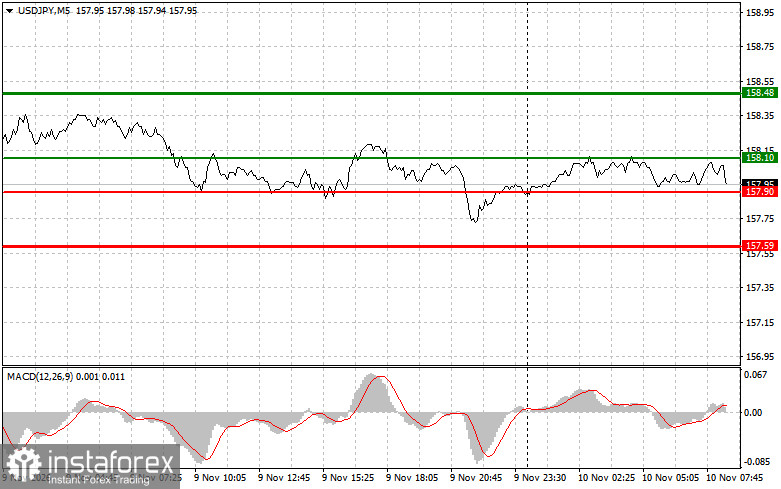
What the Chart Shows:
- Thin green line – the entry price at which the trading instrument can be bought.
- Thick green line – the estimated price level at which Take Profit orders can be placed or profits can be closed manually, as further gains above this level are considered unlikely.
- Thin red line – the entry price at which the trading instrument can be sold.
- Thick red line – the estimated price level at which Take Profit orders can be placed or profits can be closed manually, as further declines below this level are considered unlikely.
- MACD indicator. When entering the market, it is important to consider the overbought and oversold zones.
Important. Beginner Forex traders should exercise extreme caution when making entry decisions. Before the release of important fundamental reports, it is generally best to stay out of the market to avoid exposure to sharp exchange rate fluctuations. If trading during news releases, always place stop-loss orders to minimize potential losses. Without stop-loss orders, the entire trading account can be depleted very quickly, especially when position sizing is not managed properly and large trading volumes are used.
It is also important to remember that successful trading requires a clearly defined trading plan, such as the one outlined above. Making spontaneous trading decisions based on current market conditions is inherently a losing strategy for an intraday trader.