 English

 Русский
 Bahasa Indonesia
 Bahasa Malay
 ไทย
 Español
 Deutsch
 Български
 Français
 Tiếng Việt
 中文
 বাংলা
 हिन्दी
 Čeština
 Українська
 Română



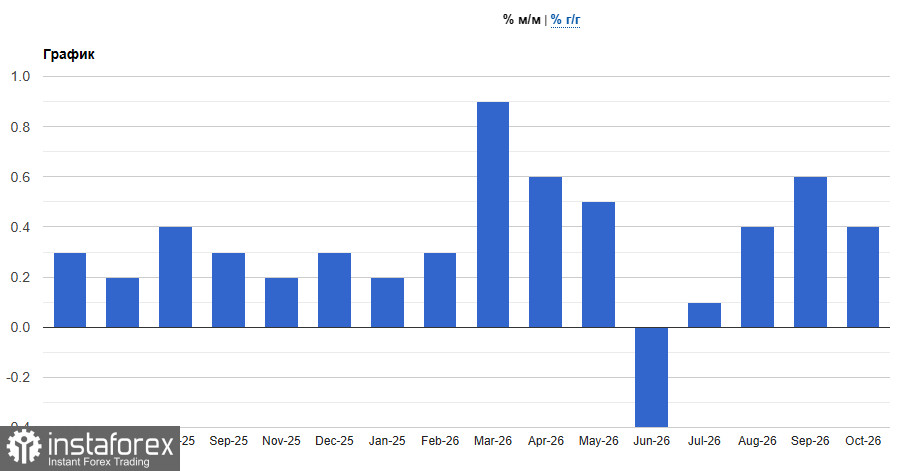
Yesterday, the dollar rose against all major currencies and US Treasury yields jumped sharply. The reason was the data: the core Consumer Price Index rose 0.3% month-on-month versus a 0.2% forecast, beating expectations for the third month in a row; the headline index jumped 0.4% versus a 0.3% forecast, after a 0.6% increase in September.
The pressure was broad-based. Rent, the largest component of the index, rose 0.3%; electricity gained 0.9%; auto insurance posted its biggest increase in more than a year; and food prices rose at the fastest pace since April. Gasoline climbed 1%, airfares were up 0.4%, and services excluding energy and rent rose 0.4%. Remarkably, Brent rose roughly 12% in October, so the energy shock is still filtering through to consumers — the recent drop in oil below $92 from about $116 on October 30 could not have been reflected in this report.
The report also said that tariffs added to the increase. Furniture, appliances, and toys became notably more expensive; smartphones rose the most on record amid the release of a new iPhone Duo model; and entertainment services posted their largest gain this year after streaming services raised prices. There were few mitigating factors: health insurance fell the most in over three years after a half-year data update, used cars declined, and AI-related construction components paused — software fell 1.5%, and computer prices rose at the slowest pace in four months.
The three-month annualized core CPI rose to 3.75% — the highest in more than two years — and the six-month annualized rate was 2.69%. There is no year-over-year comparison because data collection in October last year was interrupted by a government shutdown, but economists estimate core inflation at about 2.8% versus 2.6% in September, which would be the highest since May. Real hourly wages were almost unchanged, and the biggest losers are households whose incomes are not keeping pace with prices — precisely the demographic that helped Democrats win the midterms.
For the Federal Reserve, this is the last report before the December 9 meeting. The funds rate remains 3.75–4.00% after the September hike and an October pause on a 10–2 vote, with Lisa Cook and Beth Hammack voting for a raise. On September 3, Christopher Waller was willing to hold the funds rate given continued progress, but on Tuesday, he said he would support a December rate hike. If the core PCE is 0.3% or higher, a 50-basis-point rate hike may be required. After Waller's remarks, the probability of a December rate hike rose from 78.8% to 96.3% per CME FedWatch; the market is also pricing further hikes into 2027, and a small chance of a 50-bp move already in December.
For currencies, this restores the dollar's main supporting argument: the rate differential. The Federal Reserve is expected to reach 4.00–4.25% after December, while the ECB's deposit rate is 2.50% and a raise to 2.75% on December 17 is seen as the last one. With the policy rate at 4.00%, the Bank of England views a second move in December as a 50/50 call given cheaper oil.
All this suggests the report cemented a December rate hike and added the risk of an acceleration to 50 bps. I believe the dollar will remain supported in the coming sessions and EUR/USD and GBP/USD will retrace to Friday's lows. Falling oil and progress on Iran could ease the pressure, but their effect on inflation will only show up in November's report, so I do not expect a sustained dollar reversal before the December 9 meeting.
Technical picture for EUR/USD
Buyers now need to think about taking out the 1.1170 level. Only that would allow targeting a test of 1.1200. From there, it would be possible to climb to 1.1220, but doing so without support from large players would be quite difficult. On a pullback, I would expect major buyers to take action only around 1.1140. If there is nobody there, it would be prudent to wait for the 1.1110 low to be refreshed or to open long positions from 1.1080.
Technical picture for GBP/USD
Pound buyers need to clear the near-term resistance at 1.3355. Only that would allow targeting 1.3377, above which it will be quite difficult to break. The more distant target is the 1.3305 area. On a decline, bears will try to seize control of 1.3325. If they manage that, a break of the range would seriously damage bull positions and push GBP/USD toward the 1.3300 low with the prospect of reaching 1.3270.