 English

 Русский
 Bahasa Indonesia
 Bahasa Malay
 ไทย
 Español
 Deutsch
 Български
 Français
 Tiếng Việt
 中文
 বাংলা
 हिन्दी
 Čeština
 Українська
 Română



Today gold trades around $4,060 per ounce after yesterday's 2.6% drop, which fully erased the rebound to $4,122. Silver gained 1% to $52.06 after a 3.5% decline the previous day; platinum and palladium were slightly higher.
The October inflation report drove the sell-off. The core consumer-price index rose 0.3% month-on-month vs. a 0.2% forecast, exceeding expectations for the third month in a row, while the headline jumped 0.4% vs. a 0.3% forecast. The result landed exactly on the threshold Christopher Waller named the day before: with a core print of 0.3%, he is prepared to consider a 50-basis-point step. The probability of a December hike rose from 78.8% on November 9 to 96.3%. Gold pays no yield, so rising rates and yields make bonds more attractive, and a stronger dollar makes the metal more expensive for most buyers.
Federal Reserve officials amplified the effect. Austan Goolsbee called the report "worrying, on the verge of alarming." "We have a real problem with inflation," said Goolsbee, president of the Chicago Fed. In October he allowed for either a hike or a pause, and on November 9 he compared AI-driven investment to overheated demand. Loretta Mester, Dallas Fed president, still sees the need for at least two 25-bp hikes, possibly at an accelerated pace. In early September, Waller was willing to hold rates if inflation progressed, and now he allows for 50 bp. The tone has shifted from waiting to acceleration, and that shift is weighing on the metal.
Cheap oil did not save gold this time. On Monday, the metal rose as Brent fell and the dollar weakened, and it seemed lower energy prices would revive demand. Brent is now below $92, and WTI around $84, but the October CPI still reflects roughly a 12% monthly rise in Brent, so the effect of cheaper oil will show up only in November's data.
Gold has support, but it is limited. The $4,000 mark remains the main floor, although on November 3–4 the metal already dipped below it. Central-bank purchases and safe-haven demand provide backing. Notably, this time the equity correction did not pull gold down as sharply as at the end of October, when it was sold to cover stock losses: gold appears to be ceasing to be a source of liquidity. It is trading again as a rates-sensitive asset.
I believe pressure on gold will persist in the coming sessions. While the Fed prepares for a December 9 hike and allows for a 50-bp step, and the dollar and yields remain near yesterday's levels, it will be hard for the metal to hold above $4,100; a test of $4,000 is more likely, and if it falls below that, the next target is the November 4 low around $3,942. Central banks and further oil declines could soften the fall, but I link a notable reversal to Friday's PPI: a softer producer-price report could let gold recoup some losses.
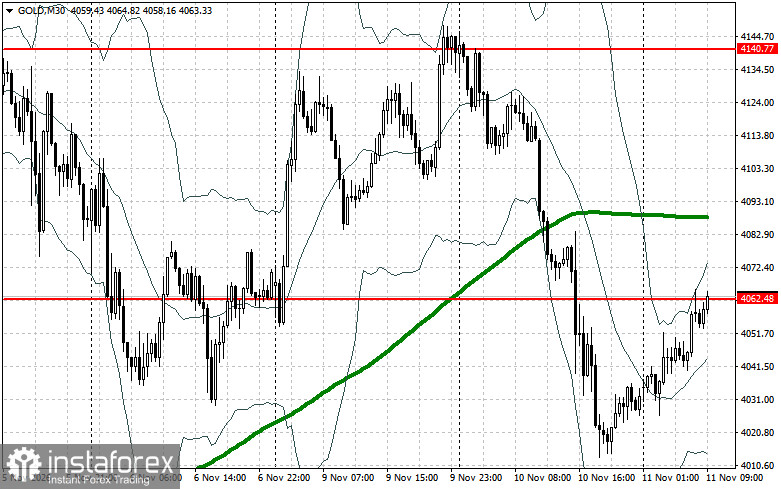
As for the technical picture, buyers need to take the nearest resistance at $4,062. That would set up a target of $4,140, above which a breakout will be difficult. The most distant target is the $4,192 area. In the event of a decline, bears will try to seize control of $4,001. If they succeed, a range breakout would deal a serious blow to bull positions and push gold to a $3,954 low with the prospect of moving to $3,906.