 English

 Русский
 Bahasa Indonesia
 Bahasa Malay
 ไทย
 Español
 Deutsch
 Български
 Français
 Tiếng Việt
 中文
 বাংলা
 हिन्दी
 Čeština
 Українська
 Română



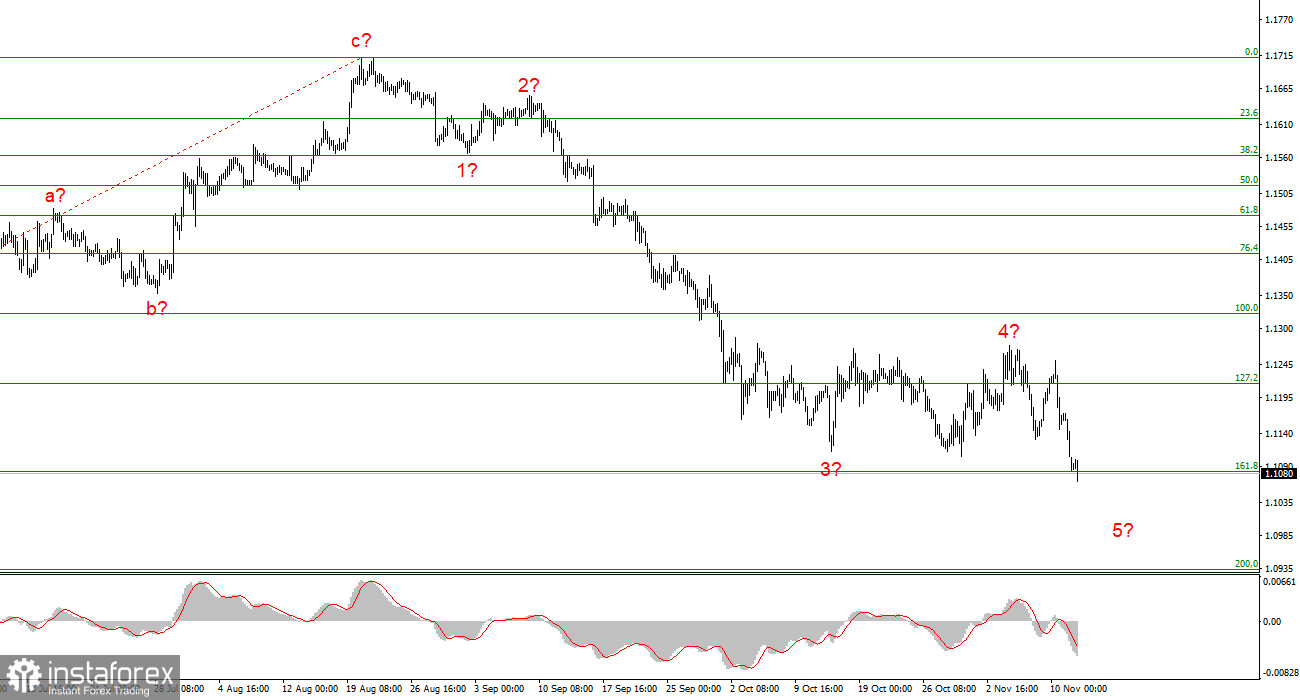
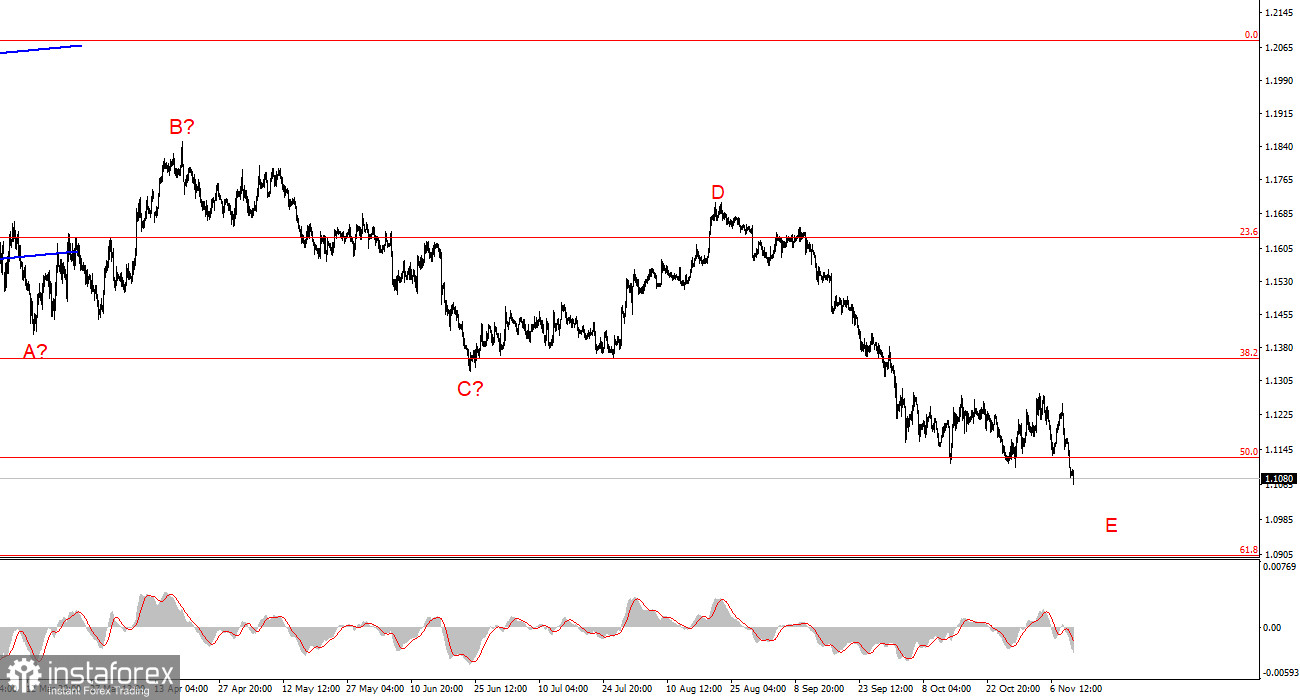
The wave count on the 4-hour chart for EUR/USD has become more complex. On the higher time frame (lower chart), the downward trend segment has taken the form of a five-wave structure A-B-C-D-E, which could be completed at any moment, as it appears quite well-developed. All the waves within this segment are approximately equal in size, so this structure is considered corrective. If this assumption is correct, an impulsive upward trend segment will begin to form once it is complete, with targets located well above the 20.00 level.
On the lower time frame (upper chart), an impulsive wave sequence is still developing, which may belong to wave E of the higher time frame. If this is indeed the case, the dollar's strengthening is approaching its end, regardless of how much further it rises. The presumed wave 5 of E is either complete or nearing completion. In any case, the current wave structure suggests that the downward wave sequence is nearing completion on both charts. News developments and a sharp shift in market sentiment have driven the US currency significantly higher, but few new factors remain that could support further dollar appreciation.
The Dollar Is Keeping the Market on Edge
The EUR/USD pair declined by another 70 basis points on Thursday. For more than a month, the market has failed to find reasons to buy the euro or even to stop buying the dollar, which has been in demand for three months. It is therefore time to remind readers why the dollar continues to rise. The first reason is that hawkish expectations regarding monetary policy are continuing to build. The second reason is that all other factors have become irrelevant.
This combination allows the US currency to remain in demand even though the Fed has so far conducted only one round of policy tightening. However, market participants are not interested in how many rounds of tightening the central bank has implemented. What matters is how much further it may raise interest rates in the future. It would not be surprising if the dollar began to decline as soon as inflation showed its first signs of slowing, as happened in 2022, when the market started anticipating monetary policy easing.
Meanwhile, expectations of further policy tightening over the coming months continue to rise. There are no doubts about the Fed's December meeting. However, the market has recently started anticipating the next rate hike in January rather than March. According to the CME FedWatch tool, the probability of this scenario currently stands at 62%. The market is now even considering the possibility of four rounds of policy tightening. It is difficult to say how realistic this scenario is, as much will depend on when the conflicts in Eastern Europe and the Middle East come to an end. If these conflicts are resolved, oil prices will return to their pre-war levels, which would slow inflation. Therefore, it would be premature to forecast even three rounds of FOMC policy tightening. However, the market likes this prospect, and the dollar is benefiting significantly from it.
General Conclusions
Based on the EUR/USD analysis, the pair remains within the global corrective trend segment A-B-C-D-E. However, this structure appears to be fully developed and could therefore be completed at any moment. In my view, this is a favorable time not only to consider buying the euro but also to anticipate the development of a full-fledged upward trend segment. According to the higher time frame, the instrument is expected to rise to at least the 1.1700–1.1800 level. An unsuccessful attempt to break above 1.1082, corresponding to the 161.8% Fibonacci level, would indicate that the market is ready for buying. A breakout above this level would signal an opportunity to sell.
On the higher time frame, a downward trend segment is visible, taking the form of an A-B-C-D-E structure. The internal wave structure of wave E has taken an impulsive five-wave form, but it may already be complete. If this assumption is correct, a new upward trend segment will now begin to develop.
Key Principles of the Analysis
- Wave structures should be simple and easy to understand. Complex structures are difficult to trade and often involve changes in the expected market direction.
- If there is no clear understanding of what is happening in the market, it is better to stay out of it.
- There can never be 100% certainty about the direction of price movement. Do not forget to use protective Stop Loss orders.
- Wave analysis can be combined with other types of analysis and trading strategies.