 English

 Русский
 Bahasa Indonesia
 Bahasa Malay
 ไทย
 Español
 Deutsch
 Български
 Français
 Tiếng Việt
 中文
 বাংলা
 हिन्दी
 Čeština
 Українська
 Română



The euro continues to fall against the dollar and yesterday broke Friday's low at 1.1131, which not long ago looked like firm support. From the high, the euro has lost roughly 180 pips, wiping out the entire autumn rebound. Overnight, the pair held in a range from 1.1085 to 1.1100, then slid sharply and only began to recover slightly by morning.
The main reason for the decline remains the same. The market increasingly expects a US rate hike. The probability of a December Federal Reserve hike rose to 96.3% after Christopher Waller's remarks, versus 78.8% on November 9. After US inflation, traders now fully price a 25-bp move for the December 9 meeting. Goldman also expects another hike in March 2027. Two-year Treasury yields — the price the market requires for two-year money — rose 17 basis points to a 19-month high. That is strong support for the dollar: higher yields make holding US assets more attractive.
Fed rhetoric reinforces this stance. On September 3, Waller was ready to hold rates if inflation progressed, but he has since said he may support a December hike and even a 50-bp move if inflation does not improve. Lorie Logan called for at least two 25-bp hikes, and Austan Goolsbee described the inflation report as worrying and did not rule out a larger step. The Fed funds rate is now 3.75–4.00% while the European Central Bank's deposit rate is 2.50%, a gap of 1.25–1.50 percentage points. Even an expected ECB rise to 2.75% will not close it. In my view, as long as rate expectations for the US and Europe diverge so strongly, pressure on the euro will persist.
There is no major euro-zone data today, so market attention will likely shift to the ECB's Economic Bulletin. This regular review explains how the bank assesses the economy and prices and can set the tone ahead of the December 17 meeting, where the ECB will present new forecasts and is expected to raise the deposit rate from 2.50% to 2.75%. If the Bulletin contains hawkish assessments of inflation and rates, the euro could notch a small recovery, though a strong dollar will still limit gains.
The ECB does have arguments for a hawkish stance. Eurostat's flash showed euro-area inflation at 4.0% in October, up from 3.8% in September, and energy prices rose 20.8% year-on-year. In the September projections, the bank expected average 2026 inflation of 3.0%, so reality is running ahead. GDP grew 0.4% in Q3 vs. 0.2% expected, Italy's industrial output rose 1.2% month-on-month in September, and German inflation slowed to 2.8% from 3.3% in October. Weak spots remain: the composite PMI fell to 51.7 from 53.1, and retail sales fell 0.7% in September. On October 29, Christine Lagarde said the Governing Council discussed the appropriateness of a hike and that, absent major shocks, the direction for December is clear; by early November Joachim Nagel had become a supporter of a December hike. In my view, the balance of these assessments will shape the Bulletin's tone, and a hawkish variant would only let the euro slightly claw back recent losses.
Momentum
The price is now at 1.1080, inside a range between 1.1069 and 1.1102. A move beyond the boundary is a breakout, but one touch isn't enough—confirmation is needed, meaning several consecutive five-minute candles must close beyond the level. Otherwise, you can easily get caught by a false breakout, after which price returns.
From above 1.1102 is active. A close above it opens the road to 1.1133 and then to 1.1167. The first target sits almost where Friday's low was, and such places often turn from support into resistance after a breakout, so I would be especially cautious about upside there. The only plausible catalyst for a rise would be a hawkish ECB Bulletin, but a strong dollar works against that. I have little faith in this scenario.
From below, the reference is 1.1069; a close below it leads to 1.1036 and then to 1.1004. I consider this direction primary. The price is only eleven pips from the level, and overnight it already pierced it once, down to 1.1067, then returned. That means buyers are present here, and a novice should not enter on the first touch. Wait for candles to close below; otherwise, you risk getting caught by another rebound.
Mean Reversion
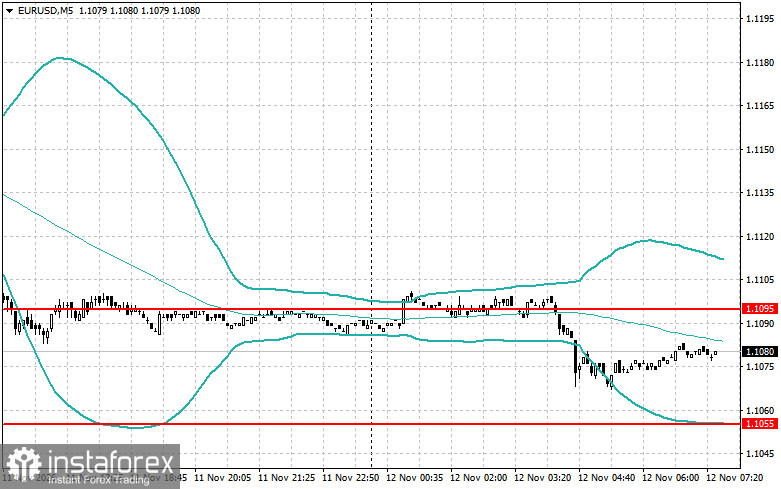
There are two levels here: 1.1095 and 1.1055. The upper reference, 1.1095, sits seven pips below the breakout point 1.1102 and coincides with the zone where price hit the ceiling several times overnight. The scheme is this: price rises to 1.1095, fails to hold, and turns down; then I consider selling with a stop above 1.1102, with a small buffer. But if price passes 1.1095, reaches 1.1102, and closes confidently above, that is a breakout, and selling there is not allowed. You cannot determine the move's character from a single touch, so it's better to skip the first reaction in the zone.
The lower reference 1.1055 lies fourteen pips below the breakout point 1.1069 and nineteen pips above the first downside target at 1.1036. The scheme is mirrored. Price breaks 1.1069, falls to 1.1055, finds no continuation, returns above, and then I look to buy with a stop below 1.1036, with a margin. Such a pullback is most likely if the ECB Bulletin is calm and the market starts taking profits after the prolonged fall. If the price closes below 1.1055, the reversion is canceled, and the downward breakout plays.