 English

 Русский
 Bahasa Indonesia
 Bahasa Malay
 ไทย
 Español
 Deutsch
 Български
 Français
 Tiếng Việt
 中文
 বাংলা
 हिन्दी
 Čeština
 Українська
 Română



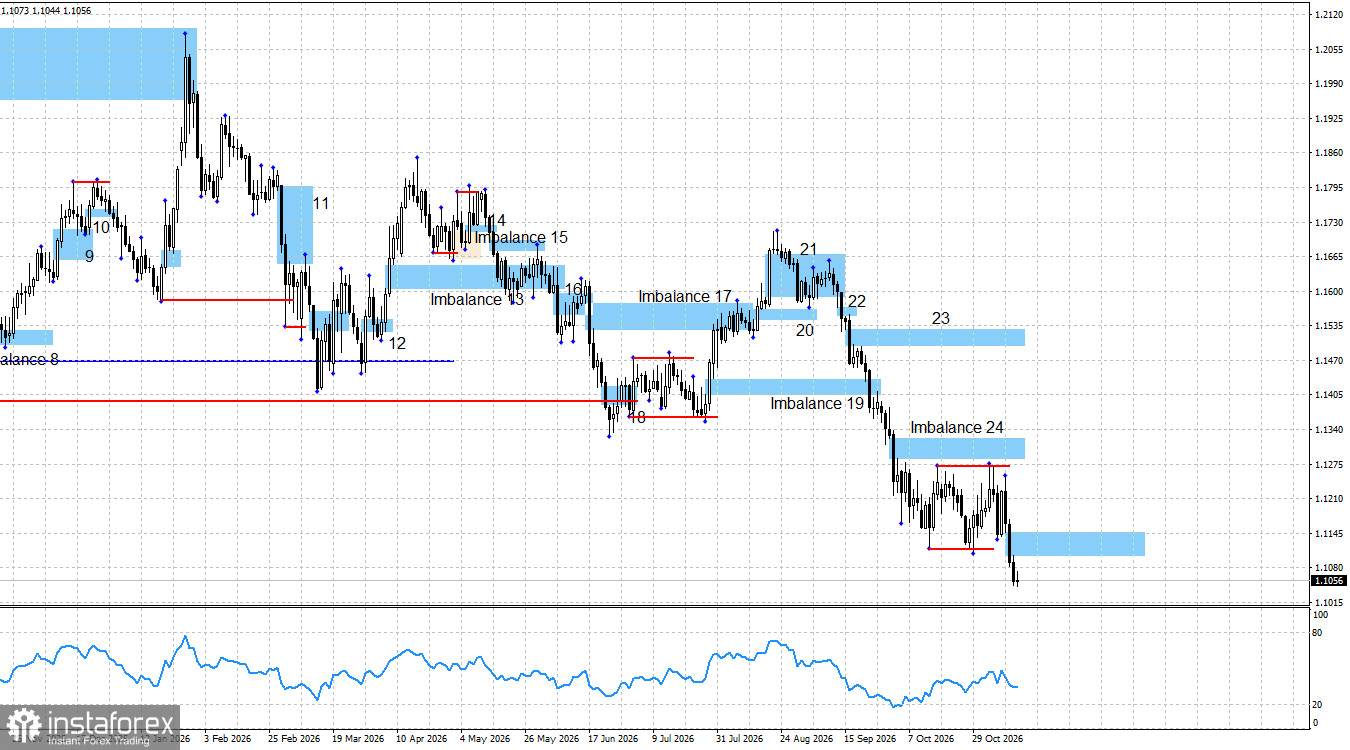
The EUR/USD pair traded between 1.1114 and 1.1269 for an entire month. On Tuesday, the United States released its October inflation report, which triggered renewed selling pressure from the bears. This pressure continued on Wednesday, pushing the euro slightly below the previously established range. At this point, it is too early to say with certainty that the sideways trend has ended. The price could still sweep liquidity below the two most recent lows before reversing in favor of the European currency. However, the price action over the past five trading days does not suggest anything positive for the euro. There has been no clear rebound, bounce, or liquidity sweep. The current movement increasingly resembles a brief pause before another decline. No significant news capable of providing new support for the dollar emerged on Wednesday, yet the bears continued to exert pressure. They maintained their selling activity on Thursday and simply took a brief pause on Friday. Therefore, another decline in EUR/USD seems rather unusual to me, to say the least. I cannot identify any convincing reasons for further dollar appreciation after the US currency has already gained ground over the past three months. The market is still pricing in future Fed monetary policy tightening, which is expected in a month and has already been priced in repeatedly.
Over the past two months, the fundamental backdrop has frequently favored the European currency, but this has had virtually no effect on its exchange rate. Last week, it became known that the Republican Party had suffered a decisive election defeat, while inflation in the European Union accelerated to 4%. The US Congress will now be divided, and cooperation between Democrats and Republicans is likely to be extremely difficult. As a result, many important government decisions could face significant delays. The renewed acceleration in inflation in the European Union points to further ECB monetary policy tightening, just as rising inflation in the United States suggests further Fed tightening. If the market is pricing in another FOMC rate hike, it should also be pricing in further ECB tightening. However, over the past few months, the cause-and-effect relationships influencing EUR/USD have become increasingly inconsistent.
It is worth recalling that one of the main reasons behind the dollar's appreciation over the past three months was the Fed's hawkish stance. However, in reality, the Fed's position is not particularly hawkish compared with that of other central banks. For example, the ECB is preparing to deliver its third rate hike in December, while the Bank of England has only just begun its monetary policy tightening cycle but could implement as many as four full rounds of rate increases. The British pound has at least partially reflected these factors, whereas the euro has not.
At present, I see no signs that the bearish advance is coming to an end. Imbalance 24 remains valid, and the price has yet to react to it by generating a sell signal. The bulls need to invalidate Imbalance 24 and form bullish patterns before any meaningful recovery can be expected. This would require a sharp upward move in the euro, which remains absent. The liquidity sweep above 1.1270, together with strong US labor market and inflation data, triggered renewed selling pressure. The bulls can now only hope for another liquidity sweep below the recent lows. Another bearish imbalance formed this week.
Overall, the fundamental backdrop, in my view, continues to favor the bulls. Despite the Fed's increasingly hawkish monetary policy stance, this is not the only factor determining exchange rates. Thursday's economic data provided no grounds for further dollar purchases, yet the market is currently showing no interest in selling the US currency. Under any circumstances.
Economic Calendar for the United States and the European Union
- European Union – Industrial Production (10:00 UTC).
On November 16, the economic calendar contains just one release, which is unlikely to attract much market attention. The impact of the fundamental backdrop on market sentiment on Monday will be extremely limited or nonexistent.
EUR/USD Forecast and Trading Tips
In my view, the pair remains in the process of forming a bullish trend that has entered a year-long corrective phase. The fundamental backdrop shifted sharply in favor of the bears nine months ago, but the broader trend, which has been in place for four years, cannot yet be considered invalidated or complete.
The bulls could resume their advance before the end of the year, but their current opportunities are limited to the low of 1.1066 established in June last year and the low of 1.1105 recorded two weeks ago.
As for the bears, they have Imbalance 24 and the liquidity sweep above the most recent peak. A liquidity sweep is not, in itself, a pattern or trading signal, but it warns the market of a potential move in a particular direction. This is precisely the type of movement observed over the past five days. No trading signals have formed in recent days. However, a new bearish imbalance emerged this week, which could contribute to the formation of additional sell signals.