 English

 Русский
 Bahasa Indonesia
 Bahasa Malay
 ไทย
 Español
 Deutsch
 Български
 Français
 Tiếng Việt
 中文
 বাংলা
 हिन्दी
 Čeština
 Українська
 Română



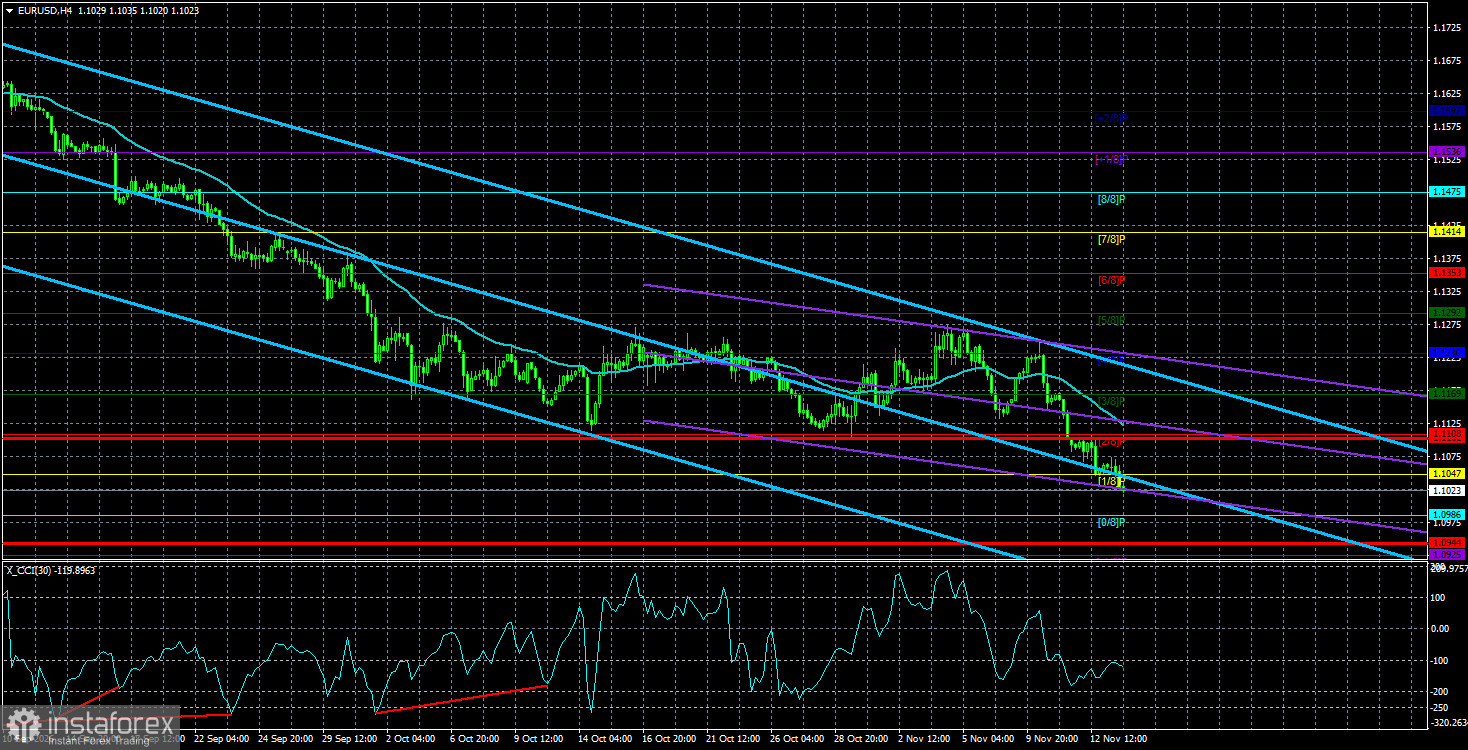
The EUR/USD currency pair continued its downward move on Friday, which probably surprises no one. The European currency fell almost throughout last week, and, as always, people found reasons and pretexts. After all, those who look will always find. And for the past three months, the market has been occupied only with finding reasons to buy the US dollar.
In fact, we are surprised that most experts continue to ignore the European Central Bank's monetary tightening. It feels as if we are talking about the central bank of Uganda or Nigeria. The US currency has been rising for three months, but no economists are saying out loud that the ECB will raise rates for the third time this year in December, and that the rate-hiking cycle will likely continue next year. Inflation in the European Union has risen to 4%. In the United States, it is 3.7%. However, everyone is now talking about future Federal Reserve tightening, and the dollar has been rising for three consecutive months, driven by increasingly "hawkish" market expectations. Despite the fact that the ECB's stance is at least no less hawkish.
Thus, we continue to draw the attention of traders who want to assess the market adequately and logically to the fact that central bank monetary policy alone cannot support the dollar for so long. Recall that the euro, in essence, cannot even correct. The correlation with the British pound is lost, although the Bank of England has also begun tightening policy, and inflation in the UK is also rising, as it is in the rest of the world.
Simply put, the United States, the European Union, the United Kingdom, and many other countries faced roughly the same inflation problems in 2026, and their central banks are taking roughly the same measures to address them. So what, then, is the reason for the relentless rise of the dollar? In our view, it comes down to speculation, interventions, and manipulation. The currency market is a mechanism with many cogs and elements, each of which, in one way or another, affects exchange rates. Large players have more opportunities to influence movements because they have enormous financial capabilities. Now ask: why should these market "whales" trade the way someone wants? Why should they enter trades based on macroeconomic factors or fundamentals? They CAN do that because the general economic mechanisms continue to operate. However, they are NOT OBLIGED to do so. Therefore, from time to time we observe market movements that look completely illogical.
In such moments, we advise relying on technical analysis, as it best illustrates what is happening in the market. Accordingly, a downward trend continues on the 4-hour and daily timeframes, which is a downward correction against the upward trend on the weekly timeframe. Thus, in the short term, the euro will continue to fall. In the long term, we expect the single European currency to resume growth.
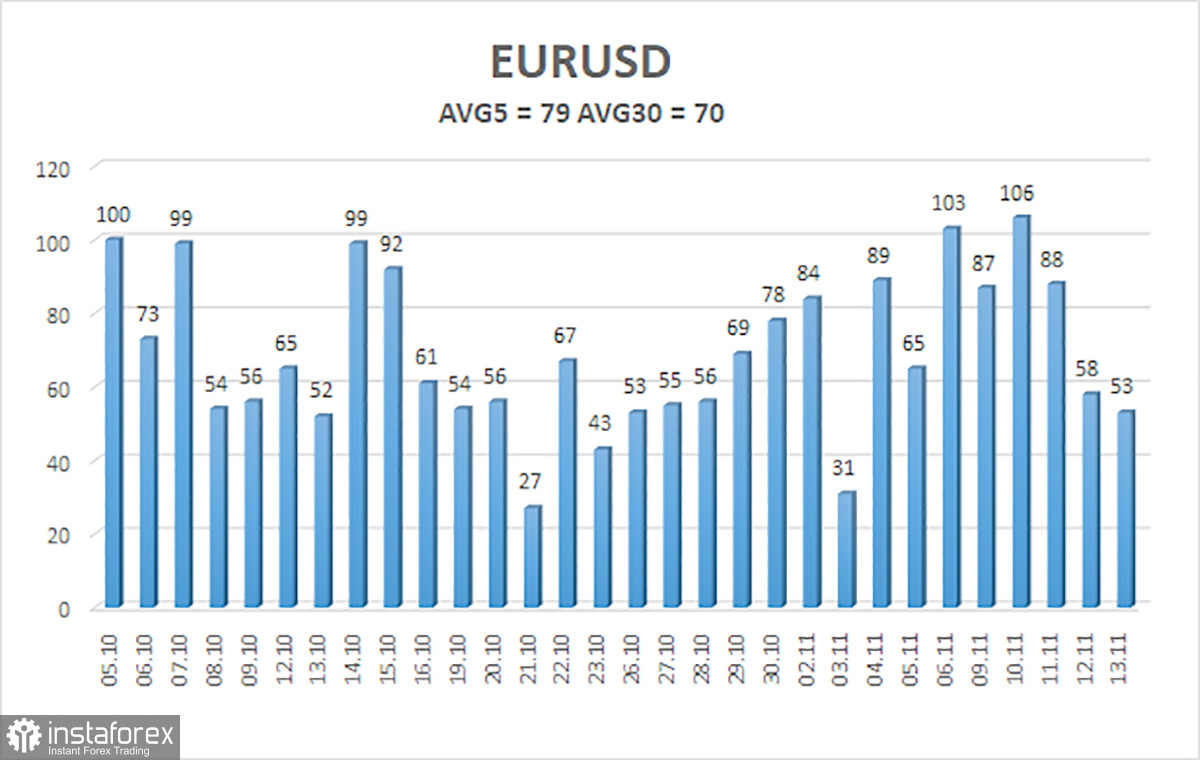
The average volatility of the EUR/USD currency pair over the last 5 trading days as of November 16 is 79 pips and is characterized as "average." We expect the pair to move between the levels 1.0944 and 1.1102 on Monday. The higher linear regression channel is directed downward, indicating a downtrend. The CCI indicator entered the oversold area five times and formed four "bullish" divergences, and all these signals were ignored. The illogical downward trend persists.
The nearest support levels:
S1 – 1.0986;
S2 – 1.0925;
S3 – 1.0864
The nearest resistance levels:
R1 – 1.1047;
R2 – 1.1108;
R3 – 1.1169
Trading recommendations:
The EUR/USD pair remains in a downward channel with insufficient fundamental, macroeconomic, and geopolitical justification. The global fundamental background for the dollar remains negative, but in 2026, geopolitics and the Fed's "hawkish" stance provided strong support for the US currency. Practically all other factors have been ignored for the past three months. With price below the moving average, short positions can be considered, targeting 1.0986 and 1.0944, since the trend remains downward. Above the moving average, long positions can be considered with targets of 1.1230 and 1.1292; however, the euro has found it extremely difficult to strengthen in recent months.
Notes on the charts:
- Linear-regression channels help identify the current trend. If both channels point the same way, the trend is strong.
- The moving average (settings 20,0, smoothed) defines the short-term tendency and the direction in which you should trade now.
- Murray levels are target levels for moves and corrections.
- Volatility levels (red lines) indicate the likely price channel the pair will inhabit over the next day based on current volatility.
- CCI indicator — entries into the oversold area (below -250) or overbought area (above +250) suggest a trend reversal may be imminent.