 English

 Русский
 Bahasa Indonesia
 Bahasa Malay
 ไทย
 Español
 Deutsch
 Български
 Français
 Tiếng Việt
 中文
 বাংলা
 हिन्दी
 Čeština
 Українська
 Română



Well, as everybody knows, the Fed is tightening its monetary stance. A whole series of FOMC officials' speeches indicate that many have shifted toward a more hawkish stance than before. Certainly, expecting and planning are not the same thing, but hawkish expectations are indeed rising across the board. In my view they are not rising so much that the dollar should climb without pause for three months straight. Yet market participants think otherwise.
Large commercial banks are also revising their FOMC rate forecasts for the coming months. I should note one important detail: the market already expected at least three rounds of Fed tightening back in September. Now talk is of four rounds by March next year. In other words, the divergence between earlier expectations and the current ones is not huge. At least it hardly justifies a three-month dollar rally. Also remember that the ECB may conduct its third round of tightening in December and could deliver a fourth hike next year.
Bank of America economists believe the Fed will raise rates at each of the next three meetings: in December, January, and March. Thus, by March the policy rate would reach a peak in the 4.5–4.75% range. The bank says the latest U.S. inflation report confirmed market fears that the Fed is lagging in the fight against high consumer price growth. Therefore, an acceleration of tightening is now the base case. In Bank of America's view, the Fed no longer has the luxury of waiting and analyzing while raising rates only once a quarter.
The bank adds that a fourth round of tightening may not occur if inflation slows by then. At the same time, if inflation continues to rise despite Fed action, the Fed may pursue two additional hikes. In other words, Bank of America expects the FOMC to raise rates as long as necessary—and only inflation can determine how long that will be. Taken together, this points to rising hawkish sentiment in markets, though hawkishness is not confined to the Fed.
Other articles to read:
Analysis EUR/USD. November 18. Any reason for a better future?
Analysis of GBP/USD on November 18: GBP hardly benefits from the current situation.
Wave analysis of EUR/USD:
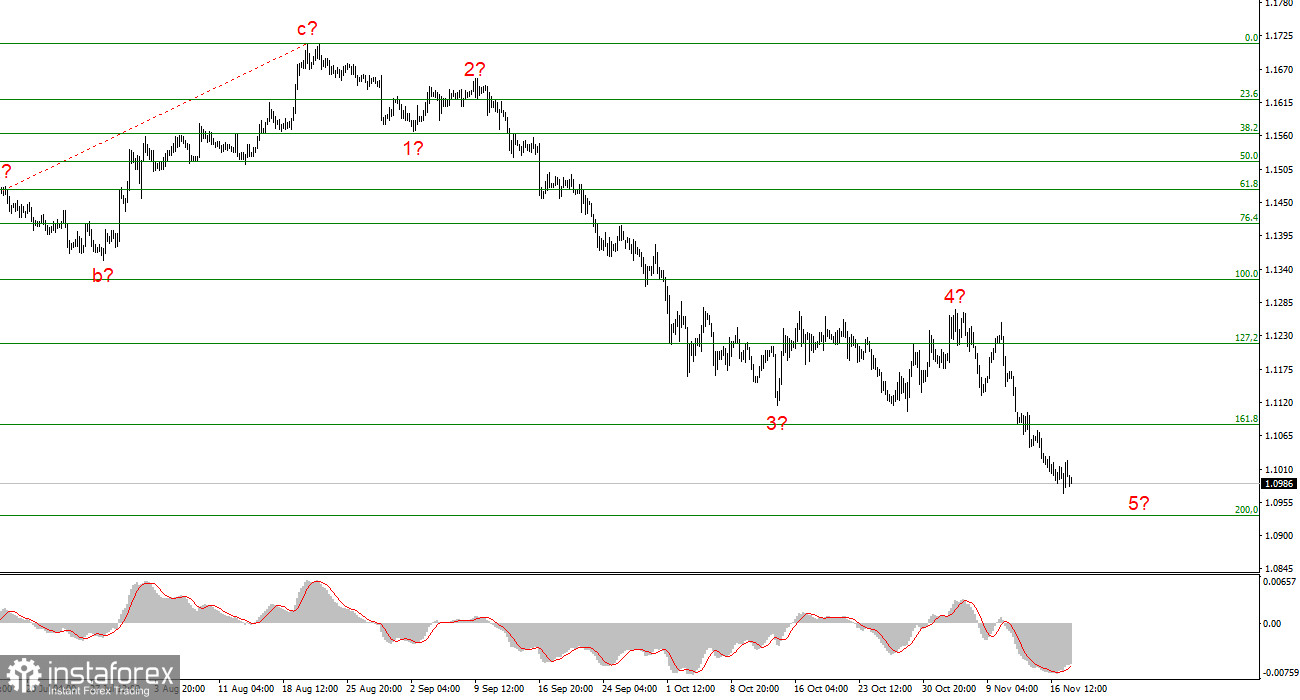
Based on my EUR/USD analysis, I conclude the instrument remains within a global corrective A-B-C-D-E trend segment. However, this structure looks fully complete and may finish at any moment. In my view, now is a good time not only to buy the euro but also to expect a full bullish trend segment. On the higher timeframe, one should expect a rise of at least 1,700–1,800 pips. In my view, the deeper the instrument falls now, the stronger the eventual rise will be. However, confirmations of the end of the downward wave sequence are required—for example, a failed break of 1.0902 (which corresponds to 61.8% on Fibonacci on the higher timeframe).
Wave analysis of GBP/USD:
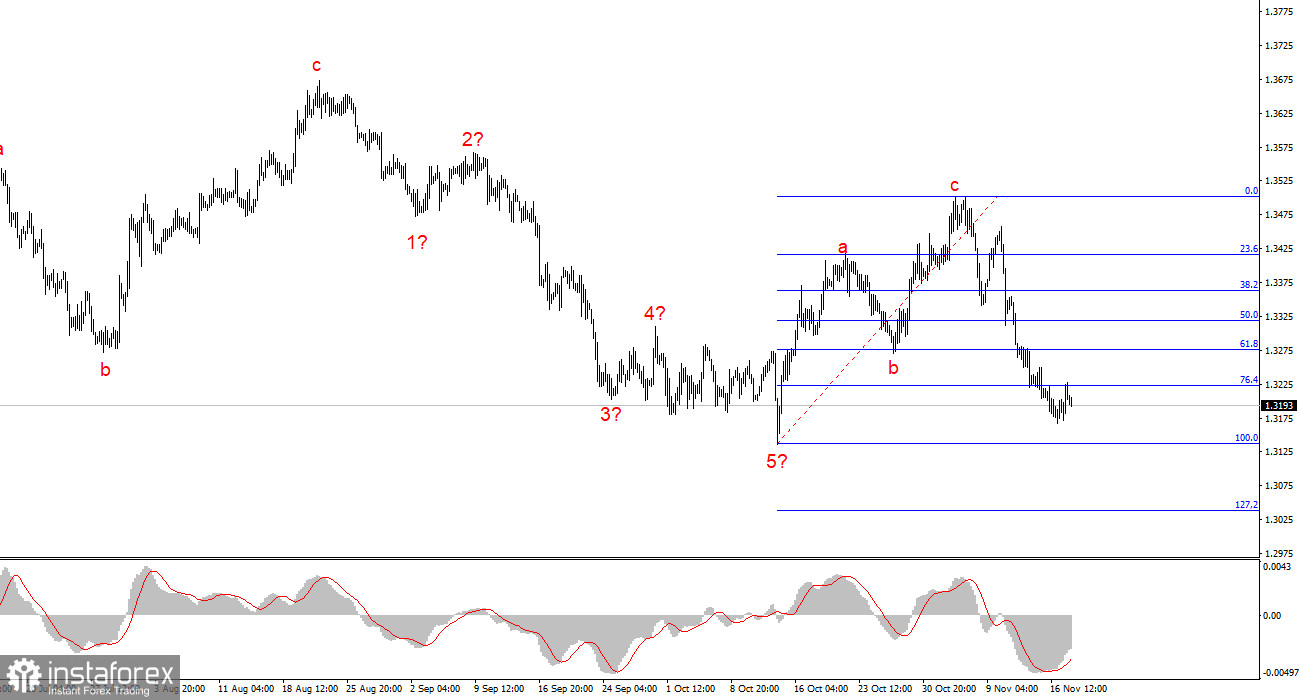
The wave picture for GBP/USD has become completely clear. On the higher chart we now have a corrective A-B-C-D-E structure that, logically, should already be complete. However, the lower timeframe indicates the downward wave sequence is not finished. Consequently, the pound's decline may continue toward targets around 1.3138 and 1.3039, which correspond to 100.0% and 127.2% on Fibonacci. The deeper the pound falls, the more I look toward long-term buy opportunities.
Key principles of my analysis:
1) Wave structures should be simple and understandable. Complex structures are hard to trade and often change.
2) If you are not confident about what is happening in the market, it is better not to enter.
3) There is no such thing as 100% certainty in direction; do not forget protective stop-loss orders.
4) Wave analysis can be combined with other types of analysis and trading strategies.