English

 Русский
 Bahasa Indonesia
 Bahasa Malay
 ไทย
 Español
 Deutsch
 Български
 Français
 Tiếng Việt
 中文
 বাংলা
 हिन्दी
 Čeština
 Українська
 Română




West Texas Intermediate (WTI), the benchmark for US crude, has come under renewed selling pressure after mixed moves in the previous session. On Wednesday, prices fell toward $82.15. The contract also revisited the two?month low set last week as the market remains worried about the prospect of excess supply on the global market.
The International Energy Agency (IEA) expects oil supply to outpace demand through the fourth quarter of 2026–2027. Additional downward pressure came from data published Tuesday by the American Petroleum Institute (API). According to the report, US commercial crude inventories rose by 5.28 million barrels in the week ending November 13. At the same time, tanker traffic through the Strait of Hormuz has begun to normalize despite attacks on vessels, which also contributes to lower oil prices.
At the same time, a geopolitical risk premium continues to support the market amid fresh escalation between the US and Iran. The US struck an Iranian missile launch site hours after Iran launched drones at a US military radar station in Bahrain. In addition, Iran?aligned Houthi forces in Yemen reported launching drones toward two pumping stations on Saudi Arabia's East–West pipeline. Such developments can constrain sellers' activity and prevent bears from opening overly aggressive positions to push prices down further.
For better trading opportunities today, focus should be on the US Energy Information Administration (EIA) crude inventory report, due later in the North American trading session. Also of interest are the minutes from the Federal Open Market Committee (FOMC). The minutes may contain new signals about the future path of Fed policy. Those expectations can significantly affect the US dollar and, through it, the price of dollar?denominated commodities, including oil.
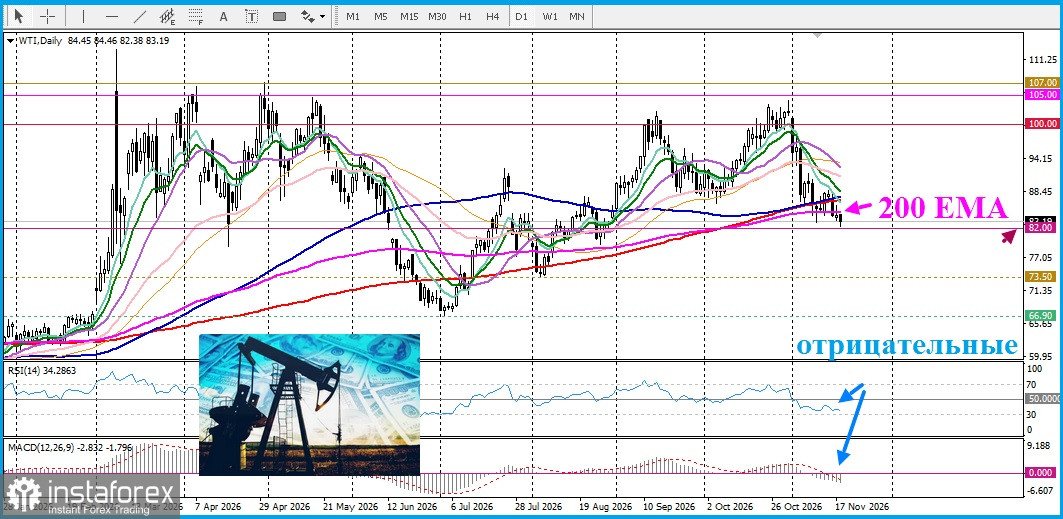
From a technical viewpoint, the short?term picture for crude remains bearish: prices are trading below the 200?day exponential moving average (EMA). The first significant support level is at $82.00. Resistance on any recovery lies around the 200?day EMA at $84.70. With oscillators in negative territory, the bears currently have the advantage.