 English

 Русский
 Bahasa Indonesia
 Bahasa Malay
 ไทย
 Español
 Deutsch
 Български
 Français
 Tiếng Việt
 中文
 বাংলা
 हिन्दी
 Čeština
 Українська
 Română



Review of trades and trading advice for the Japanese yen
The test of the 159.19 level occurred when the MACD indicator had just begun moving downward from the zero line, confirming the validity of the short entry point. However, the pair did not experience a significant decline.
Japan's morning economic data was favorable for the yen. The trade deficit narrowed to JPY 476.5 billion in October, compared with a forecast of JPY 956.0 billion and a previous reading of JPY 556.5 billion. Exports increased by 20.5%, against expectations of 20.0%, while import growth slowed to 21.6%, compared with a forecast of 25.8%. This is important for the yen because the less a country spends on imported energy and raw materials, the less yen needs to be sold to purchase foreign currencies for payments. Lower oil prices also help reduce this burden.
During the second half of the day, USD/JPY will be influenced by the Fed meeting minutes and US economic data. The minutes will reveal how extensively policymakers discussed a potential December rate hike following the 10–2 vote to keep rates unchanged at the October 28 meeting. Building permits are forecast at 1.380 million, compared with 1.398 million previously, housing starts at 1.250 million, up from 1.221 million, and pending home sales at -2.0%, compared with -7.3% previously. These indicators show how the housing market is coping with mortgage rates of around 7.2%. Only particularly weak readings are likely to put significant pressure on the US dollar. Remarks from Fed official Michael Barr today could also restore demand for the US currency. As long as the Fed maintains a more hawkish stance than the Bank of Japan, USD/JPY is likely to retain its upward potential, while any decline is expected to remain corrective.
As for the intraday strategy, greater emphasis will be placed on implementing Scenarios #1 and #2.
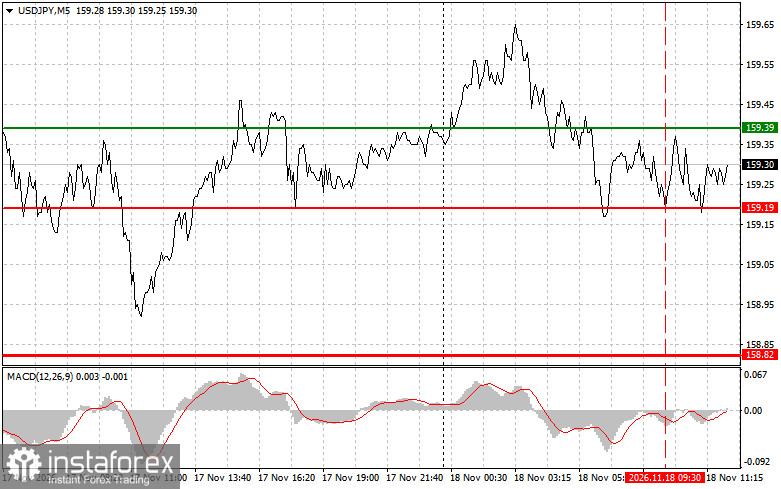
Buy Signal
Scenario #1: Buying USD/JPY today is possible when the price reaches the entry level around 159.39 (the green line on the chart), with an upward target of 159.75 (the thicker green line on the chart). Around 159.75, the long position will be closed and a reverse short position opened, targeting a move of 30–35 points in the opposite direction from that level. A rise in the pair today can only be expected following strong US economic data.
Important! Before buying, make sure that the MACD indicator is above the zero line and has only just begun to rise from it.
Scenario #2: USD/JPY will also be considered for buying today if the price tests the 159.17 level twice consecutively while the MACD indicator is in oversold territory. This would limit the pair's downward potential and trigger an upward market reversal. A rise toward the opposite levels of 159.39 and 159.75 can be expected.
Sell Signal
Scenario #1: Selling USD/JPY today is planned after the price breaks below the 159.17 level (the red line on the chart), which could trigger a rapid decline in the pair. The sellers' key target will be 158.82, where the short position will be closed and a reverse long position opened immediately, targeting a move of 20–25 points in the opposite direction from that level. Downward pressure on the pair is likely to return if the central bank intervenes.
Important! Before selling, make sure that the MACD indicator is below the zero line and has only just begun to decline from it.
Scenario #2: USD/JPY will also be considered for selling today if the price tests the 159.39 level twice consecutively while the MACD indicator is in overbought territory. This would limit the pair's upward potential and trigger a downward market reversal. A decline toward the opposite levels of 159.17 and 158.82 can be expected.
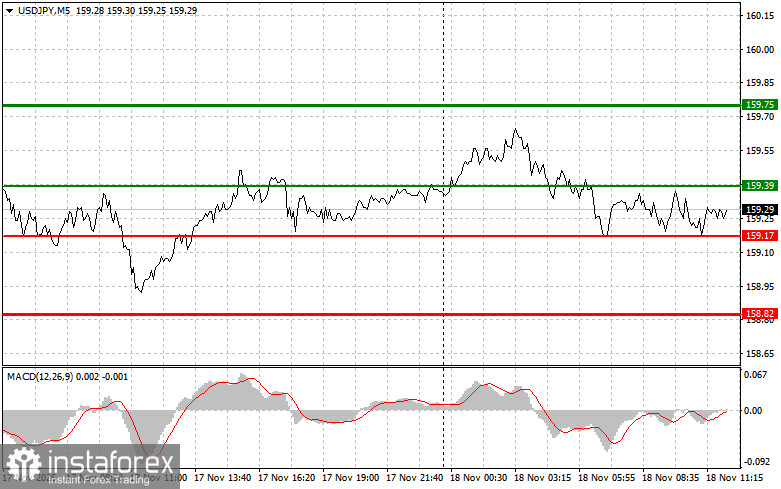
What the Chart Shows:
- Thin green line – the entry price at which the trading instrument can be bought;
- Thick green line – the estimated price level at which Take Profit orders can be placed or profits can be taken manually, as further upward movement above this level is unlikely;
- Thin red line – the entry price at which the trading instrument can be sold;
- Thick red line – the estimated price level at which Take Profit orders can be placed or profits can be taken manually, as further downward movement below this level is unlikely;
- MACD indicator. When entering the market, it is important to consider overbought and oversold conditions.
Important. Beginner Forex traders should exercise extreme caution when making entry decisions. Before the release of major fundamental reports, it is generally best to stay out of the market to avoid exposure to sharp exchange rate fluctuations. If trading during news releases, always place stop-loss orders to minimize potential losses. Without stop-loss orders, the entire trading account can be lost very quickly, especially if risk management rules are not followed and large position sizes are used.
Remember that successful trading requires a clear trading plan, such as the one outlined above. Making spontaneous trading decisions based on current market conditions is a fundamentally flawed strategy for an intraday trader.