 English

 Русский
 Bahasa Indonesia
 Bahasa Malay
 ไทย
 Español
 Deutsch
 Български
 Français
 Tiếng Việt
 中文
 বাংলা
 हिन्दी
 Čeština
 Українська
 Română




On Wednesday, the NZD/USD pair shows a sustained downward trend, approaching levels last seen in March 2020. That period marked a global correction in financial markets triggered by the COVID-19 pandemic. The New Zealand dollar is weakening against the US dollar for two key reasons: a softer domestic New Zealand economy and forecasts of tighter monetary policy from the US Federal Reserve.
The Kiwi's prolonged downtrend correlates with a deteriorating macroeconomic backdrop and monetary policy prospects that remain unfavorable for the currency. Recent economic releases have heightened concerns about the resilience of New Zealand's recovery. On Wednesday, Statistics New Zealand published producer price index (PPI) data for finished goods. The indicator rose 0.8% in Q3 versus a 1.7% increase in the prior quarter — a slowdown — and missed the 1.1% forecast. A similar pattern appears in producer prices for raw materials and intermediate goods, where growth was only 0.7% (versus 2.9% in the previous quarter and a 1.5% forecast).
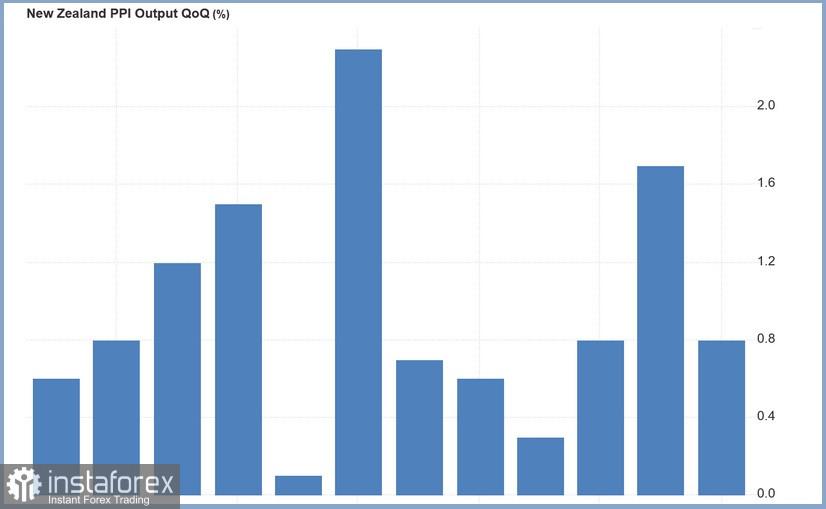
They indicate weakening inflationary pressure at the producer level, which may give the Reserve Bank of New Zealand (RBNZ) additional room to keep monetary policy accommodative.
The central bank's unexpected shift to more dovish rhetoric in October has already put significant pressure on the national currency, as market participants revise their expectations for New Zealand's interest rate path. At the same time, an RBNZ survey in Q4 showed a slight rise in two?year inflation expectations to 2.36% from 2.34% in the previous quarter. The one-year-ahead forecast stands at 2.92%, indicating persistent inflation concerns. This creates a difficult dilemma for policymakers: economic activity remains sluggish while inflation expectations constrain the scope for aggressive easing. Additional concern comes from New Zealand's unemployment rate reaching 5.7%, signaling continued weakness in the labor market.
Political uncertainty could further complicate the situation. According to preliminary results of the November 7 general election, the ruling coalition led by the National Party won a razor-thin majority of just one seat; official results will be announced on November 27. If a Labour-led government takes office, the RBNZ's mandate could be expanded again to include a duty to ensure full employment. The market could interpret that as a signal for continued accommodative policy, given the current unemployment situation.
Beyond domestic problems, NZD/USD dynamics are influenced by developments in the United States. The Federal Reserve is taking a more hawkish stance, especially after US inflation data beat expectations, prompting investors to prepare for further tightening.
St. Louis Fed President Alberto Musalem recently emphasized persistent inflation risks and indicated that further rate hikes may be needed in the coming months. Cleveland Fed President Beth Hammack also favors gradual tightening and allows for more decisive action if inflation worsens.
According to the CME FedWatch tool, markets have fully priced a 25-bp rate hike in December, and expectations for further increases in January and March are rising.
For the New Zealand dollar, this combination of factors is particularly unfavorable. Higher US interest rates increase the relative attractiveness of dollar assets, while a softer RBNZ stance reduces the local currency's appeal.
From a technical perspective, the pair has entered the 0.5525–0.5470 range of the 2020, 2022, and 2025 lows. This zone has repeatedly served as an important support area. Therefore, a decisive break below 0.5470 would signal a material deterioration in the long-term outlook, potentially opening the way for the New Zealand dollar to fall to levels not seen in nearly 18 years. Conversely, a successful hold of this zone could act as a catalyst for a recovery, although the overall fundamental picture remains challenging. Oscillators are negative, and bears have the advantage.