 English

 Русский
 Bahasa Indonesia
 Bahasa Malay
 ไทย
 Español
 Deutsch
 Български
 Français
 Tiếng Việt
 中文
 বাংলা
 हिन्दी
 Čeština
 Українська
 Română



Analysis of trades and trading tips for the Japanese yen
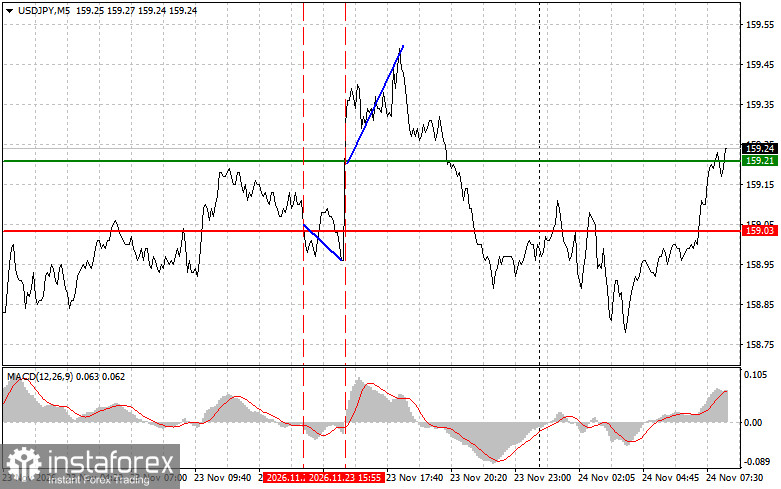
The 159.31 price test occurred as the MACD indicator began moving up from the zero line, confirming a valid entry point to buy the dollar. As a result, the pair rose by 25 pips.
Today yen pressure returned after preliminary Japanese business-activity data for November were mixed. The manufacturing PMI — reflecting purchasing managers' sentiment in industry — rose to 53.7 versus a 53.5 forecast and 53.3 the previous month. Since 50 marks expansion vs. contraction, Japan's industry continues to expand confidently. In the services sector, the picture is more modest: the services PMI fell to 50.5 from 51.7 and sits near the border between growth and stagnation, while the composite PMI, combining both sectors, slid to 51.5 from 52.1.
However, the main driver for the yen remains the dollar. U.S. data released yesterday came in slightly below expectations but remained elevated. The U.S. services PMI printed 54.7 versus a 55.6 forecast and 56.1 prior; manufacturing was 54.5 in line with estimates (54.9 previously); and the composite fell to 54.6 from 55.9. For the U.S. economy, this is still solid growth that outpaces Japan's. Additional support for the dollar came from remarks by FOMC member John Williams, who did not rule out raising rates at several consecutive meetings. The longer the market believes a hawkish Federal Reserve path, the more attractive dollar yields are relative to yen instruments.
The yen does have its own support, though. Markets still price a high probability — roughly 86% — of a Bank of Japan rate hike, and core inflation in Japan stands at about 2.2%, leaving the central bank room to continue normalization. In my view, while those expectations persist, the yen can hold up and avoid a sharp collapse, but sustained strengthening would require a weaker dollar—and at present Williams's hawkish tone and strong U.S. data stand in the way of that scenario.
For intraday strategy, I will mainly rely on Scenarios No. 1 and No. 2.
Buy Scenarios
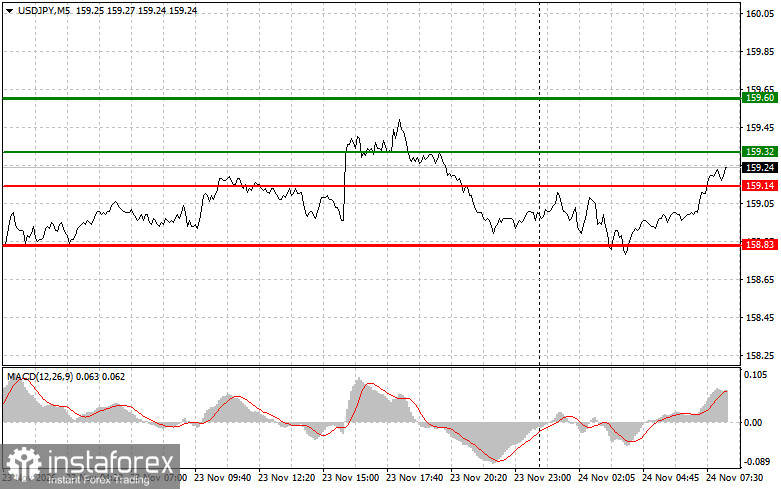
Scenario No. 1: Today I plan to buy USD/JPY when the entry point reaches around 159.32 (the green line on the chart), targeting 159.60 (the thicker green line on the chart). Around 159.60, I plan to exit long positions and open short positions in the opposite direction (expecting a 30–35 pip move back from that level). It's best to return to buying the pair on corrections and significant pullbacks. Important: before buying, make sure the MACD indicator is above zero and is just beginning to rise.
Buy Scenario No. 2: I also plan to buy USD/JPY today in case of two consecutive tests of 159.14 when the MACD indicator is in the oversold area. This will limit the pair's downside potential and lead to an upward reversal. You can expect a rise to the opposite levels 159.32 and 159.60.
Sell Scenarios
Scenario No. 1: Today I plan to sell USD/JPY only after the 159.14 level is breached (the red line on the chart), which will lead to a rapid decline in the pair. The sellers' key target will be 158.83, where I intend to exit shorts and immediately open longs in the opposite direction (expecting a 20–25 pip move back from that level). Sellers can return at any moment; only the slightest hint from the central bank is needed. Important: before selling, make sure the MACD indicator is below zero and is just beginning to fall.
Sell Scenario No. 2: I also plan to sell USD/JPY today in case of two consecutive tests of 159.32 when the MACD indicator is in the overbought area. This will limit the pair's upside potential and lead to a downward reversal. You can expect a decline to the opposite levels of 159.14 and 158.83.
What's on the Chart:
Thin green line – the entry price at which you can buy the trading instrument;
Thick green line – the suggested price where you can place a Take Profit or manually lock in gains, since further upside above this level is unlikely;
Thin red line – the entry price at which you can sell the trading instrument;
Thick red line – the suggested price where you can place a Take Profit or manually lock in gains, since further downside below this level is unlikely;
MACD indicator. When entering the market, it is important to follow the overbought and oversold zones.
Important. Beginner Forex traders must be very cautious when making entry decisions. Before the release of important fundamental reports, it is best to stay out of the market to avoid getting caught in sharp price swings. If you decide to trade during news releases, always place stop orders to minimize losses. Without stop orders, you can quickly lose your entire deposit, especially if you don't use money management and trade large volumes.
Remember, successful trading requires a clear trading plan, like the example I presented above. Spontaneous trading decisions based on the current market situation are a losing strategy for an intraday trader from the start.