 English

 Русский
 Bahasa Indonesia
 Bahasa Malay
 ไทย
 Español
 Deutsch
 Български
 Français
 Tiếng Việt
 中文
 বাংলা
 हिन्दी
 Čeština
 Українська
 Română



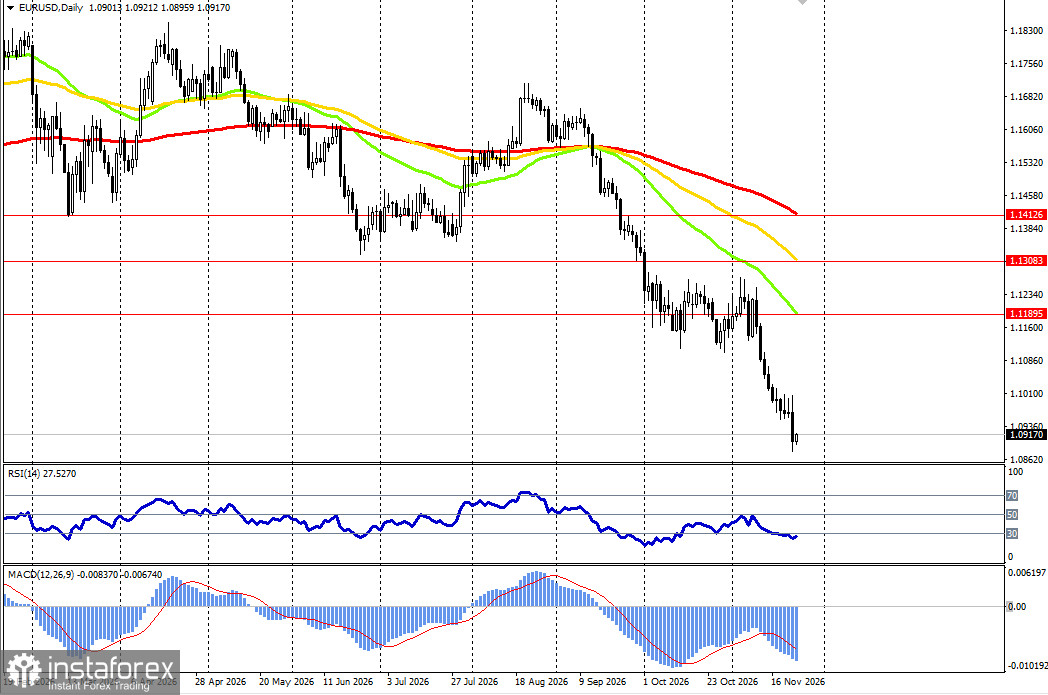
The euro/dollar pair trades around 1.0917 on November 24, 2026, after a prolonged autumn decline and a recent bounce from a local low near 1.0875–1.0880.
The pair's direction is driven by the balance of monetary policy between the U.S. Federal Reserve and the European Central Bank, inflation dynamics on both sides of the Atlantic, debt burdens, and demand for safe-haven assets.
Macroeconomic data: rates, inflation, and central bank expectations
In the eurozone, annual consumer inflation in October 2026 remained at a moderate clip around 2.0% (reflecting subdued domestic demand and heterogeneous dynamics across member states), while the ECB's key rate is held at 2.00%. ECB President Christine Lagarde has noted that the eurozone economy is holding up more resiliently than previously assessed, but further policy steps will depend on incoming inflation and wage data.
In the U.S., inflation and the labor market remain the Federal Reserve's focus amid elevated U.S. Treasury yields (around 5.1% for 10-year notes) and cooling in some economic segments, including housing. Fed Chair Kevin Warsh emphasized the economy's resilience while urging caution on further tightening ahead of the December meeting, even as market pricing continues to embed a hawkish tone and a high bar for easing in the near term.
Fiscal risks
Budget positions and public debt burdens remain an important structural factor for global capital markets and exchange rates. The U.S. debt-to-GDP ratio remains very high (about 124% of GDP for 2026), while within the eurozone debt metrics vary markedly—from relatively moderate levels in Germany to elevated burdens in France (around 119% of GDP) and Italy. During periods of market volatility and repricing of sovereign risk, investors react sharply to moves in government yields and to capital reallocation across asset classes.
Rate differential
Yield differentials and interest rate expectations in the U.S. continue to support the dollar against the euro, given the eurozone's more subdued inflation profile and the ECB deposit rate at 2.00%. That said, market participants note that the sharp fall of EUR/USD toward 1.0900 has already priced in a substantial portion of the U.S. hawkishness, so reactions to new macro releases may become more two-sided.
What could change the picture?
The euro/dollar outlook could be altered by fresh inflation and PMI releases in the eurozone and the U.S., speeches by ECB and Fed officials, and moves in U.S. Treasury yields, as well as geopolitical developments and swings in safe-haven demand.
Conclusion
As of November 24, 2026, the euro/dollar pair near 1.0917 remains under pressure from the macro backdrop and U.S. rate expectations after a deep fall from the year's highs. At the same time, proximity to local lows around 1.0875 and oversold conditions on higher timeframes make the market sensitive to corrective bounces ahead of new data and central bank decisions.
This material is informational and analytical and does not constitute individual investment advice.