 English

 Русский
 Bahasa Indonesia
 Bahasa Malay
 ไทย
 Español
 Deutsch
 Български
 Français
 Tiếng Việt
 中文
 বাংলা
 हिन्दी
 Čeština
 Українська
 Română



On Tuesday, the USD/CAD pair fell, erasing six days of gains. The decline in the U.S. dollar, combined with hawkish comments by Bank of Canada Governor Tiff Macklem, appears to have supported the Canadian dollar. At the time of this note, the pair had nearly reached the 1.4250 level.
Speaking to the Canadian Club in Toronto, Macklem emphasized: "If inflation remains unacceptably high for an extended period, we will have to consider further interest-rate increases." He also noted the Canadian economy's unusual resilience under current conditions and expressed concern that the corporate sector will likely pass higher costs on to consumers. "This secondary effect from the oil shock could become a factor that helps keep inflation elevated," he added.
The governor's verbal interventions have once again lifted market odds of a December rate hike by the Bank of Canada. Earlier this month, those prospects were revised lower after inflation prints came in below expectations. For example, Canada's headline CPI came in at 3.1% year-on-year in October versus a consensus of 3.2%. Among the key inflation measures the Bank tracks, the trimmed-mean CPI fell from 1.9% to 1.8%, while the median CPI held at 2.0%.
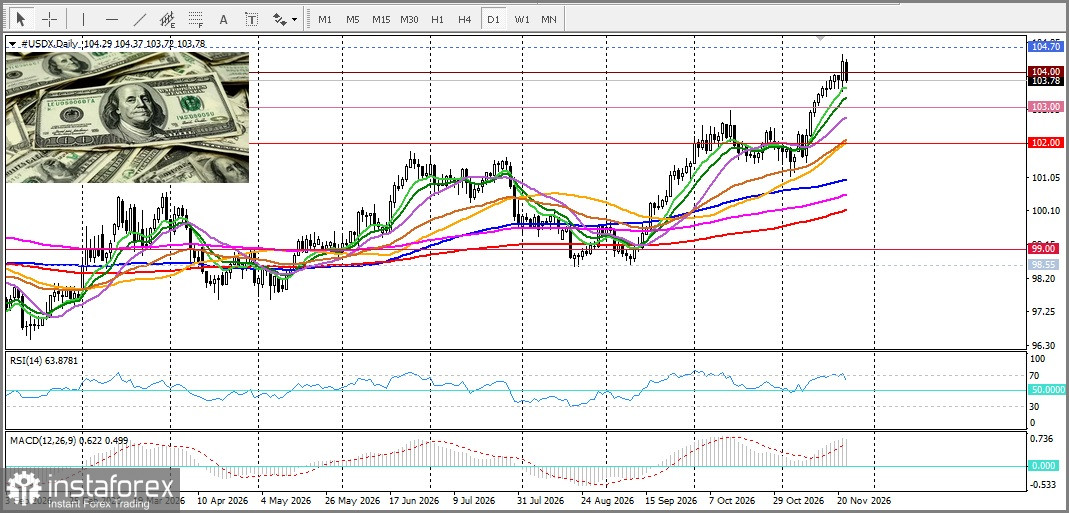
In the U.S. market, the dollar index is under pressure. Recent stock-market volatility boosted demand for U.S. Treasuries, which pushed yields down. The 10-year Treasury yield slid to about 4.88%, the lowest level since November 10. The U.S. dollar index (DXY) trades near 103.78 after reaching a 20-month high of 104.55 on Monday.
The US equity market came under pressure again after The Wall Street Journal reported that the Trump administration is preparing additional tariffs on China and other trading partners. That sell-off followed a recovery rally on Monday, sparked by news that Jensen Huang was returning as CEO of Nvidia.
Despite the pullback, the Federal Reserve's hawkish stance is likely to limit further dollar weakness. Market participants expect a more aggressive tightening path from the Fed, because officials have repeatedly said further rate increases may be needed to bring inflation back to target.
According to CME FedWatch, traders put the probability of a 25-bp hike at the December meeting at about 97%, with a roughly 68% chance of another 25-bp move in January. Expectations for further hikes into 2027 remain priced in.
For better trading opportunities, focus on Wednesday's release of October's PCE inflation figures — the Fed's preferred inflation gauge.
Technically, the pair found support just above the 14-day EMA on the pullback. Oscillators are positive, confirming a bulls' edge. The RSI is above overbought territory, suggesting bulls retain strength. A declining MACD histogram indicates the downward impulse is losing momentum. Bears will only be encouraged if price falls below the 20-day SMA.
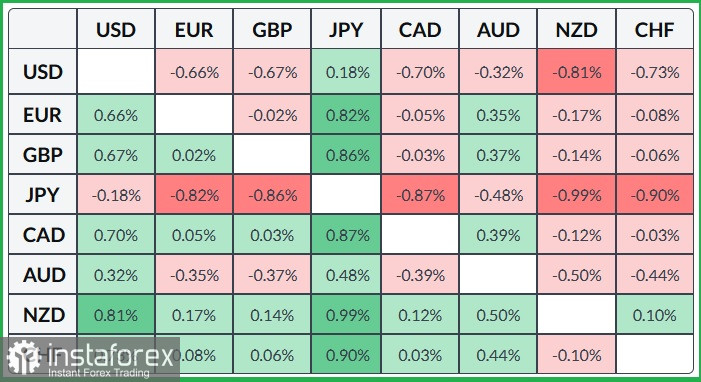
The table below shows dollar percentage moves versus major currencies so far; the largest gain has been against the Japanese yen.