 English

 Русский
 Bahasa Indonesia
 Bahasa Malay
 ไทย
 Español
 Deutsch
 Български
 Français
 Tiếng Việt
 中文
 বাংলা
 हिन्दी
 Čeština
 Українська
 Română



The euro began the week with a sharp drop, but it got a chance to catch its breath yesterday. On Monday evening, the pair fell to about 1.0882, then by yesterday evening it had risen to around 1.0981 — a roughly 100-pip recovery. Overnight it gave back about 40 pips and now trades near 1.0942.
Germany provided the main support. The Ifo index is based on a survey of German company leaders about current business conditions and expectations, and Germany's economy heavily influences the regional picture. The business-climate index came in at 90.6 (forecast 90.5, prior 90.1); the current-conditions reading rose to 89.4 (forecast 89.2, prior 88.8). Expectations missed the forecast marginally at 91.9 (forecast 92.0) but remain above October's 91.5. That's constructive and complements yesterday's PMI prints.
On paper it was a good day for the dollar, but it lacked follow-through. Conference Board consumer confidence jumped to 103.3 from 91.9 (forecast 92.4) — the best reading since January 2025. For context, the index was 84.2 in September, so it has climbed nearly 19 points in two months. Labor-market sentiment and expectations improved across several measures. At the same time, Case-Shiller home prices fell 0.5% m/m in September, mortgage rates hover near 7.2%, and ADP employment growth slowed slightly. Dollar buyers didn't push the move much further because markets are awaiting more important data that could influence Federal Reserve rhetoric.
Still, in the first half of the day, the euro faces a key test: Germany's preliminary Q3 GDP. That reading measures growth in the region's largest economy and directly affects euro-area outlooks. The consensus is for 0.2% q/q after 0.3% previously, and 1.2% y/y versus 1.0% prior. The market is looking for confirmation of the initial estimate, so a downward revision would hit the euro. The first estimate on October 30 showed 0.2% q/q (forecast 0.1%), though on October 21 the Bundesbank warned growth could be zero due to low Rhine water levels.
European Central Bank expectations also support the euro: euro-area inflation rose to 4.0% y/y in October from 3.8% in September, and markets expect the ECB to raise the deposit rate from 2.50% to 2.75% on December 17. But the main risk remains the dollar—all eyes will be on the U.S. PCE inflation report this afternoon. We'll cover that in the U.S. session preview.
Momentum
Now EURUSD stands at 1.0942, inside a range between 1.0923 and 1.0963 — about 19 pips above the lower boundary and 21 pips below the upper. A breakout is only valid after confirmation, meaning several consecutive five-minute candles must close beyond the level; a single poke proves nothing.
On the upside, 1.0963 is active. A confirmed close above it opens the way to 1.1004 and then to 1.1040. Overnight, price reached roughly 1.0967—about four pips above the level—but could not hold and fell back; that unconfirmed poke signals buyer weakness. Yesterday's high near 1.0981 remains above, but price did not stay there either. The first upside target, 1.1004, sits at Monday's high around 1.1006, where sellers are likely. That target is about 62 pips from the current price, and the second is roughly 98 pips away, so I have low conviction in such a surge.
On the downside, the reference is 1.0923; a confirmed close below it leads to 1.0884 and then to 1.0848. I treat this direction as primary, since overnight declines were decisive and the only bounce faded near 1.0967. The level is near yesterday's overnight ceiling around 1.0921, which first capped price and was then breached. It should now act as support, and a return below it would mean yesterday's rally has exhausted itself. The first downside target, 1.0884, is near Monday's low around 1.0882, where buyers previously appeared. It is about 19 pips to the level and another 36 pips between targets. I would not enter on the first touch.
Mean Reversion
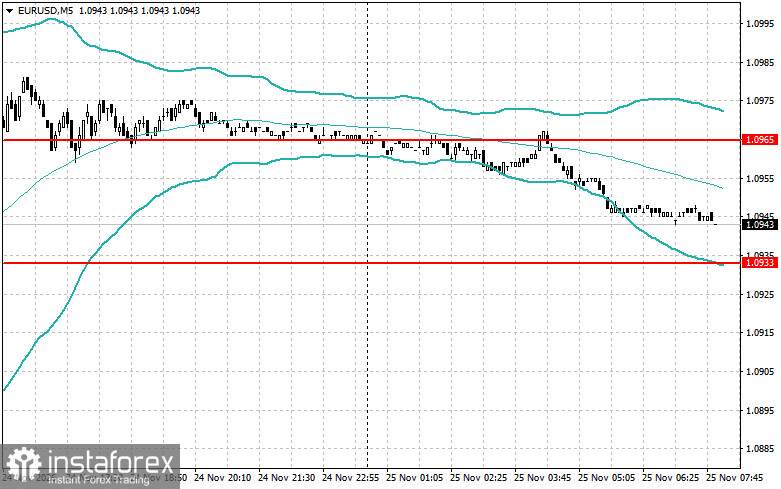
There are two levels here: 1.0965 and 1.0933. The upper reference, 1.0965, sits two pips above the upside breakout point 1.0963 and about 23 pips above current price, so the breakout and mean-reversion scenarios begin in the same zone and cannot be distinguished on the first touch. If price consolidates above 1.0963, the breakout is in play and selling is inappropriate. If price reaches 1.0965, fails to continue, and quickly returns lower — as happened overnight — I would consider selling toward 1.0933 with a stop above 1.0971, i.e., above the overnight high with a small margin. That picture is likely if Germany's GDP prints at consensus and the market retraces after the initial reaction. The difference between the scenarios can take a few minutes to resolve, so it's better to skip the first reaction in the zone.
The lower reference, 1.0933, sits ten pips above the downside breakout point 1.0923 and nine pips below current price, so it will be engaged before the confirmed break lower. Price was around this mark at the start of yesterday's move up. The scheme is: price falls to 1.0933, cannot hold below and returns higher — then I look to buy toward 1.0965 with a stop below 1.0917, i.e., beneath the breakout point with a margin. A buffer is essential because price often slips a few pips beyond levels. A rebound is likely if PCE does not alarm the market with hawkishness. If price consolidates convincingly below 1.0923, the rebound is canceled, and the downward breakout to 1.0884 is in play.