 English

 Русский
 Bahasa Indonesia
 Bahasa Malay
 ไทย
 Español
 Deutsch
 Български
 Français
 Tiếng Việt
 中文
 বাংলা
 हिन्दी
 Čeština
 Українська
 Română



Trade analysis and tips for trading the Japanese yen
The price test at 159.40 occurred as the MACD indicator began moving down from the zero line, confirming a good entry point to sell the dollar. As a result, the pair fell to around 159.01.
The yen is firmly resisting dollar pressure today, although yesterday's U.S. data gave the dollar every reason to strengthen. The Conference Board consumer confidence index was 103.3 versus a forecast of 92.4 and 91.9 in October, and the five-year note auction went through at 4.719% versus 4.708% in the previous session. Weekly ADP employment change was 21,000 versus 23,800, and September house prices fell 0.5% month-on-month, yet dollar buyers could not build on their success.
Japanese data supported the yen. The corporate services price index, which shows how prices are rising in the business services sector and is closely linked to wages, rose to 4.2% in October versus forecasts of 3.6% and 3.8% the previous month. Such a jump indicates that inflationary pressure in the country remains persistent. The Bank of Japan's core consumer price index was 2.3% versus expectations of 2.5% and 2.4% in September, so it was weaker, but service prices softened the blow, and the market did not revise rate expectations. Swaps still price in about an 86% probability of a Bank of Japan rate hike from 1.25% at the December 18 meeting.
In my assessment, while policy tightening expectations remain, the yen will actively resist dollar strengthening. For a noticeable upward move in USD/JPY, U.S. data will need to deliver even stronger confirmations, for example, later in the day on PCE inflation.
For the intraday strategy, I will rely more on scenarios No. 1 and No. 2.
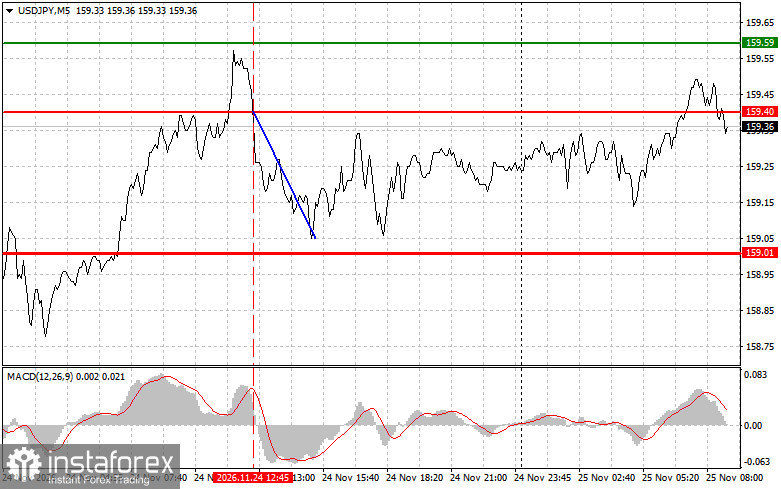
Scenarios for Buying
Scenario No. 1: I plan to buy USD/JPY today when the entry point reaches around 159.50 (the green line on the chart) with a target rise to 159.83 (the thicker green line on the chart). Around 159.83, I intend to exit long positions and open short positions in the opposite direction (expecting a 30–35 pip move back from that level). It is best to return to buying the pair on corrections and significant drawdowns in USD/JPY. Important! Before buying, make sure the MACD indicator is above the zero line and is just beginning to rise from it.
Scenario No. 2: I also plan to buy USD/JPY today in the event of two consecutive tests of 159.31 when the MACD indicator is in the oversold area. This will limit the pair's downside potential and lead to an upward reversal. You can expect a rise to the opposite levels 159.50 and 159.83.
Scenarios for Selling
Scenario No. 1: I plan to sell USD/JPY today only after the 159.31 level is retested (the red line on the chart), which should lead to a rapid decline in the pair. The sellers' key target will be 159.01, where I intend to exit shorts and immediately open longs in the opposite direction (expecting a 20–25 pip move back from that level). Sellers can return at any moment; only a hint from the central bank is needed. Important! Before selling, make sure the MACD indicator is below the zero line and is just beginning to fall from it.
Scenario No. 2: I also plan to sell USD/JPY today in the event of two consecutive tests of 159.50 when the MACD indicator is in the overbought area. This will limit the pair's upside potential and lead to a downward reversal. You can expect a decline to the opposite levels of 159.31 and 159.01.
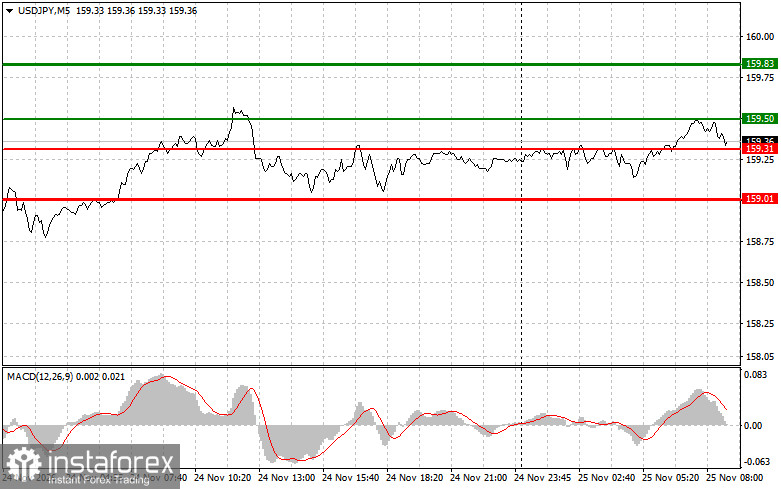
What's on the Chart:
Thin green line – the entry price at which you can buy the trading instrument;
Thick green line – the suggested price where you can place a Take Profit or manually lock in gains, since further upside above this level is unlikely;
Thin red line – the entry price at which you can sell the trading instrument;
Thick red line – the suggested price where you can place a Take Profit or manually lock in gains, since further downside below this level is unlikely;
MACD indicator. When entering the market, it is important to follow the overbought and oversold zones.
Important. Beginner Forex traders must be very cautious when making entry decisions. Before the release of important fundamental reports, it is best to stay out of the market to avoid getting caught in sharp price swings. If you decide to trade during news releases, always place stop orders to minimize losses. Without stop orders, you can quickly lose your entire deposit, especially if you don't use money management and trade large volumes.
Remember, successful trading requires a clear trading plan, like the example I presented above. Spontaneous trading decisions based on the current market situation are a losing strategy for an intraday trader from the start.