 English

 Русский
 Bahasa Indonesia
 Bahasa Malay
 ไทย
 Español
 Deutsch
 Български
 Français
 Tiếng Việt
 中文
 বাংলা
 हिन्दी
 Čeština
 Українська
 Română



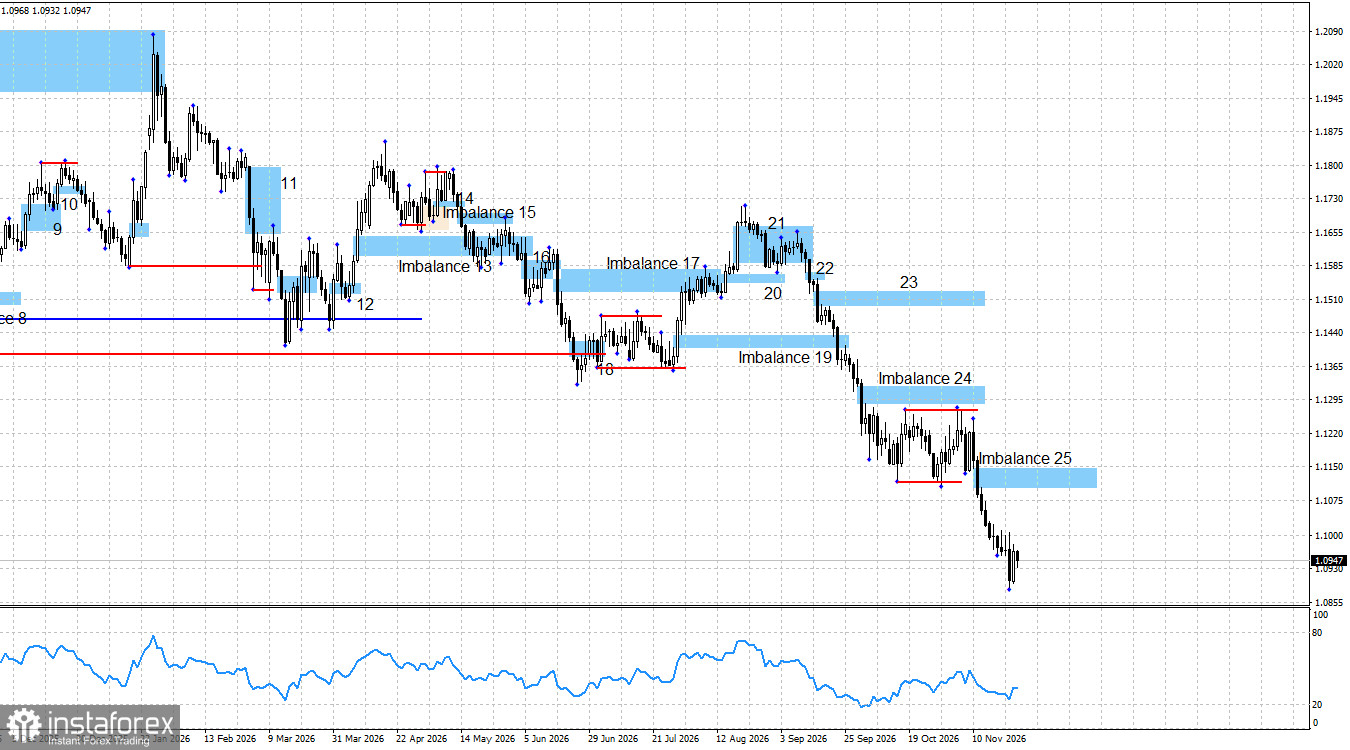
EUR/USD declined for ten consecutive days, marking only the latest advance by sellers. Since the end of August, the euro has depreciated by a total of 800 pips and currently shows no signs of halting its decline. The latest downward move began following a series of positive US economic reports. A strong US labor market, low unemployment, and elevated inflation brought sellers back into the market after they had remained on the sidelines for an entire month. However, time is passing, the euro continues to decline, and the US dollar continues to strengthen, raising the question of how much longer this trend can persist. The US currency's advantage in recent months is beyond doubt, and there are clear reasons for its strength. Nevertheless, have sellers become too aggressive?
Inflation is undoubtedly continuing to rise in the United States, as confirmed by the PCE report. However, inflation is also rising in the European Union. The ECB is not standing idle and is also consistently raising interest rates. Capital flows into US technology companies involved in artificial intelligence are another significant factor. However, the European Union also has a stock market, while the US dollar continued to appreciate even on days when US stock indices declined. The market has reached a paradoxical situation: the dollar's appreciation can be explained quite easily, but its strength and consistency are becoming increasingly disproportionate to the underlying economic conditions.
Over the past three months, the fundamental news background has frequently favored the European currency, yet this has had virtually no impact on its exchange rate. The Republican Party suffered a significant defeat in the elections, and Congress is now divided, with Democrats and Republicans finding it extremely difficult to reach agreements. The renewed rise in inflation in the European Union points toward further ECB policy tightening, just as rising inflation in the United States suggests further Fed tightening. ECB officials are also emphasizing the need for additional rate hikes, just as their Fed counterparts are doing. If the market is pricing in tighter FOMC monetary policy, it should also be pricing in further ECB tightening. However, in recent months, these cause-and-effect relationships have not been reflected in EUR/USD price movements.
It is worth recalling that one of the main reasons behind the dollar's appreciation over the past three months has been the Fed's hawkish stance. However, in practice, its stance is not particularly hawkish compared with those of other central banks. For example, the ECB is set to implement its third rate hike in December, while the Bank of England could deliver as many as four full rounds of rate increases. The British pound has at least partially responded to these factors, whereas the euro has not.
At present, there are no signs that the bearish advance is coming to an end. Imbalance 24 remains valid, and the price has yet to react to it, as even a corrective pullback in the euro has become a rare occurrence. The liquidity sweep above 1.1270, together with strong US labor market and inflation data, triggered another wave of selling. Another bearish imbalance (Imbalance 25) has now formed. However, the euro must first reach this imbalance before new sell signals can be considered. Buyers are left hoping for a favorable turn of events and a voluntary retreat by sellers.
Overall, the fundamental news background continues to favor buyers. The factors that sellers have been actively pricing in over the past three months do not appear sufficiently strong to justify the extent of the euro's decline. Meanwhile, the European currency has received virtually no positive news during this period. Several important US economic reports were released today, but market reaction suggests that traders were largely unimpressed. The PCE index rose to 3.8% year over year, but this was precisely the figure expected by market participants. US GDP grew by 4.3% in the third quarter, but this was the second estimate rather than the final reading. Orders for durable goods increased by 0.2%, although this is far from the most important indicator at present. Traders' reaction to the US economic data was virtually nonexistent.
Economic Calendar for the United States and the European Union:
- Germany – Consumer Confidence Index (07:00 UTC).
On November 26, the economic calendar contains just one release, which is unlikely to attract traders' attention. The economic backdrop is expected to have no significant impact on market sentiment on Thursday.
EUR/USD Forecast and Trading Recommendations:
The pair remains in the process of forming a bullish trend that has entered a corrective pause lasting an entire year. The fundamental news background shifted sharply in favor of sellers nine months ago, but the broader trend, which has been in place for four years, cannot yet be considered invalidated or complete. Buyers could resume their advance before the end of the year, but they currently lack any real opportunities to do so. There are no bullish patterns, no liquidity sweeps, and no other supporting signals.
As for sellers, they have a new bearish imbalance (Imbalance 25). A reaction to this imbalance could provide an opportunity to open new short positions targeting 1.0733. At present, however, sellers see no reason to take a pause.