 English

 Русский
 Bahasa Indonesia
 Bahasa Malay
 ไทย
 Español
 Deutsch
 Български
 Français
 Tiếng Việt
 中文
 বাংলা
 हिन्दी
 Čeština
 Українська
 Română



On Wednesday, USD/CAD continued to fall, retreating from a 19-month high. Pressure on the pair persists despite the US dollar's resilience: the Bank of Canada's "hawkish" rhetoric helps the Canadian dollar appear stronger than most other major currencies. At the time of writing, the USD/CAD pair was dipping below the round level of 1.4200.
Attention should be paid to the remarks by Bank of Canada governor Tiff Macklem, in which he outlined a "hawkish" approach. Macklem named the CPI-trim and CPIX (CPI excluding volatile components) as preferred measures of core inflation, but emphasized that "core inflation around 2% by itself does not determine monetary policy decisions." He noted that the 2% target applies to the overall consumer price index (CPI). Core measures help forecast overall CPI dynamics but are not an independent target. And since the overall CPI "has been around 3% since last April," and, according to the bank's forecast, "will reach 3.4% by year-end," it is quite logical that a 25 bp rate hike to 2.75% at the December 9 Bank of Canada meeting remains highly likely.
In the US, according to the CME FedWatch tool, markets already fully price in a 25 bp rate hike by the Federal Reserve in December. Data published on Wednesday strengthen the case for further monetary tightening: policymakers are striving to bring inflation back to the 2% target.
In October, the Core PCE index rose 3.3% year-on-year. This is higher than September's 3.1% and the 3.2% forecast. Month-on-month, the indicator increased by 0.3%, as expected. Meanwhile, the preliminary estimate showed that US GDP grew at an annualized 4.3% in Q3, exceeding the 3.4% forecast.
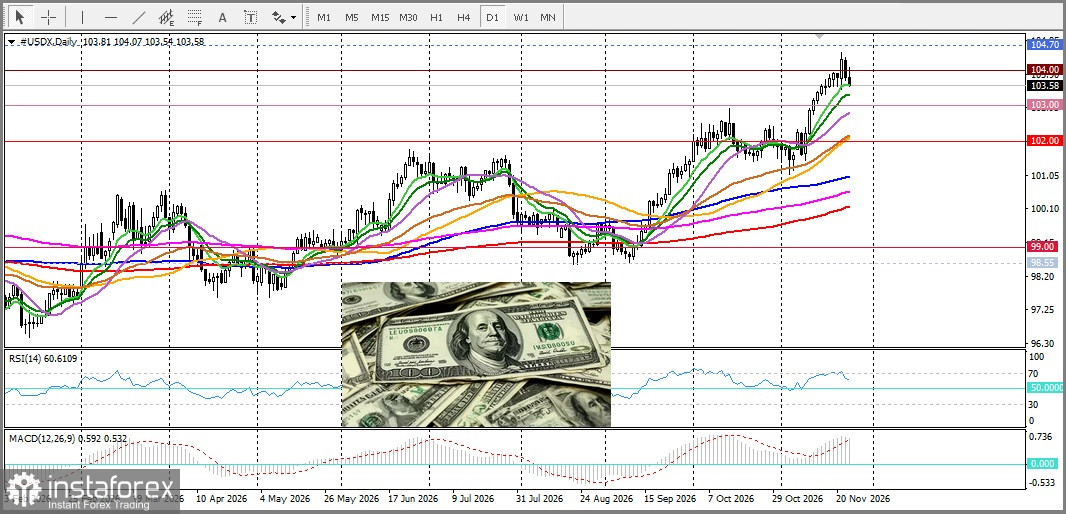
Expectations that US interest rates will remain high continue to support the dollar and may limit further declines in USD/CAD. The US Dollar Index (DXY) holds around 103.58.
Nevertheless, on Wednesday the dollar fails to continue strengthening. Amid a stock sell-off, especially in the technology sector where the Nasdaq fell about 4%, investors are flocking to U.S. government bonds. Treasury yields are falling across the curve: the benchmark 10-year yield dropped to 4.84% — the lowest level since November 9. The decline also narrows the gap with Canadian bond yields and adds another factor supporting the Canadian dollar. The 10-year Canadian government bond yield is around 3.62%.
From a technical standpoint, the pair is very close to the 20-day SMA; if it fails to hold that, the 50-day SMA may slow the decline somewhat. The next support will be the round level of 1.4100 and the 100-day SMA. If the pair still holds the 1.4200 level, bulls still have a chance to restore positive sentiment. Oscillators have approached zero and remain neutral.
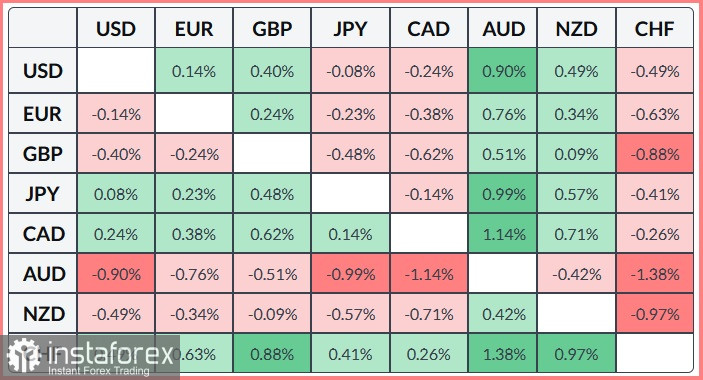
The table below shows Wednesday's percentage change in the Canadian dollar against major currencies. The most notable gain for the Canadian dollar was against the Australian dollar.