 English

 Русский
 Bahasa Indonesia
 Bahasa Malay
 ไทย
 Español
 Deutsch
 Български
 Français
 Tiếng Việt
 中文
 বাংলা
 हिन्दी
 Čeština
 Українська
 Română



The pound greets Thursday at 1.3100 and is once again following the dollar. Yesterday midday, the pair held around 1.3061, rose to 1.3128 in the evening, and overnight returned almost to the round number. With no UK data yesterday, the US decided everything.
Yesterday's US releases were dense and mostly stronger. Q3 US GDP was revised to 4.3% annualized, up from an initial 3.4% and 2.2% in Q2. Investment and consumption added 0.9 percentage points to the prior estimate. Private domestic demand rose 5.8%. The deflator, the price index inside GDP that shows how quickly everything the economy produces is getting more expensive, was the only soft spot — it was 1.8% versus a 2.2% forecast (6.1% in Q2).
Inflation for October came in tougher. This is about PCE — the price index for American purchases that the Federal Reserve watches. Headline PCE rose to 3.8% from 3.7% month-on-month. Core PCE (ex food and energy), which shows whether price increases are spreading across the economy, was 3.3% versus a 3.2% forecast and 3.1% in September. Personal incomes rose 0.7% month-on-month, while personal spending rose only 0.3% versus a 0.4% forecast (0.6% in September), and real spending, adjusted for prices, even fell slightly. The savings rate is 4.1%.
The labor market looks stronger than expected. Initial jobless claims were 189,000 versus a 201,000 forecast and 202,000 a week earlier; continued claims were 1,697,000 versus 1,792,000. New-home sales jumped 14.2% to 701,000 (forecast 650,000; prior 614,000). Building permits were 1.297 million versus a 1.295 million forecast (1.398 million a month earlier). The weakest release was durable goods orders, just +0.2% versus a +0.7% forecast (previous +2.0%).
Today US markets are closed for Thanksgiving and trading is thin, meaning fewer trades and sharper moves. The main catalyst for the pound will be the Bank of England. It will publish its Financial Stability Report, along with the summary and minutes of the Financial Policy Committee. That committee monitors the health of banks and the credit market; the Monetary Policy Committee decides rates, so there are few direct rate hints in these documents. Traders will nevertheless look for indications that high inflation and heavy household burdens require further action.
To recall the mood, remember the November 5 meeting. The Bank raised the rate from 3.75% to 4.00% as expected, but the vote was tougher than analysts had expected. Analysts expected seven votes for a hike and two against; instead, all nine members voted for the step — unity not seen in over three years. In September six members favored a pause, and in July only Pill, Greene and Mann wanted tightening. Governor Andrew Bailey said then that a second hike was more likely than not if energy prices returned to pre-dip levels. The pound did not rally; from around 1.3489 on the morning of November 5 it fell to 1.3385 the next day.
Since then, data have added to the case for a hawkish line. UK inflation accelerated to 3.6% in October from 3.5%; retail sales rose 0.7% after a 0.6% drop; and wage growth slowed to 3.5% from 3.7% but remained above roughly 3.25%, which the Bank considers compatible with the target. Household energy bills are still to come and are expected to rise about 25% in January. The market still sees a December hike as about 50/50. In my view, if the documents show the committee is not going to stop, the pound will have reason to rise even in thin trading; with a neutral tone, the reaction will be weak.
Momentum
GBPUSD trades at 1.3100, in the lower part of the range between 1.3092 and 1.3140, and only about 8 pips separate the price from the lower boundary. While the price remains inside the range, there is no signal. A signal appears when several five-minute candles in a row close beyond the boundary — a simple touch is not enough, because a probe without settlement often ends in a return.
The upper level is 1.3140. Settlement above it opens the way to 1.3173 and then to 1.3209. Yesterday evening the pair stopped around 1.3128, about 12 pips short of the level, and overnight it did not return to that mark. A push higher needs a catalyst, and the BoE minutes could provide it if they show readiness to continue hikes. Then the scenario is quite realistic; without hawkish wording, I would not count on it.
The lower level 1.3092 is almost right under the price. Settlement below it leads to 1.3047 and 1.3013, and the first target is about 45 pips away. The overnight low around 1.3096 fell just short of this mark. The first target lies near yesterday's low around 1.3044, where buyers already appeared, so a pause can be expected there. By distance, this is the nearest scenario, but in terms of background it depends on a neutral reaction to the minutes, when the pound lacks support. I would not enter on the first touch.
Mean Reversion
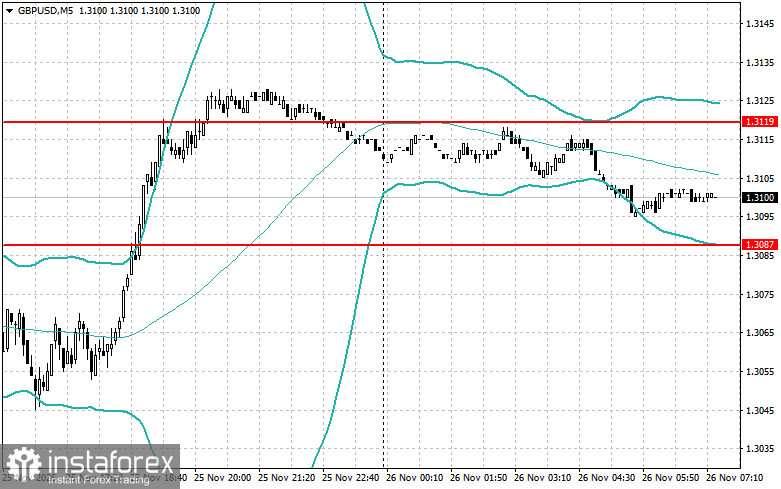
There are two anchors here, 1.3119 and 1.3087. The upper one sits 19 pips above the price and 21 pips below the buy breakout point at 1.3140, so there is a large gap between them. Overnight, the price twice hit the area near 1.3117 and reversed, so that ceiling has already worked. The scheme is as follows. The price moves above 1.3119, fails to continue, and returns below — then I consider selling toward 1.3087, placing the stop above the buy breakout point with a small margin at 1.3146. If price reaches 1.3140 and settles above, selling is no longer allowed—that is a breakout. This scenario makes sense if the BoE minutes don't add hawkishness and the market retraces after the initial surge.
The lower anchor at 1.3087 sits 5 pips below the sell breakout point at 1.3092, and a novice needs to be especially cautious here. The same zone serves as both a downside breakout and a possible return point, and one touch does not distinguish them. If the price moves below 1.3092, reaches 1.3087, and confidently settles below, that is a breakout and buying is not allowed. If it pokes below 1.3087 and quickly returns above 1.3092, the return is in play, and I look to buy toward 1.3119, placing the stop below at 1.3081. A bounce is likely because trading is thin due to the US holiday, and an unconfirmed probe down can easily be a one-off. The difference between the scenarios takes only a few minutes, so it is wiser to skip the first reaction in the zone.