 English

 Русский
 Bahasa Indonesia
 Bahasa Malay
 ไทย
 Español
 Deutsch
 Български
 Français
 Tiếng Việt
 中文
 বাংলা
 हिन्दी
 Čeština
 Українська
 Română



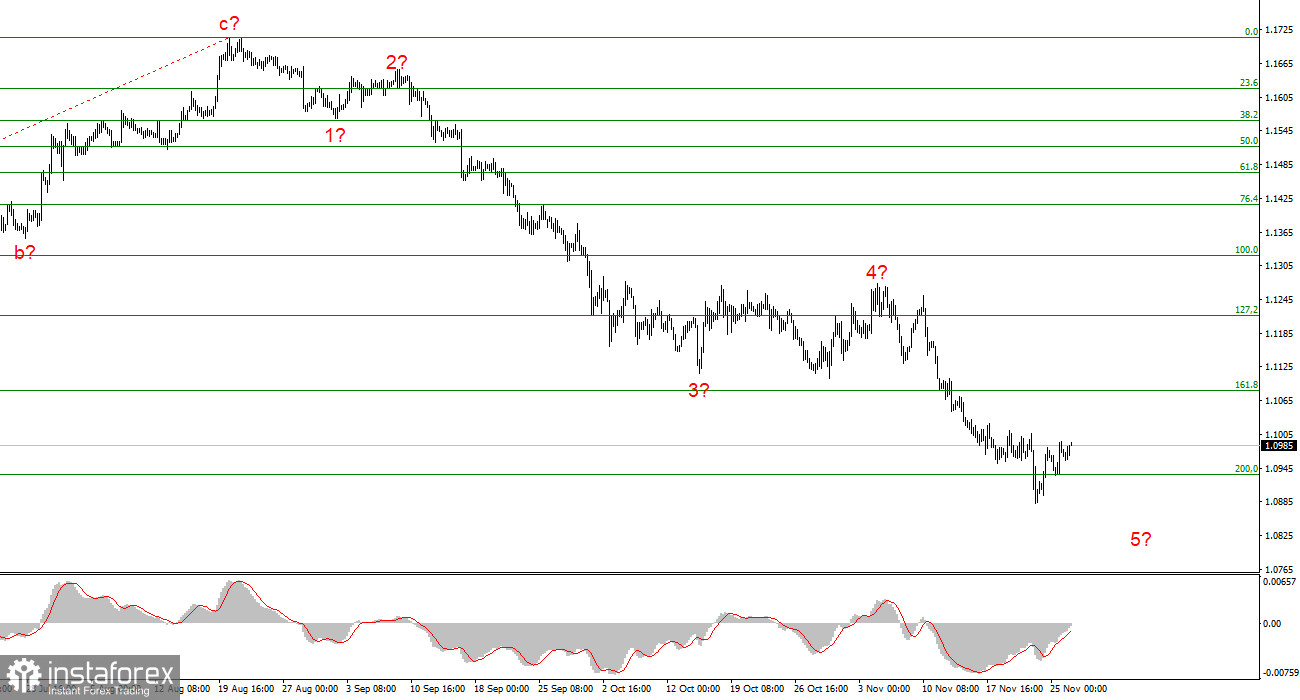
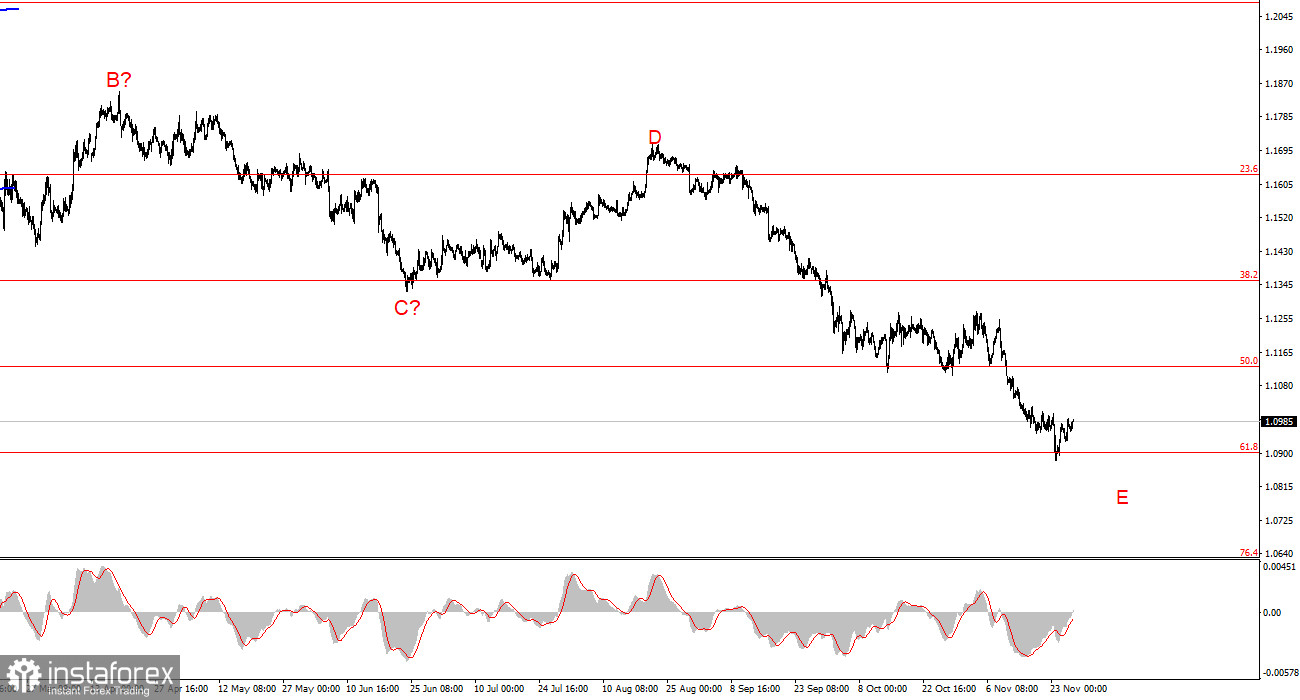
The wave count on the 4-hour chart for EUR/USD has become more complex. On the higher timeframe (lower chart), the downward trend segment has taken the form of a five-wave structure, A-B-C-D-E, which could be completed at any moment, as it appears structurally complete. All the waves within this segment are approximately equal in size, which is why this structure is considered corrective. If this assumption is correct, the formation of a new impulsive upward trend segment will begin once the correction is complete, with targets located well above the 1.2000 level.
On the lower timeframe (upper chart), the formation of an impulsive wave sequence is still underway, which may belong to wave E of the higher timeframe. If this is indeed the case, the dollar's strengthening is approaching its end, regardless of how strong its recent gains have been. The expected wave 5 of E is nearing completion. In any case, the current wave structure suggests that the downward wave sequence is approaching completion on both charts. Economic news and a sharp shift in market sentiment triggered a significant appreciation of the US dollar, but few new reasons remain to support further gains in the US currency.
The euro has struggled to maintain its downward movement and appears to be losing momentum.
The EUR/USD exchange rate remained unchanged throughout Thursday. Trading activity was minimal, as the United States is celebrating Thanksgiving today, while the European Union effectively joined the holiday by releasing no economic reports during the day. However, the minutes of the ECB's October meeting were published in Europe today, and this topic deserves a more detailed discussion, as there is plenty to examine. With virtually no significant events scheduled for today, the market decided to take a pause, which could now last until Monday. The only economic report released on Thursday was Germany's Consumer Confidence Index, which came in at -30.2 points. There is probably no need to mention market expectations, as they were clearly also low and negative.
Naturally, this report cannot be interpreted positively. However, how could it have hindered the European currency? It could not. In recent weeks, market participants have been selling the euro for virtually any reason, and sometimes without any apparent reason at all. Naturally, several specific factors have been cited to explain this trend: the French budget crisis, the AI boom in the United States, which continues to attract investment from around the world, and the FOMC's hawkish monetary policy stance. However, there is a growing impression that even if the dollar continues to appreciate at the same pace over the next year as it has over the past three months, economists will still attribute its gains to the AI boom or the French budget crisis.
In my view, the European currency is currently at a crossroads. Either the current downward trend segment will come to an end, or it will develop into an even longer and more complex structure. The second scenario is possible only if the market identifies new reasons for a substantial increase in demand for the US currency. Under this scenario, EUR/USD could continue declining for several more months while the Fed continues tightening monetary policy.
General Conclusions
Based on the EUR/USD analysis, the pair remains within the global corrective trend structure A-B-C-D-E. However, this structure appears fully developed and could be completed at any moment. In my view, the current conditions present a favorable opportunity not only to consider buying the European currency but also to anticipate the formation of a fully developed upward trend segment. According to the higher timeframe, the pair could rise to at least the 1.1700–1.1800 level. In my view, the more sharply the instrument declines now, the stronger its subsequent recovery could be. However, confirmation of the completion of the downward wave sequence is required. One possible signal would be an unsuccessful attempt to break above the 1.0902 level, corresponding to the 61.8% Fibonacci retracement level on the higher timeframe.
On the higher timeframe, the downward trend segment has taken the form of an A-B-C-D-E structure. The internal wave structure of wave E has developed into a five-wave impulsive pattern, but this formation may already be complete. If this assumption is correct, a new upward trend segment will begin to develop in the near future.
The Main Principles of My Analysis:
- Wave structures should be simple and easy to understand. Complex structures are difficult to trade and are often subject to changes.
- If there is no confidence in the current market situation, it is better to stay out of the market.
- There can never be absolute certainty about the direction of price movement. Do not forget to use protective Stop Loss orders.
- Wave analysis can be combined with other forms of analysis and trading strategies.