 English
 Русский
 Bahasa Indonesia
 Bahasa Malay
 ไทย
ไทย Español
 Deutsch
 Български
 Français
 Tiếng Việt
 中文
中文 বাংলা
বাংলা हिन्दी
 Čeština
 Українська
 Română

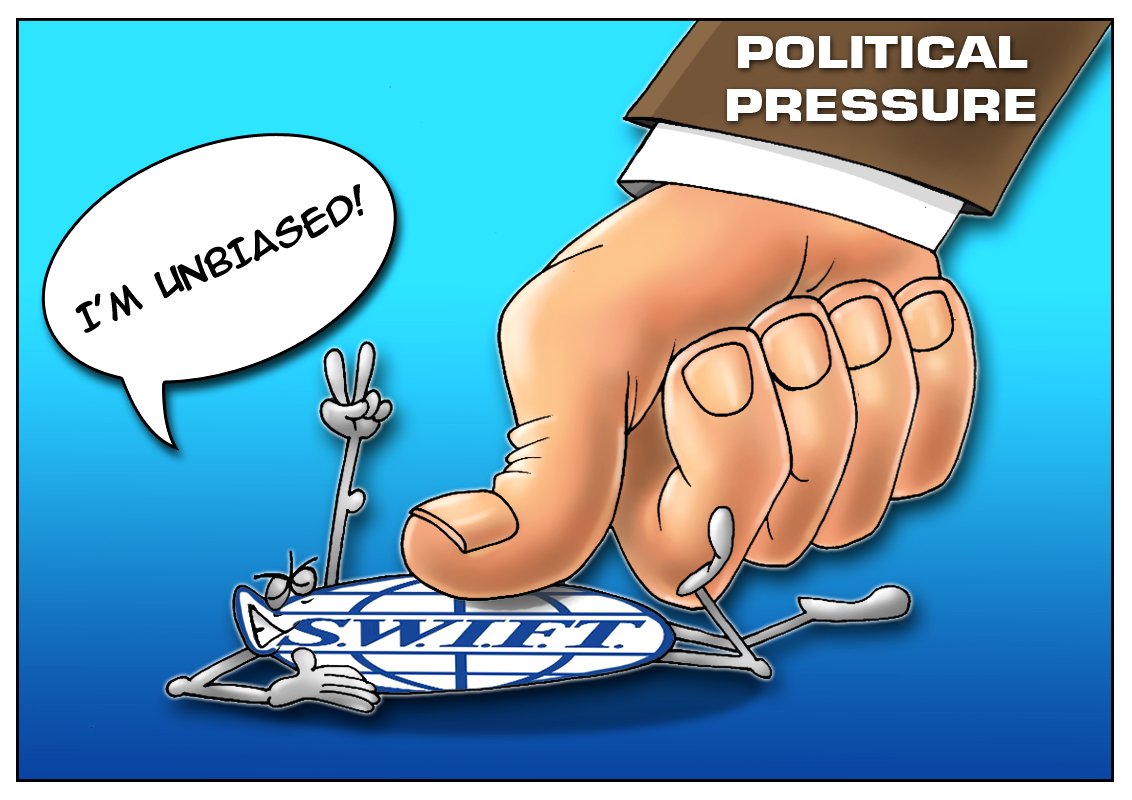
Despite pressure from the Western governments, the Society for Worldwide Interbank Financial Telecommunications (Swift) refused to ban Russia’s access to its services. In the context of the hard geopolitical situation, the financial transaction network managed to assert its independence from the views of the world political elite. On the contrary, escalating efforts to affect the Swift’s policy led to the opposite result. "Swift will not respond to individual calls and pressure to disconnect financial institutions from its network,” the Swift management posted the statement on the official website. It also reads that the board and shareholders have recently received requests to disconnect financial institutions in Russia and Israel as form of politically driven economic sanctions. The main requirement to cut off Russia from its network was made by the U.S. Moreover, the EU considered blocking Russian companies from Swift at a summit, but the resolution has not been passed yet. Swift is a not-for-profit co-operative whose network sends millions of financial transaction messages every day across more than 200 countries. It is also known as SWIFT-BIC (Bank Identifier Codes), BIC code, SWIFT ID or SWIFT code. The service began in 1973, with 239 banks from 15 countries sharing the communication services. The headquarters are located in Brussels. Swift is a company acting under Belgium’s law. In 2010, shareholders comprise over 9,000 banks from 209 countries. Nowadays, Swift is used by more than 10,000 firms including almost 1,000 global corporations. Swift processes over 1 billion transactions or 2.5 billion payment orders annually.