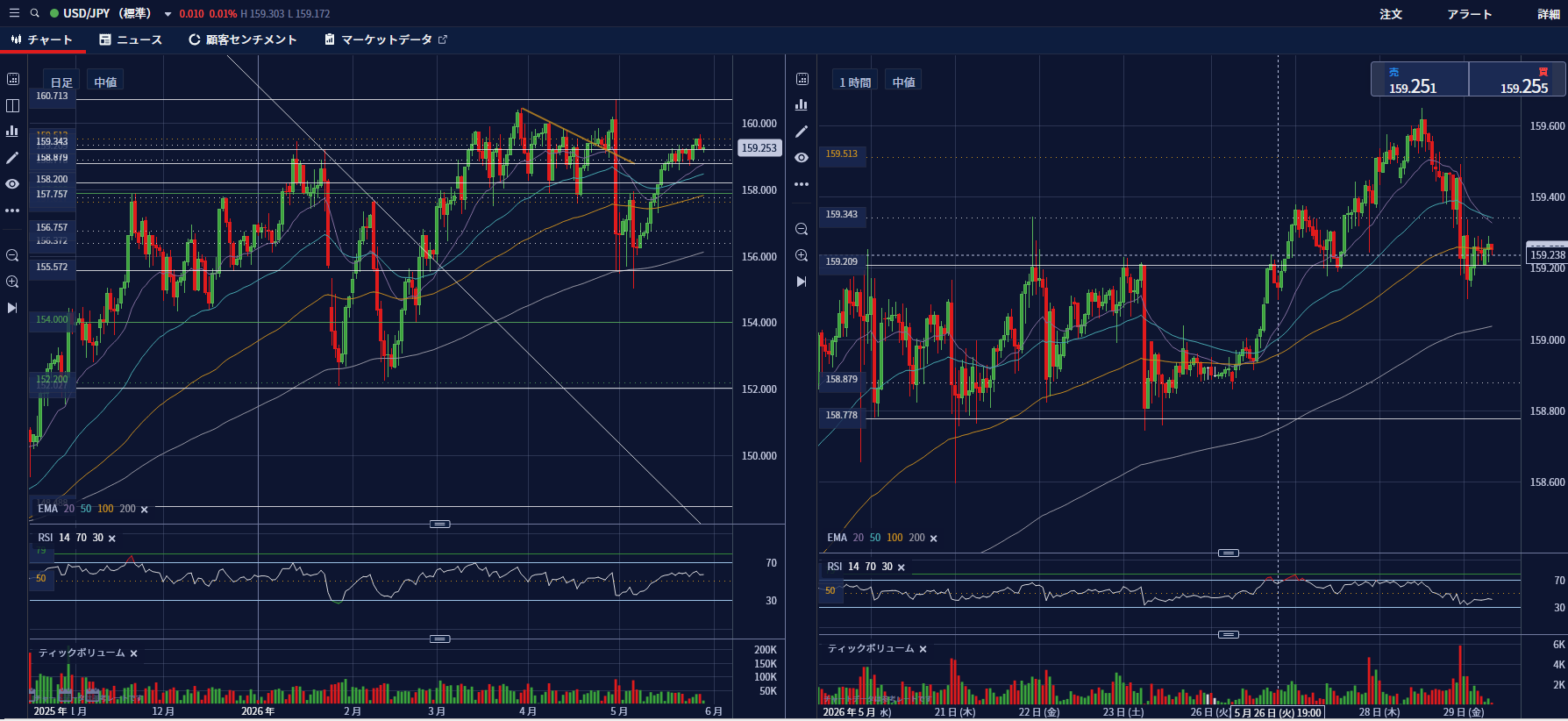
The picture for USD/JPY is still bullish on D1. Yesterday's weak US GDP slightly shook the market. But look at D1. The reaction was very indicative. Instead of falling, there was a short southern spike that was instantly bought up. On the daily chart, the pair is significantly pressing towards the round level of 160. Moving averages (EMA 20 50 100 200) are forming a beautiful bullish fan. But below 160.0, the market is starting to struggle. There is an upward impulse. Acceleration is not there yet. On H1, it can be seen that after a strong buy-up, the dollar failed to continue its rise properly. The high was weakly updated. Then there was a sell-off and the price fell back to the EMA. This looks more like exhaustion under resistance. The 159.2 zone is currently key. As long as it holds above it, the bulls still maintain the structure. Below it, they could quickly drag it down to 158.9 and further to 158.2. The main point now is the reaction at 160.0. If there is a confident breakthrough and consolidation above, then the path to 160.7 - 161.5 will open up. But for now, the market seems to be contracting below the level. That's why the scenario of a false breakout looks quite realistic. A spike above 160.0. Then a quick return back down. For USD/JPY, this is a very typical behavior near strong levels. Plus, one must not forget about the risk of intervention. The 160 area is already sensitive for the Japanese authorities. Therefore, buying right under the resistance without confirmation doesn't look as comfortable as it may seem at first glance. The plans for today are simple. I am focusing only on buying. Right now, during the European session, the price is smoothly correcting and testing the mirror level around 159.20 - 159.25. This is where the hourly moving averages intersect, and the RSI has been relieved. When forming a reversal pattern on lower timeframes, one can try a careful buy. The local target is yesterday's high at 159.60. Further aim is to break the 160 level. If the American session, with PCE inflation data, causes turbulence again and pushes the price lower - it's not a big deal. The ideal buying zone will remain yesterday's demand level at 158.87 and support at 158.77. From there, the big players will again defend their positions.
*The market analysis posted here is meant to increase your awareness, but not to give instructions to make a trade
 English
 Русский
 Bahasa Indonesia
 Bahasa Malay
 ไทย
ไทย Español
 Deutsch
 Български
 Français
 Tiếng Việt
 中文
中文 বাংলা
বাংলা हिन्दी
 Čeština
 Українська
 Română
