 NZDUSD Daily Forecast NZD/USD Extends Recovery as Risk Appetite Returns and Traders Rebuild Bullish Exposure
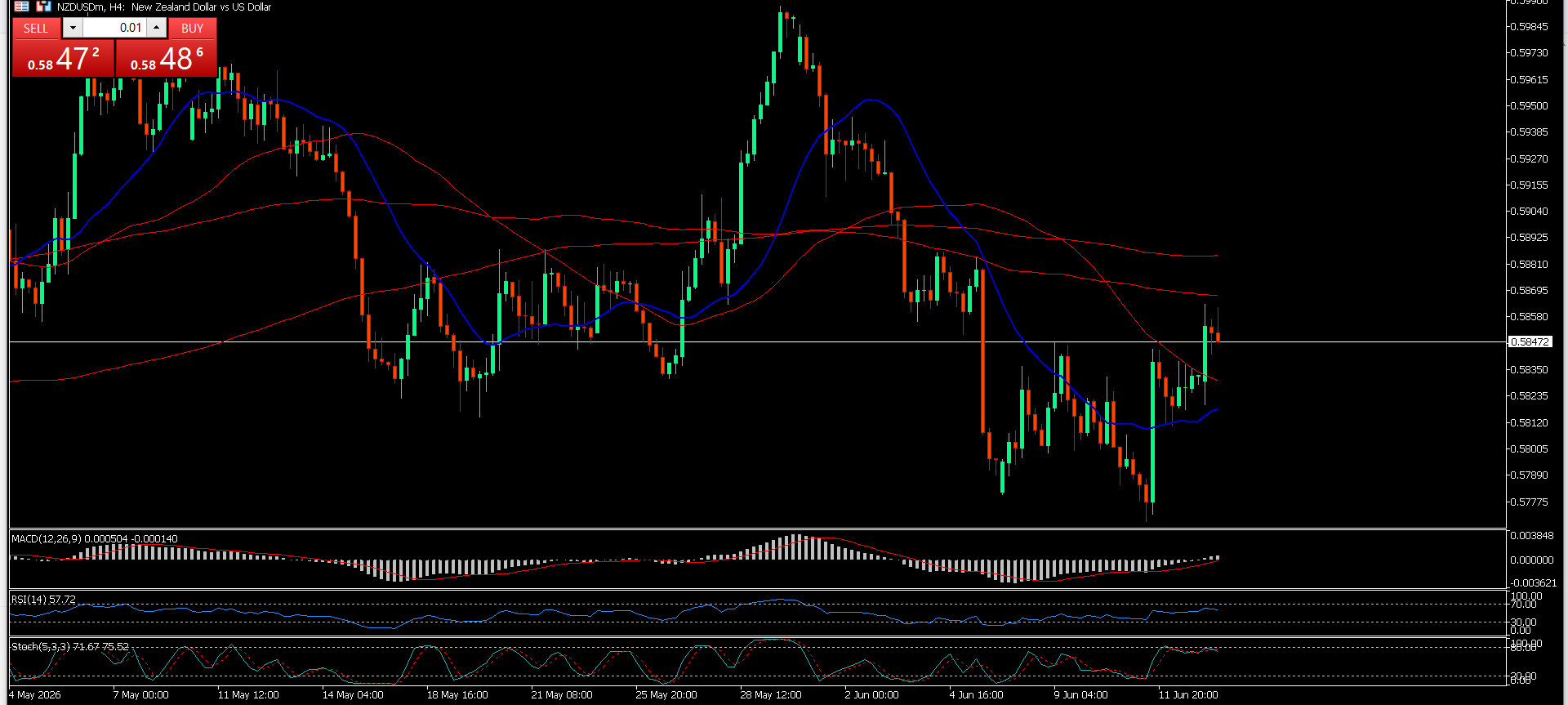
 The New Zealand Dollar began the week on a stronger footing, extending its recovery against the US Dollar as improving global risk sentiment encouraged investors to rotate away from traditional safe-haven assets and back into higher-beta currencies. NZD/USD climbed toward the 0.5850 region, reaching its highest level in more than a week as markets reacted positively to news that the United States and Iran had reached a framework agreement aimed at ending months of conflict and reopening the strategically important Strait of Hormuz. The improvement in sentiment triggered a broad repositioning across global markets. Investors who had previously sought shelter in the US Dollar during periods of heightened geopolitical uncertainty have started unwinding defensive positions, creating fresh demand for growth-sensitive currencies such as the New Zealand Dollar. This shift reflects more than simple optimism about peace. It represents a reassessment of global macro risks, inflation expectations, and future monetary policy paths. One of the most important consequences of the agreement is its potential impact on energy markets. The prospect of uninterrupted oil shipments through the Strait of Hormuz has weighed heavily on crude prices at the start of the week. Lower energy prices reduce inflationary pressure throughout the global economy by easing transportation, manufacturing, and supply-chain costs. For investors, this transmission mechanism matters because inflation expectations directly influence central-bank policy expectations and bond-market pricing. As oil prices retreat, markets are becoming less concerned about a renewed inflation shock forcing central banks into more aggressive tightening cycles. This has encouraged capital to flow back toward risk assets, commodity-linked currencies, and growth-oriented trades. The New Zealand Dollar has been one of the beneficiaries of that rotation, particularly as investors trim US Dollar holdings accumulated during the peak of geopolitical uncertainty. Market psychology has also shifted noticeably. Only a week ago, traders were largely focused on downside protection and geopolitical hedging. Today, the emphasis has moved toward rebuilding exposure to risk-sensitive assets. While investors remain cautious given that several details of the agreement still require formal approval, the immediate fear premium embedded across markets has begun to fade. From a positioning standpoint, recent NZD/USD gains appear to be supported by both short-covering activity and fresh buying interest. During the earlier decline, speculative traders accumulated significant bearish exposure as geopolitical tensions intensified and demand for the US Dollar strengthened. The easing of those risks has forced many of those positions to unwind, adding fuel to the pair’s recovery. More importantly, the move is now attracting new buyers who view improving global sentiment as an opportunity to re-enter higher-yielding and growth-linked currencies. Attention is now shifting toward the Federal Reserve meeting later this week. Although policymakers are widely expected to leave interest rates unchanged, the event carries unusual significance. Investors will be looking for clues regarding how the Fed views the changing inflation outlook following the apparent easing of Middle East tensions. The meeting will also be closely watched because it represents another opportunity for markets to assess the policy approach of Chairman Kevin Warsh. Institutional investors understand that the Fed's tone could determine whether the recent decline in the US Dollar evolves into a broader trend or remains a temporary adjustment. If policymakers acknowledge reduced inflation risks and signal greater flexibility in future policy decisions, pressure on the Greenback could intensify. Conversely, a firm commitment to maintaining restrictive policy settings would likely limit further NZD/USD upside. Technically, the recovery structure continues to improve. The pair remains above the neckline of an inverted Head and Shoulders pattern, a formation often associated with medium-term trend reversals. Holding above this breakout zone suggests buyers remain in control despite some hesitation near current levels. The 38.2% Fibonacci retracement of the early June decline near 0.5857 is acting as immediate resistance and explains the current pause in momentum. This level represents the first significant test for bulls following the breakout. A decisive move above it would strengthen the recovery narrative and expose the June highs around 0.5890. Beyond that, the 61.8% Fibonacci retracement near 0.5910 becomes the next major objective. From a market-structure perspective, a break through that area would indicate that the recent decline has largely been absorbed and that broader bullish momentum is returning. Support remains concentrated around the neckline zone near 0.5845. As long as price holds above this level, buyers retain a technical advantage. Below it, attention would shift toward 0.5810 and then the June low near 0.5760, where stronger demand previously emerged. For now, NZD/USD is benefiting from a combination of improving sentiment, easing geopolitical fears, declining safe-haven demand, and renewed risk appetite. Whether this recovery develops into a larger trend will depend heavily on Federal Reserve guidance and how investors continue to reassess global inflation risks in the aftermath of the US-Iran agreement.
*The market analysis posted here is meant to increase your awareness, but not to give instructions to make a trade
 English
 Русский
 Bahasa Indonesia
 Bahasa Malay
 ไทย
ไทย Español
 Deutsch
 Български
 Français
 Tiếng Việt
 中文
中文 বাংলা
বাংলা हिन्दी
 Čeština
 Українська
 Română