 WTI Oil Daily Forecast WTI Oil Price Forecast: Crude Slips as US-Iran Diplomacy Eases Supply Fears Despite Persistent Geopolitical Risks
 Crude oil has entered a phase where headlines are carrying more weight than traditional supply-and-demand dynamics. After weeks of elevated geopolitical premiums, West Texas Intermediate (WTI) has come under renewed selling pressure as traders respond to reports that the United States and Iran have agreed to pause military strikes and resume diplomatic discussions. The shift has prompted investors to reassess the immediate threat to global energy supplies, pushing WTI toward the $69.60 region despite the fragile nature of the broader Middle East situation. While the latest decline reflects improving market sentiment, traders remain reluctant to aggressively unwind bullish positions, recognizing that the geopolitical backdrop can change rapidly. The latest catalyst came after reports that Washington and Tehran agreed to halt retaliatory military actions and hold technical negotiations in Qatar. Markets interpreted the development as a meaningful step toward reducing tensions around the Strait of Hormuz, one of the world's most strategically important energy corridors. Nearly one-fifth of global oil shipments pass through the narrow waterway, meaning even temporary disruptions can trigger sharp price swings. As expectations of uninterrupted crude flows improved, the geopolitical risk premium that had supported prices over recent sessions began to fade. Despite the encouraging diplomatic signals, the broader environment remains far from stable. Military exchanges over recent days demonstrated how quickly negotiations can deteriorate. Iran's Revolutionary Guard claimed responsibility for attacks on multiple US military facilities in the Gulf following American strikes on Iranian targets, highlighting that the conflict remains highly sensitive. Investors therefore continue to price in the possibility that any breakdown in negotiations could immediately restore supply concerns. This explains why oil prices have softened rather than collapsed, with traders maintaining a cautious approach until more concrete progress emerges from upcoming talks. Beyond geopolitics, the market is beginning to shift its attention back toward underlying supply-demand fundamentals. The upcoming American Petroleum Institute inventory report will provide fresh insight into domestic consumption trends. A larger-than-expected decline in crude inventories would reinforce the view that demand remains resilient despite slowing global economic momentum, potentially allowing prices to recover from current levels. Conversely, another sizeable inventory build would strengthen concerns about adequate supply and softer consumption, adding further pressure to an already cautious market. Macroeconomic developments also continue to shape sentiment. Expectations that the Federal Reserve may maintain a restrictive monetary policy for longer have strengthened the US Dollar in recent weeks, creating an additional headwind for commodity prices. Since crude oil is priced in US Dollars, a stronger Greenback makes energy purchases more expensive for international buyers, often limiting upside momentum. At the same time, investors remain attentive to global manufacturing activity and economic growth indicators, as weaker industrial demand could offset any supply-related price support.
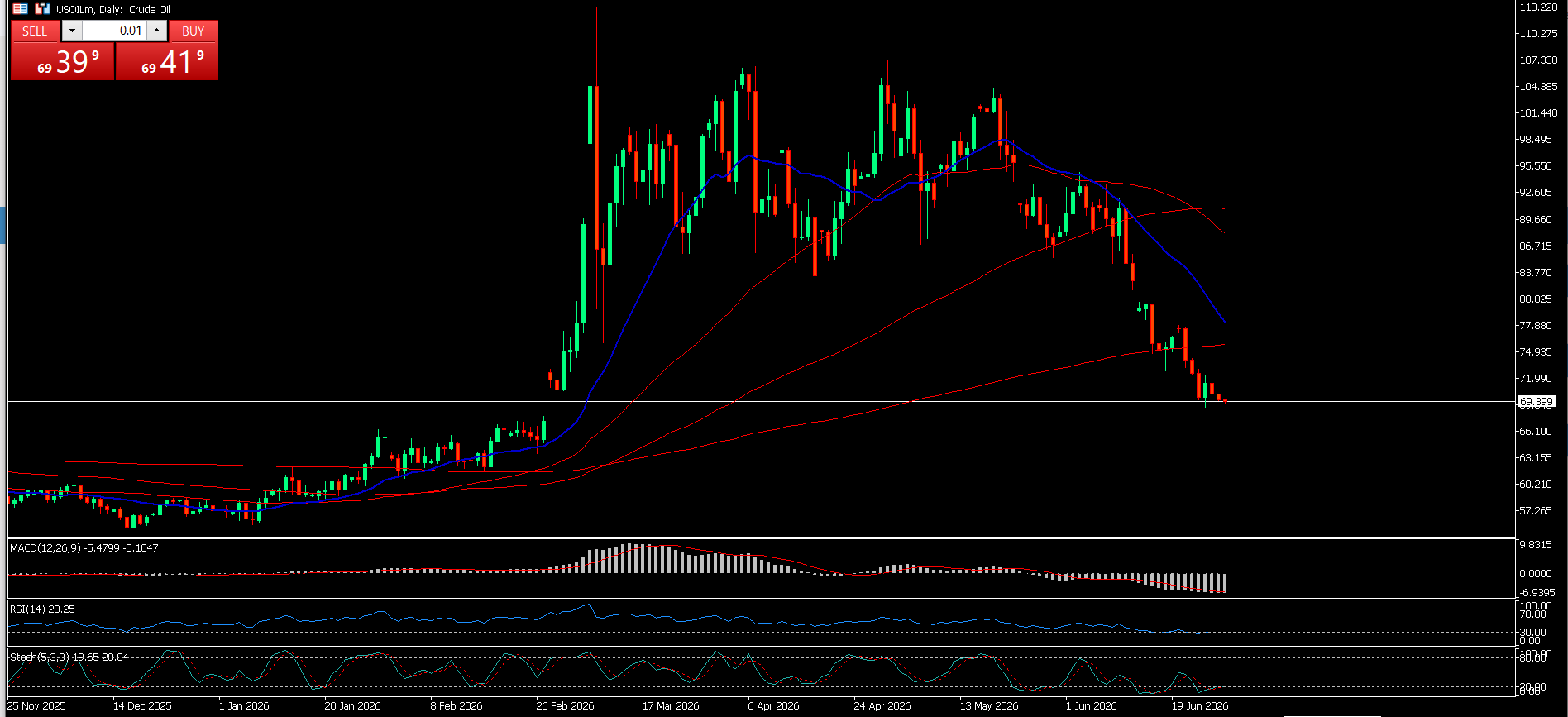
From a technical perspective, WTI has entered a corrective phase after failing to sustain its recent breakout. The retreat below the psychological $70.00 level reflects fading bullish momentum rather than a complete trend reversal. Price action suggests that buyers are becoming increasingly selective, preferring to wait for stronger confirmation before rebuilding long positions. Immediate support is emerging around the $69.00 area, followed by a more significant demand zone near $67.50. A decisive break below these levels could expose the market to a deeper correction toward the $65.00 region, where longer-term buyers may begin to re-enter. On the upside, the first resistance remains the $70.50-$71.00 area, with stronger selling pressure expected around $72.50. A sustained recovery above this resistance cluster would indicate that geopolitical concerns are once again outweighing improving supply expectations and could reopen the path toward the mid-$70s. Until then, rallies are likely to face hesitation as traders evaluate every diplomatic headline alongside incoming inventory and macroeconomic data. Although the near-term balance has shifted modestly in favor of lower prices, the broader outlook remains exceptionally headline-driven. Any meaningful progress in US-Iran negotiations could continue to reduce supply concerns and keep WTI under pressure. However, given the history of volatility surrounding the region and the strategic importance of the Strait of Hormuz, crude oil remains highly vulnerable to sudden reversals. For now, market participants are navigating a delicate equilibrium where diplomacy encourages selling, but persistent geopolitical uncertainty prevents a more aggressive bearish move.
*The market analysis posted here is meant to increase your awareness, but not to give instructions to make a trade
 English
 Русский
 Bahasa Indonesia
 Bahasa Malay
 ไทย
ไทย Español
 Deutsch
 Български
 Français
 Tiếng Việt
 中文
中文 বাংলা
বাংলা हिन्दी
 Čeština
 Українська
 Română
