 Gold Daily Forecast
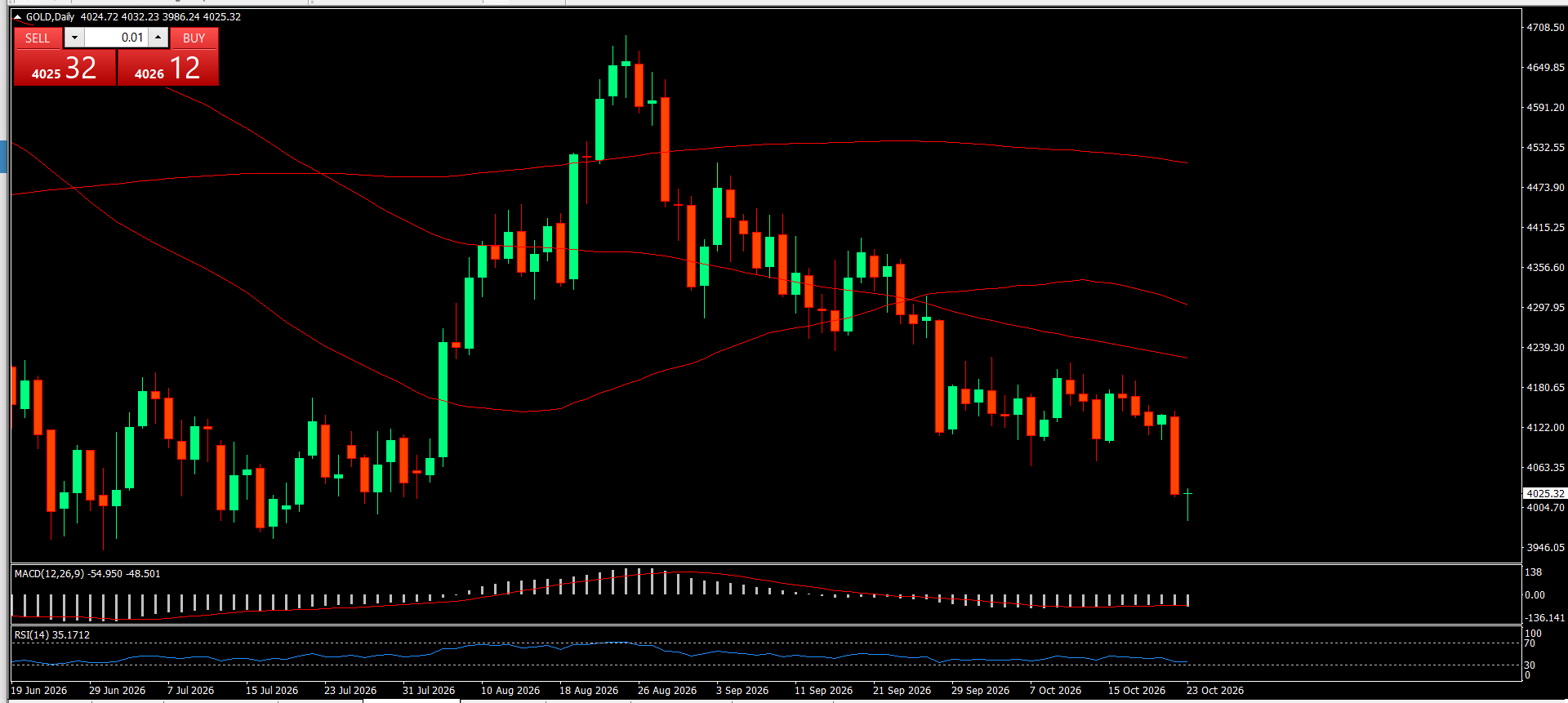
The XAU/USD pair is recovering above the key support zone of $4000 on Friday after hitting fresh multi-month lows at $3986 earlier this week amid heavy selling pressure during Asian trading sessions. Buying interest seems to be emerging after a substantial drop on Thursday, when the pair fell 2.81%. As the writing goes, the XAU/USD pair is changing hands near $4029. Rabobank analysts described Thursday's session for global financial markets as "brutal", with the S&P 500 benchmark index down 1.2% to close at $7663, dragged lower by "the Philadelphia Stock Exchange Semiconductor index heading toward the lowest levels since July of this year." Alongside the sharp declines, government bonds surged. Rabobank emphasised that "bad news for equities translated into positive news for US Treasuries, where the US 10-year yield fell below 5%, marking the lowest levels since September despite high energy prices. The 2-year note yield fell below 4.75%." Despite bullish drivers, gold finished Thursday lower, unable to capitalise on negative stock moves and weaker Treasuries. The region remains in political turmoil, and oil prices continue to rise toward $100 per barrel, near levels seen over the last five weeks. Rising oil prices raise inflation expectations, implying sustained higher interest rates and adding pressure on precious metals. Moreover, investors may reduce precious metal positions to hedge equity losses. As mentioned earlier, technical sellers may become active if price breaks out of the $4100-$4200 consolidation zone. In light of the preceding discussion, gold could be susceptible to further sell-offs on any bounce attempts amid stabilisation trends in the US Dollar and Treasuries, which are recovering after Thursday's fall. The DXY index measures the US Dollar's performance relative to a basket of six major currencies, registering 101.78, up 0.14%. The 10-year US Treasury yield currently stands at 4.99%. Later Friday, traders will watch S&P Global's Preliminary October PMI surveys and the University of Michigan's Final Consumer Sentiment Index with inflation forecasts. The Federal Reserve is expected to hold interest rates steady in December, after raising rates by 25 basis points in September. Policymakers' decisions on the persistent threat of inflation and the risk of a recession due to reduced investment in artificial intelligence are under scrutiny. Any hint of further monetary tightening could undermine gold's gains. On the daily chart, the pair has extended its decline below all key moving averages and remains bearish. Technical momentum has weakened, with the RSI hovering near the 35 level and approaching the oversold region. Furthermore, the MACD remains below the 0-level threshold. Meanwhile, the ADX has risen toward 24. This indicates that the downtrend remains in force. Resistance levels are psychologically at $4,100 and continue up to $4,200; the next support barrier is around the 100-day SMA at $4,224, which could mark resistance to recovery moves. The 50-day SMA is a key resistance barrier at $4,302 ahead of $4,400. The 200-day SMA stands firmly overhead at $4,509, reinforcing the prevailing bearish pattern.
* Phân tích thị trường được đăng ở đây nhằm mục đích nâng cao nhận thức của bạn, nhưng không đưa ra hướng dẫn để thực hiện giao dịch
 Tiếng Việt

 Русский
 English
 Bahasa Indonesia
 Bahasa Malay
 ไทย
 Español
 Deutsch
 Български
 Français
 中文
 বাংলা
 हिन्दी
 Čeština
 Українська
 Română

